Imagine a secluded island, teeming with life. Deer graze peacefully, birds nest in lush trees, and small mammals scurry through the undergrowth. This idyllic scene, however, operates under an invisible, yet fundamental, ecological principle: Carrying Capacity. It is a concept that helps us understand the delicate balance between a population and the resources available to sustain it, not just on an island, but in every ecosystem on Earth, including our own global habitat.
What is Carrying Capacity? The Island Analogy
At its core, carrying capacity refers to the maximum population size of a biological species that can be sustained indefinitely by a given environment, given the available food, habitat, water, and other necessities. Think back to our island. It has a finite amount of fresh water, a limited supply of edible plants, and only so much space for animals to live and reproduce. These are the island’s resources.
As the population of deer, for instance, increases, they consume more plants. If their numbers grow too large, they might eat all the available vegetation faster than it can regenerate. This would lead to a scarcity of food, impacting their health, reproduction, and ultimately, their survival. The island can only “carry” so many deer before its resources become insufficient. That invisible limit is the carrying capacity.
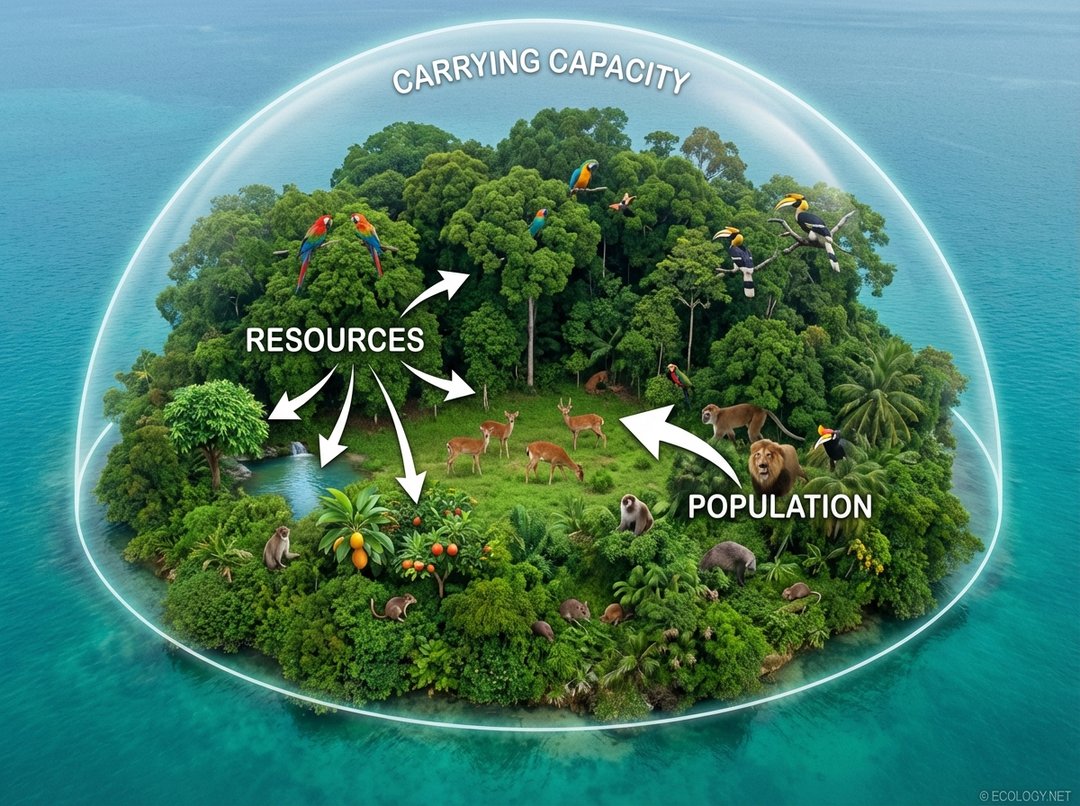
Understanding this balance is crucial for ecologists and anyone interested in the health of our planet. It is not just about the number of individuals, but also about the quality of life and the long-term sustainability of the population and its environment.
The Dynamics of Population Growth: The S-Curve
Populations rarely grow unchecked forever. Their growth often follows a predictable pattern known as the S-shaped (sigmoid) growth curve, which beautifully illustrates the concept of carrying capacity over time.
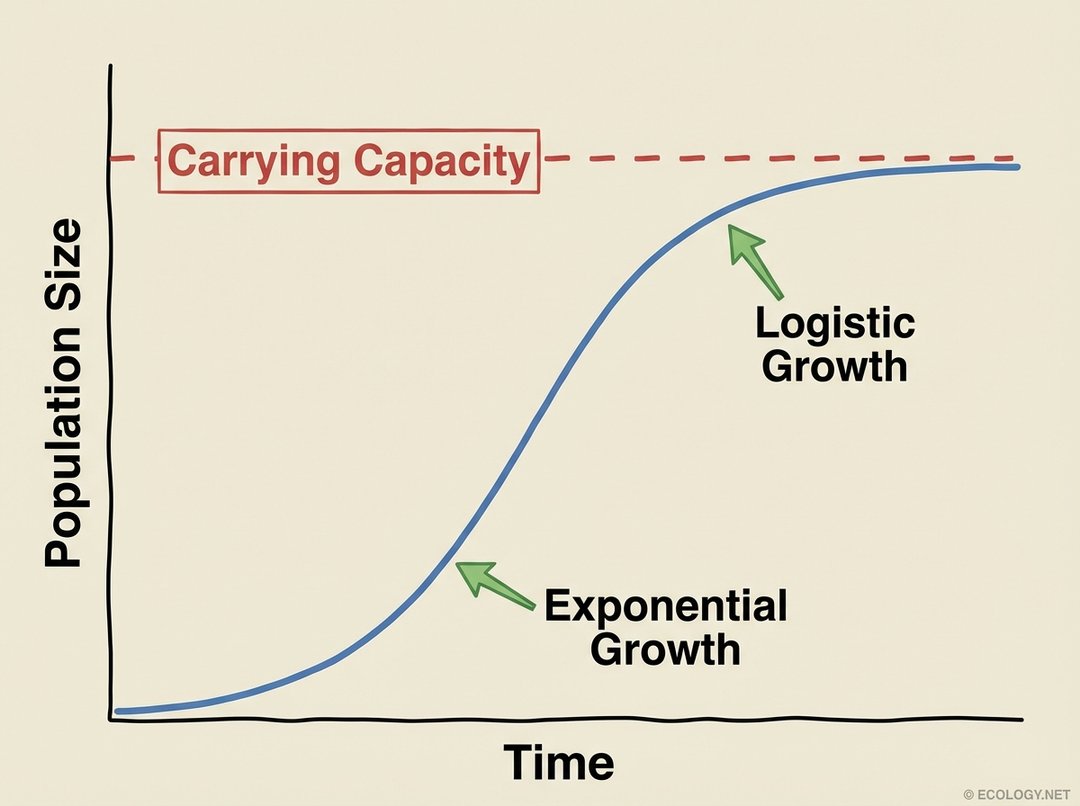
Initially, when resources are abundant and there are few individuals, a population might experience exponential growth. This is the steep, upward-sloping part of the ‘S’, where the population increases at an accelerating rate, much like a small group of rabbits introduced to a new, resource-rich field. Each generation is significantly larger than the last.
However, as the population continues to grow, resources become scarcer, competition intensifies, and factors like disease or predation may become more prevalent. The growth rate begins to slow down. This phase is called logistic growth, where the curve starts to flatten. Eventually, the population growth rate approaches zero, and the population size stabilizes around the environment’s carrying capacity. At this point, birth rates and death rates are roughly equal, and the population fluctuates around the horizontal line representing the carrying capacity.
The S-curve is a powerful model because it shows that even in ideal conditions, natural limits will eventually regulate population size.
Factors Influencing Carrying Capacity
Carrying capacity is not a static number. It can fluctuate based on a variety of environmental factors and the specific needs of the species in question. These are often referred to as limiting factors:
- Resource Availability:
- Food: The quantity and quality of food sources.
- Water: Access to fresh, potable water.
- Shelter/Habitat: Suitable places for living, breeding, and protection from predators and elements.
- Environmental Conditions:
- Biological Interactions:
- Predation: The presence of predators can limit prey populations.
- Disease: Pathogens can spread more easily in dense populations, increasing mortality.
- Competition: Individuals within a species (intraspecific) or between different species (interspecific) compete for the same limited resources.
For example, a severe drought can drastically reduce the carrying capacity of an area for herbivores by limiting plant growth and water sources. Conversely, a particularly mild winter might temporarily increase it by reducing winter mortality.
Human Impact and Exceeding Carrying Capacity
While the concept of carrying capacity applies to all species, its implications for human populations are particularly profound. Unlike other species, humans have developed technologies and complex societies that allow us to manipulate our environment, extract resources from distant locations, and even temporarily overcome some natural limiting factors. This ability, however, comes with significant consequences.
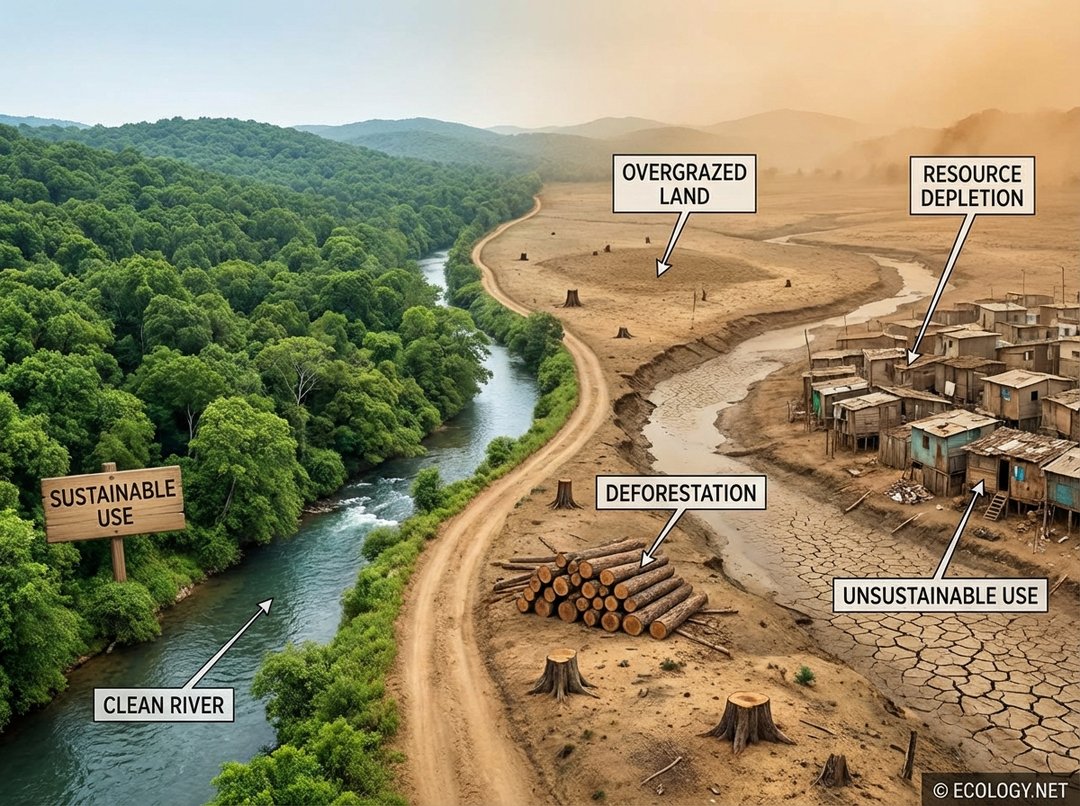
When human populations grow beyond the sustainable capacity of their local or even global environment, we begin to see signs of resource depletion and environmental degradation. This can manifest in many ways:
- Deforestation: Clearing forests for agriculture, timber, or development, leading to soil erosion and loss of biodiversity.
- Water Scarcity: Over-extraction of groundwater and surface water for agriculture, industry, and domestic use, depleting vital reserves.
- Pollution: Contamination of air, water, and soil from industrial activities, waste, and agricultural runoff, harming ecosystems and human health.
- Loss of Biodiversity: Habitat destruction and overexploitation leading to species extinction.
- Climate Change: Emission of greenhouse gases from human activities altering global climate patterns, impacting ecosystems worldwide.
These impacts are not merely local; they often have cascading effects across the globe. For instance, overfishing in one ocean can affect fish populations and marine ecosystems thousands of miles away, impacting global food security.
The Ecological Footprint: A Measure of Our Demand
To better understand our collective impact, scientists developed the concept of the Ecological Footprint. This metric measures the amount of biologically productive land and water area required to produce all the resources an individual, city, or country consumes and to absorb the waste it generates. It is essentially a way to quantify how much of the Earth’s carrying capacity we are using.
When our ecological footprint exceeds the Earth’s biocapacity (its ability to regenerate resources and absorb waste), we are effectively “overshooting” the planet’s carrying capacity. This means we are consuming resources faster than they can be replenished and accumulating waste faster than it can be assimilated, leading to a deficit that cannot be sustained indefinitely.
Living Within Our Means: Towards Sustainable Carrying Capacity
Understanding carrying capacity is not about predicting a doomsday scenario, but about empowering us to make informed choices for a sustainable future. It highlights the urgent need for responsible resource management, technological innovation, and societal shifts towards more sustainable practices.
Strategies for living within the Earth’s carrying capacity include:
- Sustainable Resource Management: Implementing practices that ensure resources are used at a rate that allows for their regeneration. This includes sustainable forestry, responsible fishing, and efficient water use.
- Transition to Renewable Energy: Shifting away from fossil fuels to solar, wind, and other renewable energy sources to reduce our carbon footprint.
- Waste Reduction and Recycling: Minimizing waste generation and maximizing recycling and reuse to lessen the burden on landfills and reduce demand for new resources.
- Conservation and Restoration: Protecting natural habitats, preserving biodiversity, and restoring degraded ecosystems to enhance the Earth’s biocapacity.
- Population Stabilization: Addressing factors that influence population growth, such as education, healthcare, and access to family planning, to achieve a stable global population.
- Technological Innovation: Developing new technologies that are more resource-efficient, less polluting, and promote circular economies where products are designed for longevity and recyclability.
The concept of carrying capacity reminds us that we are an integral part of the global ecosystem, not separate from it. Our long-term well-being is inextricably linked to the health and resilience of the natural world.
Conclusion
Carrying capacity is more than just an ecological term; it is a fundamental principle that governs life on Earth. From the smallest pond to the vast global ecosystem, it dictates the limits of growth and the necessity of balance. By understanding how populations interact with their environments, and particularly by recognizing the profound impact of human activities, we can strive to live more harmoniously with our planet. Embracing sustainable practices and respecting ecological limits are not just environmental imperatives, but essential steps towards securing a prosperous and healthy future for all species, including our own.