Imagine a bustling city where every resident, from the smallest insect to the largest predator, plays a vital role in the daily rhythm of life. This intricate urban landscape is not a human metropolis, but an ecosystem, and its residents are what ecologists call biotic factors. These living components are the very essence of life on Earth, constantly interacting, influencing, and shaping the environments they inhabit. Understanding biotic factors is key to unraveling the mysteries of nature and appreciating the delicate balance that sustains all life.
What Exactly Are Biotic Factors?
At its core, a biotic factor is any living or once-living component of an ecosystem that affects another organism or the environment. This includes everything from microscopic bacteria and fungi to towering trees, swift-moving animals, and even the decaying remains of a fallen log. Essentially, if it’s alive or was recently alive, it’s a biotic factor.
These living elements stand in contrast to abiotic factors, which are the non-living physical and chemical parts of an ecosystem, such as sunlight, water, soil, temperature, and air. While abiotic factors provide the stage, biotic factors are the actors, constantly interacting with each other and their non-living surroundings to create the dynamic, vibrant systems we observe in nature.
The Interconnected Web of Life
The true power of biotic factors lies in their interactions. No organism exists in isolation. Every plant, animal, and microbe is part of an elaborate network, influencing and being influenced by countless others. These interactions can be direct, like a predator hunting its prey, or indirect, such as a plant providing shade that alters the soil temperature for microorganisms. These relationships are fundamental to the flow of energy and nutrients through an ecosystem, dictating its structure, stability, and biodiversity.
Key Categories of Biotic Interactions
The ways in which living organisms interact are incredibly diverse, yet they can be broadly categorized into several fundamental types. These interactions are the driving forces behind evolution, population dynamics, and the overall health of an ecosystem.
- Competition: This occurs when two or more organisms require the same limited resource, such as food, water, sunlight, or space. Competition can be between individuals of the same species (intraspecific) or different species (interspecific). For example, two male deer might compete for access to a mate, or different species of plants might compete for light in a dense forest.
- Predation: A classic interaction where one organism, the predator, hunts and kills another organism, the prey, for food. This relationship is a powerful evolutionary force, driving adaptations in both predators (e.g., sharper claws, better camouflage) and prey (e.g., faster speed, warning coloration). A hawk catching a mouse is a clear example of predation.
- Symbiosis: A close and long-term interaction between two different biological organisms. Symbiotic relationships are often categorized by the nature of the benefit or harm to each partner:
- Mutualism: Both organisms benefit from the interaction. A classic example is the relationship between bees and flowers, where bees get nectar and pollen, and flowers are pollinated.
- Commensalism: One organism benefits, while the other is neither significantly harmed nor helped. Barnacles attaching to whales, gaining a mobile home and access to food currents without affecting the whale, illustrate commensalism.
- Parasitism: One organism, the parasite, benefits at the expense of the other, the host. Ticks feeding on the blood of a dog are parasites, deriving nourishment while potentially causing discomfort or disease to the dog.
- Disease: While often overlooked in basic interaction lists, disease, caused by pathogens like bacteria, viruses, fungi, or protists, is a significant biotic interaction. Pathogens exploit host organisms, impacting their health, reproduction, and survival, and can dramatically influence population sizes and community structures.
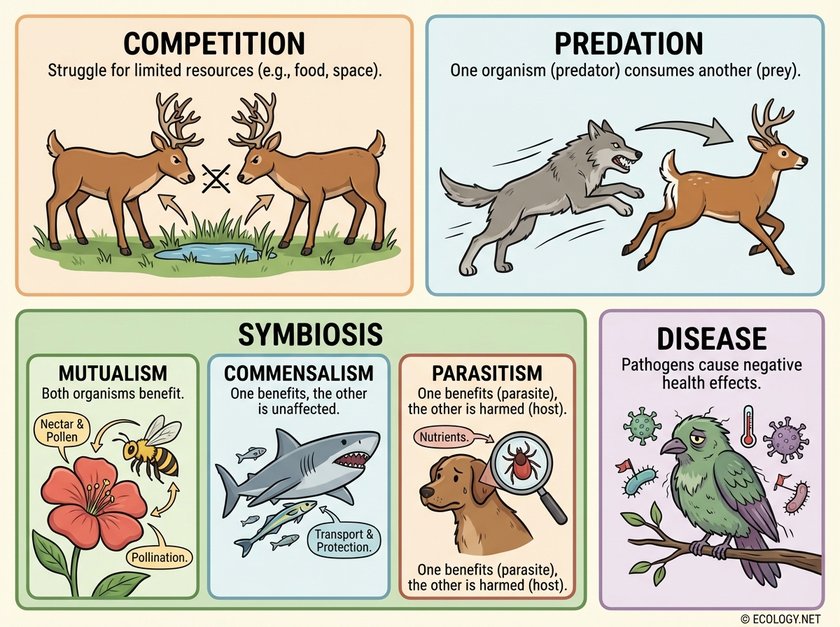
This diagram visually explains the fundamental types of biotic interactions that shape ecosystems, from direct competition to complex symbiotic relationships and the impact of disease.
The Role of Biotic Factors in Shaping Ecosystems
Beyond individual interactions, biotic factors collectively construct the very fabric of an ecosystem. They determine energy flow, nutrient cycling, and the overall biodiversity of a region.
Food Webs and Trophic Levels
Perhaps the most fundamental way biotic factors organize an ecosystem is through food webs. These complex networks illustrate who eats whom, demonstrating the flow of energy from producers (organisms that create their own food, like plants) to various levels of consumers (herbivores, carnivores, omnivores) and finally to decomposers (organisms like bacteria and fungi that break down dead organic matter). Each step in this energy transfer is known as a trophic level.
For example, grass (producer) is eaten by a rabbit (primary consumer), which in turn is eaten by a fox (secondary consumer). When the fox dies, decomposers break down its remains, returning nutrients to the soil for the grass to use again. This continuous cycle is entirely driven by biotic interactions.
Keystone Species and Ecosystem Engineers
Some biotic factors exert an influence disproportionate to their abundance. Keystone species are those whose removal would cause a dramatic shift or even collapse of an ecosystem. A classic example is the sea otter in kelp forests. By preying on sea urchins, otters prevent urchin populations from exploding and devouring entire kelp forests, thus maintaining a vital habitat for numerous other species.
Similarly, ecosystem engineers are organisms that physically modify, create, or maintain habitats. Beavers, for instance, build dams that transform flowing rivers into ponds and wetlands, creating new habitats for a wide array of aquatic and terrestrial species. These powerful biotic influences highlight how a single species can have cascading effects throughout an entire ecosystem.
Beyond Simple Interactions: Complex Webs of Life
Ecosystems are not static collections of organisms; they are dynamic systems where changes in one biotic factor can ripple through the entire web of life. Understanding these complex dynamics is crucial for ecological management and conservation.
Trophic Cascades
A fascinating example of complex biotic interactions is a trophic cascade. This occurs when predators in a food web suppress the abundance or alter the behavior of their prey, thereby releasing the next lower trophic level from predation (or herbivory). The effects can cascade down through multiple trophic levels.
Consider a simple food chain: hawks eat snakes, snakes eat frogs, frogs eat grasshoppers, and grasshoppers eat grass. If the hawk population declines, the snake population might increase. More snakes mean fewer frogs. Fewer frogs could lead to an increase in grasshoppers. An increase in grasshoppers could then result in a significant decrease in grass. This chain reaction, initiated by a change at the top of the food web, demonstrates the profound interconnectedness of biotic factors.
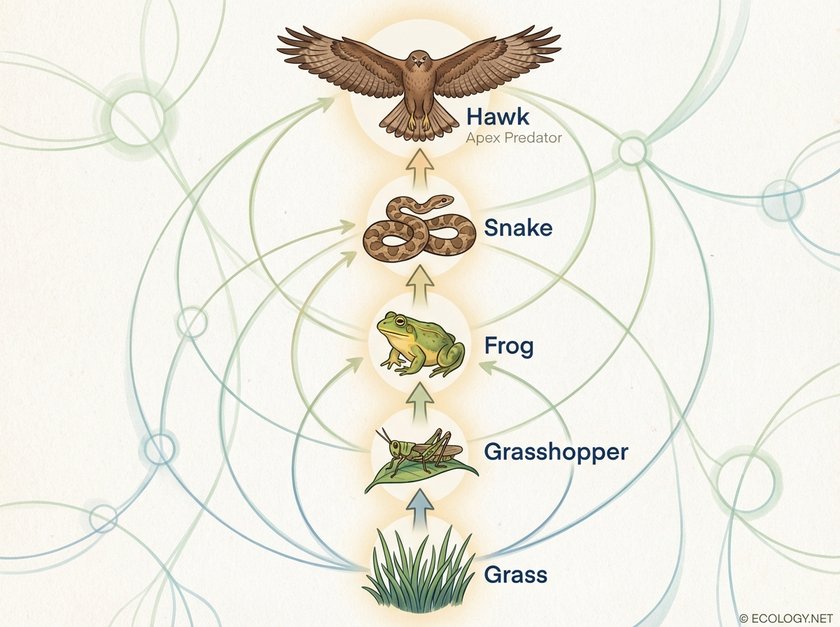
This diagram illustrates a trophic cascade, showing how changes at one level of a food chain can have far-reaching effects on other levels, emphasizing the intricate balance within ecosystems.
The Dynamic Nature of Biotic Factors
Biotic factors are not fixed entities; they are constantly evolving and adapting. Population sizes fluctuate due to birth rates, death rates, immigration, and emigration, all influenced by interactions with other biotic and abiotic factors. These dynamics can lead to boom and bust cycles, where populations surge and then crash, often in response to predator-prey relationships or resource availability.
Over longer timescales, biotic interactions drive evolution. The “evolutionary arms race” between predators and prey, or parasites and hosts, leads to a continuous refinement of adaptations. A faster gazelle escapes a cheetah, but only the fastest cheetahs catch gazelles, pushing both species towards greater speed and agility over generations.
Human Impact on Biotic Factors
Human activities have become one of the most significant biotic factors on Earth, profoundly altering ecosystems globally. From habitat destruction and pollution to climate change and the introduction of invasive species, human actions often disrupt the delicate balance of biotic interactions.
- Habitat Loss: Clearing forests for agriculture or urban development directly removes habitats, eliminating countless species and severing their biotic connections.
- Invasive Species: Introducing non-native species can have devastating effects. Without natural predators or competitors, invasive species can outcompete native organisms, disrupt food webs, and even drive extinctions.
- Climate Change: Human-induced climate change alters temperature and precipitation patterns, forcing species to adapt, migrate, or face extinction, thereby reorganizing entire biotic communities.
Understanding biotic factors is not just an academic exercise; it is essential for effective conservation. By recognizing the intricate web of life and the critical roles each organism plays, humanity can make more informed decisions to protect biodiversity and ensure the health of the planet’s ecosystems for future generations.
Conclusion
Biotic factors are the living threads that weave together the tapestry of life on Earth. From the fierce competition for resources to the cooperative dance of mutualism, and from the foundational role of producers to the cascading effects of top predators, these interactions define ecosystems. They are the engines of evolution, the architects of biodiversity, and the silent forces that shape every landscape. By delving into the world of biotic factors, one gains a profound appreciation for the interconnectedness of nature and the vital importance of every living thing in maintaining the planet’s incredible biological richness.