In the grand tapestry of life on Earth, change is the only constant. Ecosystems are perpetually in flux, adapting to shifts in climate, geology, and human impact. Yet, amidst this relentless dynamism, there exist remarkable pockets of stability, havens where life can persist and even thrive when the surrounding world becomes inhospitable. These vital sanctuaries are known as ecological refugia, and understanding them is paramount to safeguarding biodiversity in an era of unprecedented environmental transformation.
What Exactly is an Ecological Refugium?
At its core, an ecological refugium is a place that provides relatively stable and favorable conditions for species or populations, allowing them to survive periods of widespread environmental stress or disturbance. Imagine a small, verdant oasis in the middle of a vast, parched desert, or a sheltered valley untouched by a raging wildfire. These are real-world manifestations of the refugium concept.
Refugia act as biological life rafts, preserving genetic diversity and providing source populations that can eventually recolonize broader landscapes once conditions improve. They are not merely static safe zones, but dynamic elements crucial for the long-term resilience of ecosystems.

The Many Faces of Refugia: Diverse Types and Examples
Refugia are not a one-size-fits-all phenomenon. They manifest in countless forms, shaped by a complex interplay of physical, geological, and biological factors. Scientists categorize them based on the primary mechanism providing the refuge, offering a clearer lens through which to study and protect them.
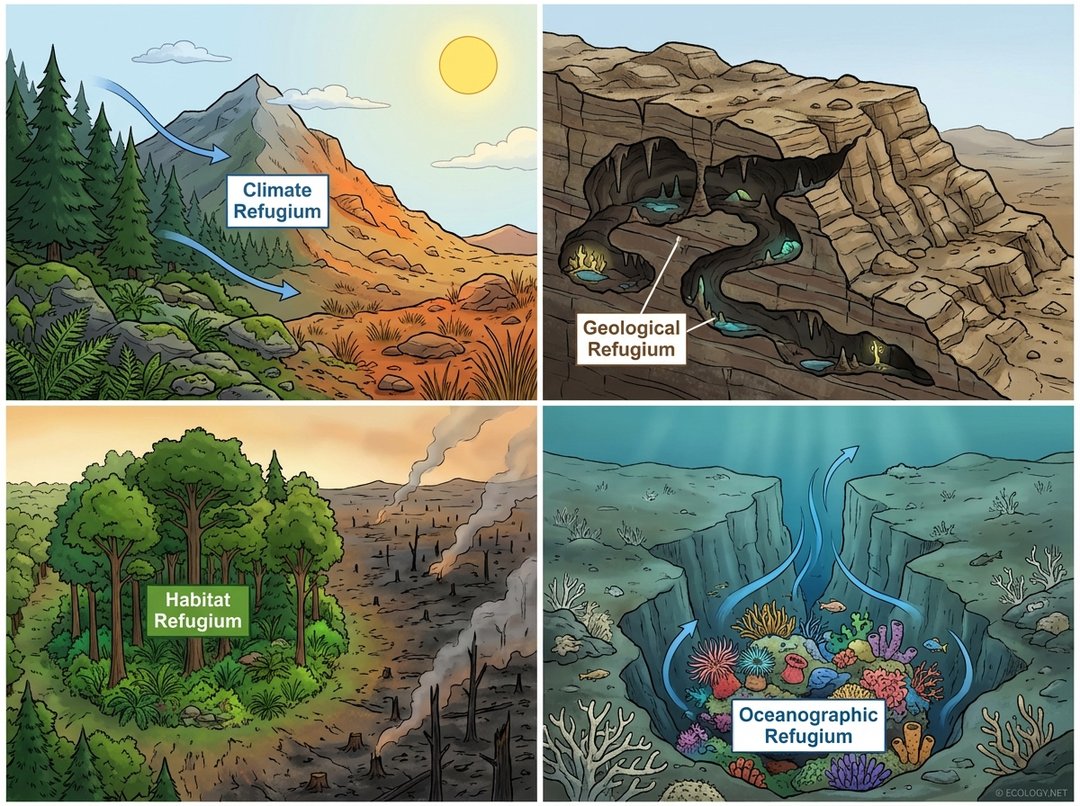
Climate Refugia
These are areas that maintain favorable climatic conditions, such as temperature or moisture, even as the broader region experiences significant shifts. They are often topographical features that create microclimates.
- North-facing slopes: In the Northern Hemisphere, these slopes receive less direct sunlight, remaining cooler and moister than south-facing slopes, offering refuge for cold-adapted species.
- High-altitude areas: Mountain peaks and plateaus can provide cooler temperatures as lower elevations warm, allowing species to migrate upwards to escape heat stress.
- Deep valleys and canyons: These can trap cool air or provide shade, buffering against extreme temperatures and maintaining higher humidity.
- Riparian zones: Areas along rivers and streams often have cooler temperatures and more consistent moisture, serving as vital refugia during droughts or heatwaves.
Geological Refugia
These refugia are defined by geological features that offer protection from environmental stressors.
- Caves and rock crevices: These subterranean or sheltered spaces provide stable temperatures, humidity, and protection from surface disturbances like fires, storms, or extreme temperature fluctuations. Many unique cave-dwelling species rely entirely on these refugia.
- Deep-sea trenches: These extreme environments can offer stable conditions for certain species, shielding them from surface ocean changes.
- Volcanic vents: While seemingly harsh, these can create unique, stable thermal and chemical environments for specialized extremophile communities.
Habitat Refugia
These are patches of intact habitat that escape disturbance, providing a haven for species when surrounding areas are destroyed or degraded.
- Unburned forest patches: During wildfires, certain areas might be spared due to wind patterns, topography, or fuel breaks, becoming critical refugia for plants and animals. These patches are vital for post-fire recovery.
- Old-growth forests: These mature forests often have complex structures, diverse microclimates, and stable conditions that can buffer against disturbances like logging or disease outbreaks, serving as refugia for specialized species.
- Isolated wetlands or springs: In arid landscapes, these permanent water sources are indispensable refugia for aquatic and semi-aquatic species during droughts.
Oceanographic Refugia
In the vast and dynamic ocean, specific areas can provide refuge from stressors like warming waters, acidification, or pollution.
- Upwelling zones: Areas where deep, cold, nutrient-rich water rises to the surface can provide cooler temperatures and abundant food, offering refuge for marine life from surface warming.
- Deep-sea canyons: These underwater canyons can create unique current patterns and stable environments, protecting species from surface disturbances and providing cooler waters.
- Specific current patterns: Certain ocean currents can transport larvae or maintain stable conditions in localized areas, creating refugia for sensitive species.
A particularly poignant example of oceanographic refugia can be seen in coral reefs.

As ocean temperatures rise, coral bleaching events become more frequent and severe. However, some coral reefs, often in deeper waters, near upwelling currents, or in areas with unique bathymetry, manage to escape the worst of these events. These “refugium reefs” become critical strongholds, preserving coral diversity and providing a source for recovery in degraded areas.
Why Are Refugia So Crucial? Their Ecological Significance
The importance of ecological refugia extends far beyond simply providing temporary shelter. They are fundamental to the long-term health and resilience of ecosystems.
- Biodiversity Conservation: Refugia are vital for protecting species that are vulnerable to environmental change. They can be the last bastions for rare or endangered species, preventing their extinction.
- Evolutionary Hotspots: By allowing populations to persist through periods of stress, refugia can become sites where species adapt to changing conditions, potentially leading to the evolution of new traits or even new species.
- Source Populations: Once the broader environment recovers from a disturbance, species from refugia can disperse and recolonize the degraded areas. This makes refugia essential for ecosystem recovery and maintaining connectivity.
- Resilience to Climate Change: As global climate patterns shift, refugia offer natural buffers against extreme events like prolonged droughts, heatwaves, or intense storms, helping ecosystems absorb and recover from these shocks.
- Maintaining Ecosystem Services: By preserving biodiversity, refugia indirectly support essential ecosystem services such as pollination, water purification, and nutrient cycling, which benefit all life, including humans.
Identifying and Protecting Refugia: A Conservation Imperative
Given their critical role, identifying and protecting refugia has become a cornerstone of modern conservation biology. This is a complex task, requiring a blend of scientific expertise and innovative approaches.
How Scientists Identify Refugia
- Climate Modeling: Scientists use sophisticated climate models to predict future environmental conditions and identify areas likely to remain stable or less impacted.
- Topographical Analysis: Detailed mapping of elevation, aspect (direction a slope faces), and hydrological features helps pinpoint potential microclimates.
- Field Surveys and Monitoring: Direct observation of species distribution, population dynamics, and environmental conditions provides ground-truthing for models and reveals unexpected refugia.
- Genetic Studies: Analyzing genetic diversity can reveal populations that have persisted in isolation for long periods, indicating historical refugia.
- Historical Data: Paleontological and ecological records can provide insights into how species responded to past climate changes, helping to identify areas that served as refugia in the past.
Conservation Strategies for Refugia
Protecting refugia requires a multi-faceted approach, often integrating with broader conservation efforts.
- Targeted Protected Areas: Establishing national parks, wildlife reserves, or marine protected areas specifically to encompass identified refugia.
- Corridor Connectivity: Creating or restoring ecological corridors that link refugia, allowing species to move between them and facilitating recolonization.
- Climate-Smart Conservation: Integrating refugia into conservation planning by prioritizing areas that are projected to remain stable under future climate scenarios. This involves managing landscapes to enhance their natural buffering capacity.
- Restoration Efforts: Restoring degraded habitats adjacent to refugia can expand their protective influence and improve overall ecosystem health.
- Reducing Local Stressors: Minimizing human impacts such as pollution, overfishing, or habitat fragmentation in and around refugia to maximize their effectiveness.
Refugia in a Changing World: Future Outlook
As the planet continues to experience rapid environmental change, the concept of refugia will only grow in importance. They represent not just places of survival, but also beacons of hope for the future of biodiversity. The challenge lies in our ability to accurately identify these critical areas, understand the mechanisms that make them resilient, and implement effective conservation strategies before they are lost.
Human actions, both destructive and restorative, play a significant role in shaping the availability and effectiveness of refugia. By protecting these natural sanctuaries, we are not just saving individual species, but investing in the long-term health and stability of entire ecosystems, ensuring a more resilient future for all life on Earth.