The Sun’s Secret Recipe: Unraveling the Wonders of Photosynthesis
Life on Earth, in its myriad forms, owes an incredible debt to a silent, tireless process happening all around us: photosynthesis. It is the fundamental engine that powers nearly every ecosystem, transforming sunlight into the energy that sustains plants, and by extension, almost all other living things. Without this remarkable biological alchemy, our planet would be a barren, lifeless rock.
What is Photosynthesis? The Basics
At its core, photosynthesis is the process by which green plants, algae, and some bacteria convert light energy into chemical energy, creating food in the form of sugars. This process uses carbon dioxide from the air and water from the soil, releasing oxygen as a vital byproduct. Think of it as nature’s own solar-powered food factory.
The simplified equation for photosynthesis reveals its elegant simplicity:
Carbon Dioxide + Water + Light Energy → Glucose (Sugar) + Oxygen
This equation represents a miraculous transformation. Plants take in the very air we exhale, absorb water, and harness the sun’s radiant energy to build complex sugar molecules. These sugars are their food, fuel for growth, reproduction, and all life processes.
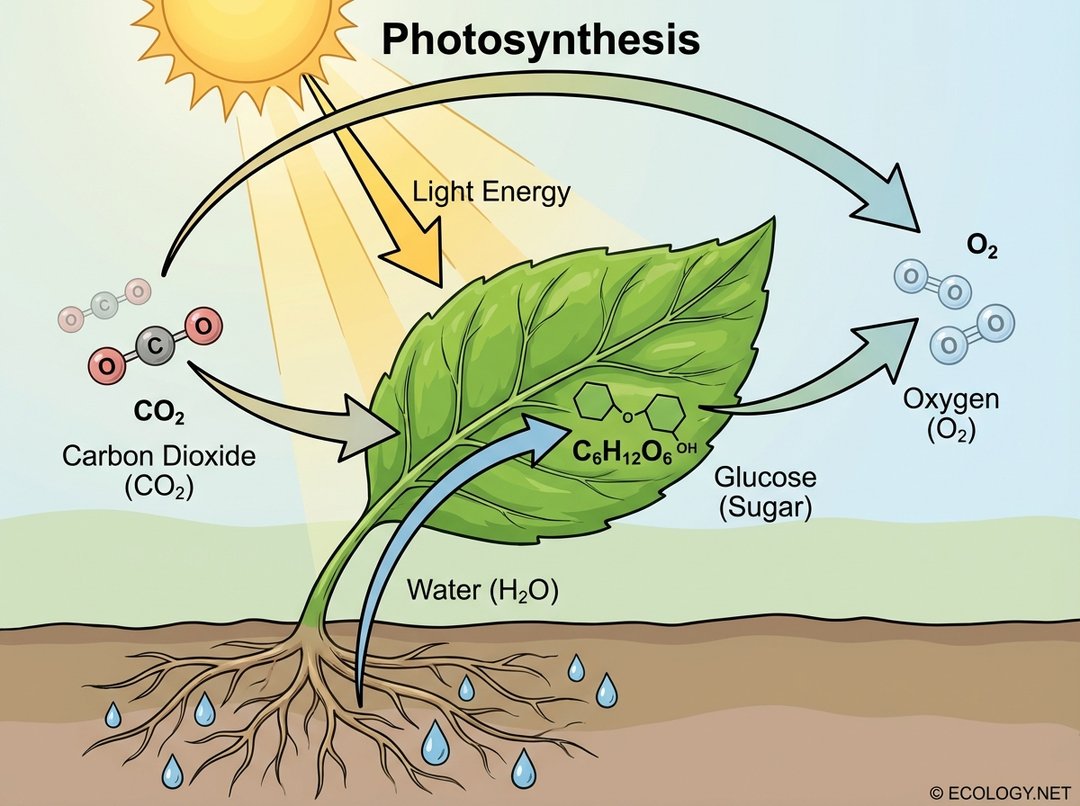
The oxygen released during this process is, of course, what nearly all aerobic life forms, including humans, breathe to survive. This makes photosynthesis not just a plant’s way of eating, but the very breath of our planet.
The Key Players: Chloroplasts and Chlorophyll
Where does this incredible process take place? The answer lies within the microscopic world of plant cells. While photosynthesis occurs throughout the green parts of a plant, it is most concentrated in the leaves. If we were to peer inside a leaf, we would find specialized structures responsible for this work.
Within the cells of a plant leaf, there are tiny, oval-shaped organelles called chloroplasts. These are the dedicated “factories” where photosynthesis happens. Each plant cell can contain dozens, even hundreds, of these chloroplasts, all working diligently to capture sunlight.
The secret ingredient within chloroplasts is a vibrant green pigment known as chlorophyll. It is chlorophyll that gives plants their characteristic green color, and more importantly, it is the molecule responsible for absorbing light energy from the sun. Different types of chlorophyll absorb different wavelengths of light, primarily red and blue light, reflecting green light, which is why we perceive plants as green.
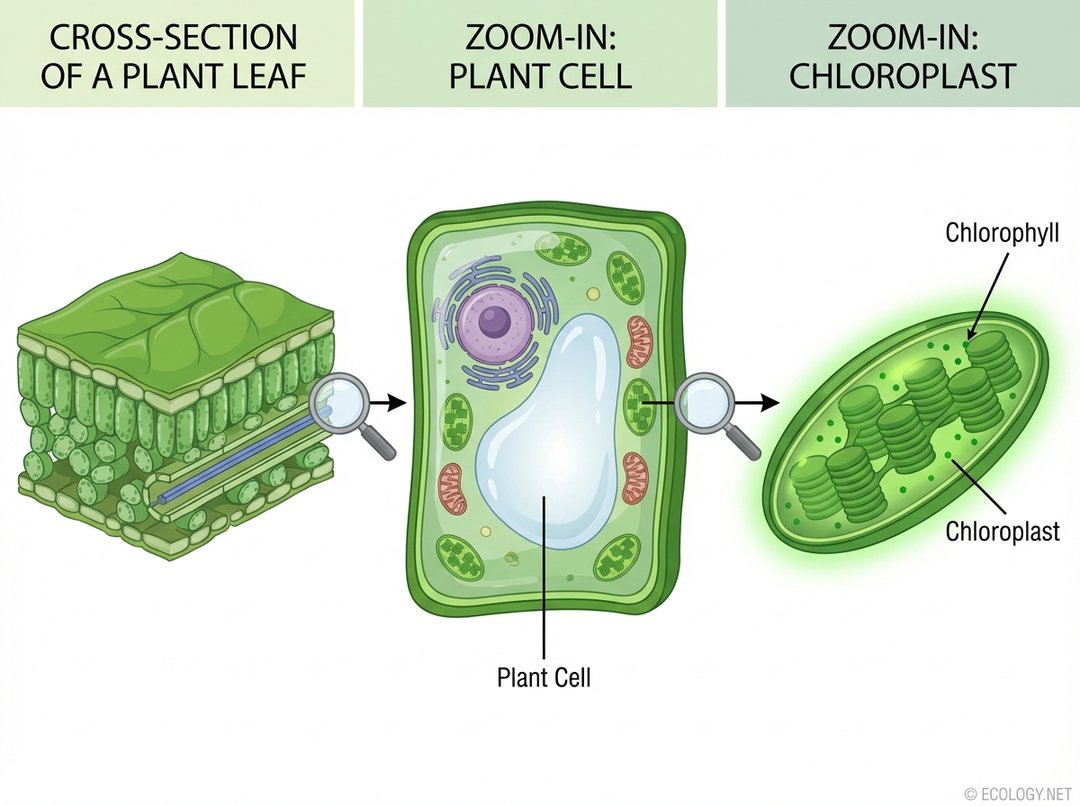
Imagine chlorophyll molecules as tiny solar panels, perfectly designed to capture the sun’s energy and kickstart the entire photosynthetic process.
How Does Photosynthesis Actually Work? Two Main Stages
Photosynthesis is not a single, instantaneous event, but rather a complex, two-stage process that occurs within the chloroplasts. These two stages are intricately linked, with the products of one stage fueling the next.
Light-Dependent Reactions: Capturing the Sun’s Energy
The first stage, aptly named the light-dependent reactions, requires direct sunlight. These reactions occur in specialized disc-like structures within the chloroplasts called thylakoids, which are often stacked into grana.
Here is what happens:
- Light Absorption: Chlorophyll molecules within the thylakoids absorb light energy.
- Water Splitting: This absorbed energy is used to split water molecules (H2O). This splitting releases electrons, protons (hydrogen ions), and crucially, oxygen (O2) as a byproduct, which is then released into the atmosphere.
- Energy Carriers: The energy from the light is used to create two important energy-carrying molecules: ATP (adenosine triphosphate) and NADPH (nicotinamide adenine dinucleotide phosphate). Think of these as rechargeable batteries, now fully charged with chemical energy.
Light-Independent Reactions (Calvin Cycle): Building Sugar
The second stage, known as the light-independent reactions or the Calvin Cycle, does not directly require light. Instead, it uses the ATP and NADPH produced during the light-dependent reactions to convert carbon dioxide into sugar. These reactions take place in the stroma, the fluid-filled space surrounding the thylakoids within the chloroplast.
Here is the sequence of events:
- Carbon Fixation: Carbon dioxide (CO2) from the atmosphere enters the stroma. An enzyme called RuBisCO helps combine CO2 with an existing five-carbon molecule.
- Sugar Production: Using the chemical energy stored in ATP and the reducing power of NADPH, a series of complex reactions converts the newly fixed carbon into glucose (sugar) and other organic compounds.
- Regeneration: The five-carbon molecule used at the beginning of the cycle is regenerated, allowing the cycle to continue.
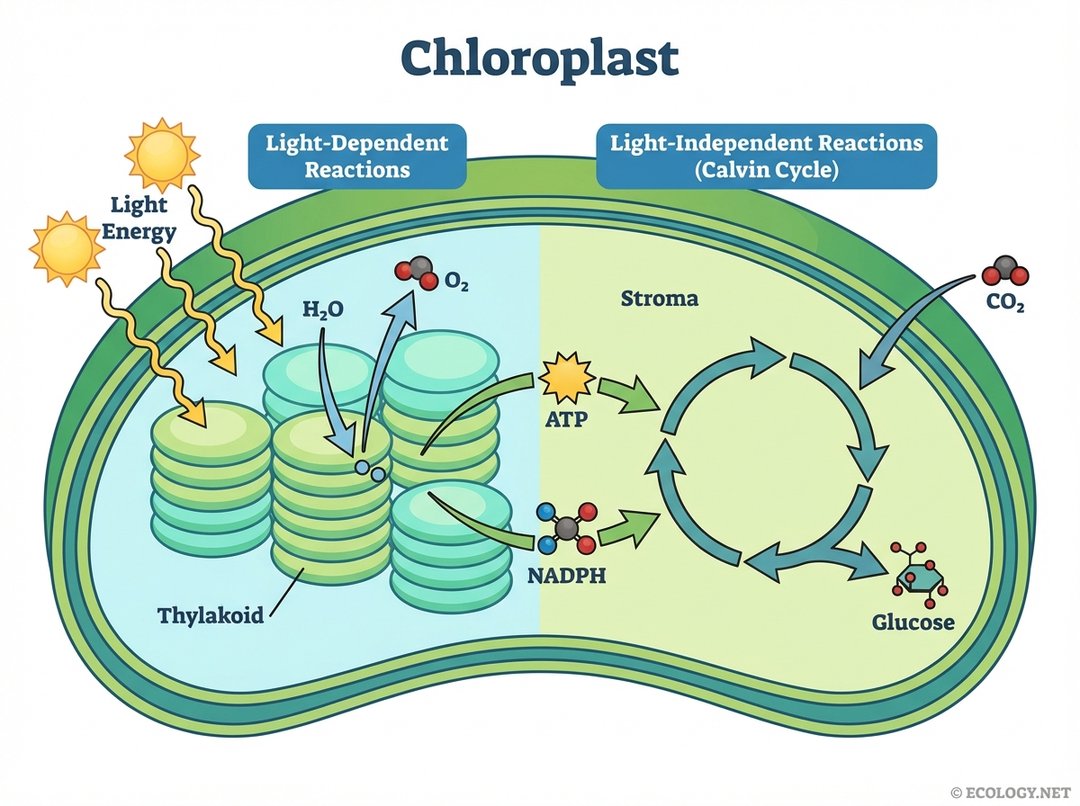
In essence, the light-dependent reactions capture the sun’s energy and convert it into a usable chemical form (ATP and NADPH), while the light-independent reactions then use that chemical energy to build the actual food molecules (glucose) from carbon dioxide.
Why is Photosynthesis So Important?
The significance of photosynthesis extends far beyond the growth of individual plants. It is the bedrock of nearly all life on Earth, playing multiple critical roles:
- The Foundation of Food Chains: Plants, as primary producers, form the base of almost every food web. Herbivores eat plants, carnivores eat herbivores, and so on. Without the energy captured by photosynthesis, these food chains would collapse. Every bite of food, whether it is a vegetable or a piece of meat, ultimately traces its energy back to the sun through photosynthesis.
- Oxygen Production: As a byproduct, photosynthesis continuously replenishes the Earth’s atmospheric oxygen, which is essential for the respiration of most living organisms, including humans. It literally allows us to breathe.
- Carbon Cycle Regulation: Photosynthesis removes vast amounts of carbon dioxide from the atmosphere, incorporating it into plant biomass. This process is a crucial component of the global carbon cycle, helping to regulate Earth’s climate. Forests, for example, are often referred to as “carbon sinks” due to their significant role in absorbing CO2.
- Energy Source: The chemical energy stored in glucose by plants is not just for their immediate use. When we burn wood or fossil fuels (which are derived from ancient plant and animal matter), we are releasing solar energy captured by photosynthesis millions of years ago.
Factors Affecting Photosynthesis
Just like any factory, the efficiency of photosynthesis can be influenced by several environmental factors. Understanding these factors is crucial for agriculture, ecology, and even climate science.
- Light Intensity: More light generally means a faster rate of photosynthesis, up to a certain point. Beyond that point, other factors become limiting. Think of a plant thriving in full sun versus one struggling in deep shade.
- Carbon Dioxide Concentration: Since CO2 is a key raw material, higher concentrations of carbon dioxide in the atmosphere can increase the rate of photosynthesis, again, up to a certain limit. This is why some greenhouses artificially enrich their air with CO2.
- Temperature: Photosynthesis involves enzymes, which are sensitive to temperature. There is an optimal temperature range for most plants. Too cold, and the reactions slow down; too hot, and the enzymes can denature, halting the process.
- Water Availability: Water is another essential raw material. A lack of water can cause plants to close their stomata (tiny pores on leaves) to conserve moisture, which in turn limits the uptake of CO2, slowing photosynthesis.
- Nutrient Availability: Plants also need various mineral nutrients from the soil, such as nitrogen, phosphorus, and magnesium, to build chlorophyll and other essential components for photosynthesis.
Beyond Plants: Other Photosynthesizers
While plants are the most visible photosynthesizers, they are not alone. Many other organisms contribute significantly to global photosynthesis:
- Algae: These diverse aquatic organisms, ranging from microscopic phytoplankton to large seaweeds, are enormous contributors to oxygen production and carbon fixation in oceans and freshwater environments. Phytoplankton alone are estimated to produce more than half of the Earth’s oxygen.
- Cyanobacteria: Often called blue-green algae, these ancient bacteria were among the first organisms to evolve photosynthesis billions of years ago. They played a pivotal role in oxygenating Earth’s early atmosphere, paving the way for the evolution of complex life.
Photosynthesis and Climate Change
The intricate relationship between photosynthesis and the global carbon cycle makes it a central topic in discussions about climate change. As human activities release increasing amounts of carbon dioxide into the atmosphere, plants and other photosynthesizers act as a natural buffer, absorbing a significant portion of this excess CO2. However, their capacity is not infinite. Deforestation reduces the planet’s photosynthetic capacity, while rising temperatures and altered precipitation patterns can stress plants, impacting their ability to photosynthesize efficiently. Understanding and protecting these natural carbon sinks is vital for mitigating the effects of climate change.
Conclusion
Photosynthesis is far more than just a biological process; it is the grand orchestrator of life on Earth. From the food we eat and the air we breathe to the fossil fuels that power our world, its influence is pervasive and profound. It is a testament to the elegance and power of nature, a constant reminder of the sun’s generosity and the intricate web of life it sustains. As we continue to explore and understand this remarkable process, our appreciation for the green world around us only deepens, highlighting our shared responsibility to protect the natural systems that make our planet habitable.