
Life on Earth thrives on energy, and at the heart of nearly every ecosystem lies a fundamental process: the capture of the sun’s radiant power by plants. This incredible feat of biological engineering, known as photosynthesis, forms the base of all food webs, fueling everything from microscopic bacteria to towering trees and the animals that depend on them. But how much of this captured energy actually becomes new plant material, available to sustain the rest of life? This crucial question is answered by a concept ecologists call Net Primary Productivity, or NPP.
What is Net Primary Productivity (NPP)?
To understand NPP, we first need to consider the total amount of energy plants initially capture. This is known as Gross Primary Productivity (GPP). Think of GPP as a plant’s total income from photosynthesis. It represents all the organic matter, or biomass, that plants create from carbon dioxide and sunlight.
However, just like any living organism, plants need energy to live, grow, and maintain themselves. They “spend” a portion of their captured energy through a process called respiration. Respiration is essentially the plant’s metabolism, burning some of the organic matter it produced to power its own life processes, such as transporting nutrients, repairing cells, and growing roots and leaves.
Net Primary Productivity (NPP) is what’s left over after a plant has paid its own metabolic bills. It is the amount of organic matter that accumulates in plant tissues after accounting for respiration. In simpler terms:
NPP = GPP – Respiration
NPP represents the actual amount of energy available to the next trophic level in an ecosystem, meaning the herbivores that eat the plants, and subsequently the carnivores that eat the herbivores. It is the true measure of an ecosystem’s capacity to support life.
Why is NPP So Important?
NPP is far more than just an ecological metric, it is a cornerstone of planetary health and directly impacts countless aspects of our world:
- Foundation of Food Webs: NPP is the ultimate source of energy for almost all heterotrophic organisms (those that cannot produce their own food). Without sufficient NPP, entire food webs would collapse.
- Carbon Sequestration: Plants absorb vast amounts of carbon dioxide from the atmosphere during photosynthesis. The carbon stored in their biomass, represented by NPP, is a vital component of the global carbon cycle. High NPP ecosystems act as significant carbon sinks, helping to regulate Earth’s climate.
- Oxygen Production: As a byproduct of photosynthesis, plants release oxygen into the atmosphere, which is essential for the respiration of most living organisms, including humans.
- Ecosystem Services: NPP underpins numerous ecosystem services, such as soil formation, water purification, nutrient cycling, and habitat provision for biodiversity.
- Human Economy: Agriculture, forestry, and fisheries are all directly dependent on NPP. The food we eat, the timber we use, and the fish we catch are all products of primary productivity.
Factors Influencing NPP
The rate at which an ecosystem produces biomass varies dramatically across the globe. Several key environmental factors dictate how high or low an ecosystem’s NPP will be:
1. Sunlight
Photosynthesis requires light, so the amount of solar radiation an ecosystem receives is a primary driver of NPP. Areas with abundant sunlight, like the tropics, generally have higher potential productivity than polar regions.
2. Water Availability
Water is an essential ingredient for photosynthesis and plant growth. Ecosystems with consistent and ample rainfall, such as rainforests, tend to have very high NPP. Conversely, deserts, with their extreme water scarcity, exhibit very low NPP.
3. Temperature
Temperature affects the rate of biochemical reactions involved in photosynthesis and respiration. Most plants have an optimal temperature range for growth. Extremely cold temperatures can limit growth, while excessively hot temperatures can cause stress and reduce productivity.
4. Nutrient Availability
Plants need various nutrients, such as nitrogen, phosphorus, and potassium, to build their tissues. Soil fertility and the availability of these essential elements can significantly impact NPP. For example, nutrient-poor soils can limit growth even if other conditions are favorable.
5. Carbon Dioxide Concentration
While often taken for granted, carbon dioxide is the raw material for photosynthesis. Higher atmospheric CO2 concentrations can, under certain conditions, enhance plant growth, though other limiting factors often come into play.
Ecosystems and Their NPP: A Global Snapshot
The interplay of these factors creates a mosaic of productivity across the planet. Some ecosystems are incredibly efficient at converting sunlight into biomass, while others struggle to support even sparse vegetation.
Consider the stark differences:

This visual comparison clearly shows how varying factors such as sunlight, water, and temperature influence net primary productivity.
Here is a general overview of different ecosystem types and their typical NPP ranges:
| Ecosystem Type | Typical NPP (grams of carbon per square meter per year) | Key Limiting Factors |
| Tropical Rainforests | 1,000 – 2,500 | Nutrients (sometimes) |
| Temperate Forests | 600 – 1,300 | Temperature, growing season length |
| Agricultural Land | 300 – 1,000 (highly variable) | Nutrients, water, human management |
| Savannas | 200 – 600 | Water, fire |
| Boreal Forests (Taiga) | 200 – 800 | Temperature, growing season length |
| Temperate Grasslands | 200 – 600 | Water, fire |
| Tundra | 10 – 400 | Temperature, short growing season |
| Deserts | 10 – 250 | Water |
| Open Ocean | 50 – 200 | Nutrients (especially nitrogen, iron) |
| Estuaries & Coral Reefs | 1,000 – 2,500 | Light, nutrients, human impact |
The Superstars of NPP: Tropical Rainforests
As the table indicates, tropical rainforests consistently rank among the highest in terms of NPP. These vibrant ecosystems are truly the superstars of primary productivity on land.

This image illustrates the article’s description of tropical rainforests as the superstars of NPP, highlighting the abundant sunlight, warmth, and rainfall that drive maximum plant growth.
Why are they so productive? It comes down to an optimal combination of all the key factors:
- Abundant Sunlight: Located near the equator, rainforests receive intense solar radiation year-round.
- Consistent Warmth: Temperatures are consistently warm, allowing for continuous growth without seasonal shutdowns.
- Plentiful Rainfall: High precipitation ensures a constant supply of water, preventing drought stress.
- Rapid Nutrient Cycling: While rainforest soils can sometimes be nutrient-poor, the rapid decomposition of organic matter and efficient nutrient cycling within the ecosystem ensures that available nutrients are quickly taken up by plants.
This combination creates an environment where plants can photosynthesize and grow at an astonishing rate, supporting an unparalleled diversity of life.
Measuring NPP: How Scientists Quantify Life’s Engine
Quantifying NPP is a complex but essential task for ecologists. It allows them to understand ecosystem health, track carbon budgets, and predict how ecosystems might respond to environmental changes. Various methods are employed, ranging from direct measurements to sophisticated remote sensing techniques.
1. Harvest Method
For smaller areas or specific plant types, scientists can directly measure NPP by harvesting biomass. This involves collecting all plant material from a defined area, drying it, and weighing it. Measurements are taken at the beginning and end of a growing season (or over specific intervals) to determine the net increase in biomass. This method is labor-intensive and destructive, making it unsuitable for large-scale assessments.
2. Remote Sensing
Satellite imagery and aerial photography are powerful tools for estimating NPP over vast regions. By analyzing the reflectance of light from vegetation (e.g., using indices like NDVI, Normalized Difference Vegetation Index), scientists can infer plant health, photosynthetic activity, and biomass accumulation. These data are then combined with ground-based measurements and models to estimate NPP.
3. Eddy Covariance Towers
One of the most advanced and widely used methods for continuous, long-term NPP measurement is the eddy covariance technique. Tall towers equipped with specialized sensors are deployed within an ecosystem to measure the exchange of carbon dioxide, water vapor, and energy between the ecosystem and the atmosphere.
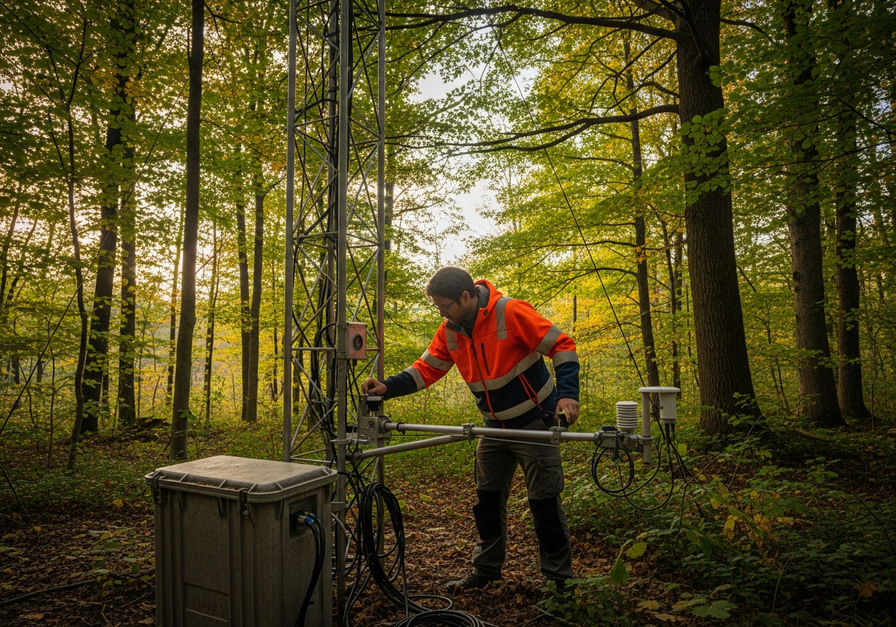
This image visualizes the article’s section on NPP measurement techniques, showing how scientists use on-site instruments to monitor the net carbon uptake of ecosystems.
These sensors can detect tiny fluctuations in CO2 concentration and wind speed, allowing researchers to calculate the net ecosystem exchange (NEE) of carbon. By accounting for ecosystem respiration, scientists can then derive NPP. Eddy covariance towers provide invaluable, real-time data on how ecosystems “breathe” and contribute to the global carbon cycle.
NPP and Global Change
Understanding NPP is more critical than ever in an era of rapid global change. Climate change, deforestation, land-use change, and pollution all have the potential to alter NPP rates across the planet. Changes in NPP can have cascading effects, impacting carbon sequestration, biodiversity, and the availability of resources for human societies.
For instance, increased atmospheric CO2 could potentially boost NPP in some areas, a phenomenon known as CO2 fertilization. However, this effect might be offset by other factors like increased drought, heat stress, or nutrient limitations. Monitoring global NPP trends helps scientists assess the health of our planet’s ecosystems and predict future environmental scenarios.
Conclusion
Net Primary Productivity is a fundamental concept that illuminates the very engine of life on Earth. It quantifies the energy captured by plants and made available to all other organisms, serving as the bedrock of every ecosystem. From the lush, vibrant tropical rainforests to the sparse, resilient desert landscapes, NPP dictates the capacity of our planet to sustain its incredible biodiversity and provide essential services. By understanding and carefully monitoring NPP, we gain crucial insights into the health of our natural world and our own place within its intricate, life-sustaining cycles.