Imagine a grand, intricate clockwork mechanism, each gear and spring working in perfect harmony to keep time. Now, imagine that clockwork is a living, breathing forest, a vibrant coral reef, or a sprawling grassland. This is an ecosystem, a complex web of life and its environment. The ability of this natural clockwork to maintain its structure, function, and processes, even when faced with internal or external pressures, is what ecologists call ecosystem stability.
Ecosystem stability is not about being static or unchanging. Nature is dynamic, constantly evolving and adapting. Instead, stability refers to the capacity of an ecosystem to persist and recover from disturbances, ensuring the continuous flow of life-sustaining services it provides. Understanding this concept is crucial for appreciating the delicate balance of our planet and the profound impact human activities can have.
The Twin Pillars of Stability: Resistance and Resilience
At the heart of ecosystem stability are two fundamental properties: resistance and resilience. These concepts help us understand how ecosystems respond to change.
- Resistance is an ecosystem’s ability to withstand a disturbance without undergoing significant changes in its structure or function. Think of a sturdy oak tree bending in a strong wind rather than breaking. A highly resistant ecosystem will show minimal alteration even when faced with considerable stress.
- Resilience, on the other hand, is the capacity of an ecosystem to recover quickly after a disturbance has occurred. It is the bounce back factor, the ability to return to its original state or a new, stable state following a disruption. A forest that regrows rapidly after a fire is demonstrating high resilience.
These two properties often work in tandem, allowing ecosystems to navigate the inevitable challenges of the natural world.

The image above beautifully illustrates both resistance and resilience. On the left, a sunlit old growth forest canopy stands strong, demonstrating its inherent resistance to everyday weather. On the right, captured moments later during a moderate windstorm, some branches are bent or broken, yet the overall structure remains largely intact, showcasing the forest’s resistance. The subtle changes also hint at its rapid recovery, a testament to its resilience.
Beyond the Basics: Other Facets of Stability
While resistance and resilience are primary, ecologists also consider other aspects when discussing ecosystem stability:
- Persistence: This refers to the length of time an ecosystem or a population within it can maintain its state or existence. A persistent ecosystem is one that endures over long periods.
- Variability: This describes the degree of fluctuation in an ecosystem’s properties over time. A stable ecosystem might still exhibit natural variability, but these fluctuations remain within a predictable range, preventing drastic shifts.
- Elasticity: A measure of how quickly an ecosystem returns to its original state after a disturbance. It is closely related to resilience but emphasizes the speed of recovery.
- Amplitude: This refers to the maximum disturbance an ecosystem can absorb before shifting to a different state. A high amplitude indicates a robust system.
The Architects of Stability: Key Factors
What makes some ecosystems more stable than others? Several interconnected factors play crucial roles:
Biodiversity’s Role
One of the most significant drivers of ecosystem stability is biodiversity, the variety of life in an ecosystem. A diverse ecosystem is often a more stable one for several reasons:
- Species Richness: A greater number of species often means a wider range of functional roles are filled, providing redundancy. If one species is affected by a disturbance, others can often compensate, maintaining overall ecosystem function.
- Functional Diversity: It is not just the number of species, but the variety of roles they play. An ecosystem with diverse plant types, for instance, might have some with deep roots, some with shallow roots, some tolerant to drought, others to flood. This functional variety ensures that some components will likely survive and thrive under different conditions.
- Genetic Diversity: Within a single species, genetic variation allows populations to adapt to changing environmental conditions over generations, enhancing the species’ and thus the ecosystem’s long term stability.
Food Web Dynamics
The intricate network of who eats whom, known as the food web, is another critical determinant of stability. Complex food webs with many alternative pathways for energy flow tend to be more stable than simple ones. If one food source or predator is removed, the other species have alternatives, preventing a cascading collapse.
Keystone Species
Some species have a disproportionately large impact on their ecosystem’s stability, far greater than their abundance might suggest. These are known as keystone species. Their removal can trigger dramatic changes or even collapse within an ecosystem.

A classic example is the sea otter in kelp forests, as depicted in this captivating image. Sea otters prey on sea urchins, which in turn feed on kelp. Without otters, urchin populations can explode, leading to overgrazing of kelp forests, transforming vibrant underwater ecosystems into barren “urchin barrens.” The presence of sea otters is therefore crucial for maintaining the stability and health of kelp forests.
The Dance of Disturbance
Disturbances are natural events that alter ecosystem structure and function, such as fires, floods, storms, or volcanic eruptions. While often perceived negatively, natural disturbances are integral to many ecosystems’ stability. Many ecosystems have evolved to not only tolerate but even depend on specific disturbance regimes.
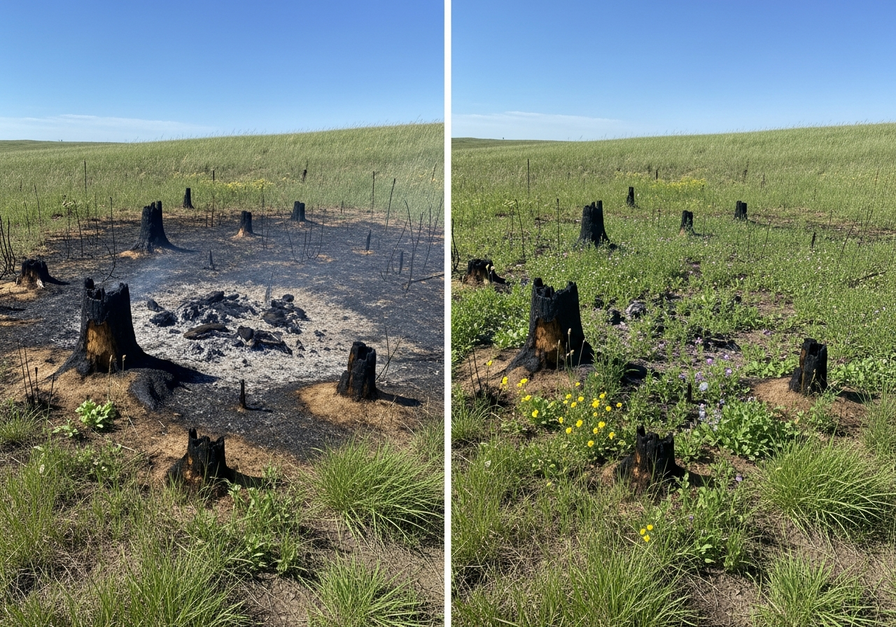
The split screen photograph above vividly illustrates this point with a North American prairie. The left panel shows a scorched landscape immediately after a wildfire, a significant disturbance. Yet, the right panel, captured just a day later, reveals a resurgence of green seedlings and wildflowers. This rapid regrowth demonstrates the remarkable resilience of prairie ecosystems, which have evolved with frequent fires. Fire clears out old growth, recycles nutrients, and stimulates the germination of many native plant species, maintaining the prairie’s long term stability.
Measuring and Assessing Stability
Ecologists employ various methods to quantify and assess ecosystem stability. This often involves long term monitoring of key indicators such as:
- Biomass: The total mass of living organisms. Stable ecosystems tend to have consistent biomass levels.
- Species Composition: Tracking the types and relative abundances of species. Significant shifts can indicate instability.
- Nutrient Cycling Rates: The speed at which essential nutrients like nitrogen and phosphorus move through the ecosystem. Stable ecosystems maintain predictable cycling rates.
- Productivity: The rate at which an ecosystem generates biomass. Consistent productivity is a sign of stability.
Mathematical models and experimental manipulations are also used to test an ecosystem’s resistance and resilience to various stressors. For instance, researchers might simulate drought conditions or remove certain species to observe the ecosystem’s response.
The Shifting Sands: Threats to Ecosystem Stability
While natural disturbances are often part of an ecosystem’s rhythm, human induced pressures can push ecosystems beyond their natural capacity for stability. Major threats include:
- Climate Change: Altering temperature and precipitation patterns, increasing the frequency and intensity of extreme weather events, and causing sea level rise, all of which stress ecosystems globally.
- Habitat Loss and Fragmentation: Destroying natural habitats for agriculture, urbanization, and infrastructure development reduces biodiversity and isolates populations, making them more vulnerable.
- Invasive Species: Non native species introduced to new environments can outcompete native species, disrupt food webs, and alter ecosystem processes, leading to instability.
- Pollution: Chemical pollutants, plastic waste, and nutrient runoff can degrade habitat quality, harm organisms, and impair ecosystem functions.
- Overexploitation: Unsustainable harvesting of resources, such as overfishing or excessive logging, can deplete populations and destabilize entire ecosystems.
Why It Matters: Our Future with Stable Ecosystems
The stability of ecosystems is not merely an academic concern for scientists; it is fundamental to human well being. Stable ecosystems provide invaluable ecosystem services, the benefits that humans receive from nature:
- Clean Air and Water: Forests and wetlands filter pollutants, providing breathable air and potable water.
- Food and Resources: Stable agricultural lands, fisheries, and forests provide the sustenance and materials necessary for human life.
- Climate Regulation: Forests and oceans absorb carbon dioxide, helping to regulate global climate.
- Pollination: Insects and other animals pollinate crops, essential for food production.
- Disease Regulation: Healthy ecosystems can help regulate the spread of diseases.
- Recreation and Cultural Value: Natural landscapes offer spaces for recreation, inspiration, and hold deep cultural significance.
When ecosystems lose their stability, these services are compromised, leading to profound consequences for human societies, including food insecurity, water scarcity, increased natural disasters, and economic instability. Protecting and restoring ecosystem stability is therefore not just an environmental imperative, but a societal and economic one. By understanding the intricate mechanisms that govern nature’s resilience and resistance, humanity can strive to live in harmony with the natural world, ensuring a stable and prosperous future for all.