Imagine a bustling city street. If a new coffee shop opens, its success might depend on how many other coffee shops are already there, or how many people live nearby. This is a bit like how populations in nature are influenced by factors that depend on their density. But what about events that hit everyone, regardless of how many individuals are around? These are the powerful, often dramatic forces known as density-independent factors, and they play a crucial role in shaping life on Earth.
In the intricate dance of ecology, populations of plants and animals are constantly buffeted by various influences. Some factors become more impactful as a population grows larger and denser, like competition for food or the spread of disease. These are called density-dependent factors. However, a whole other category of forces operates without any regard for how many individuals are present in a given area. These are the density-independent factors, and they can be incredibly powerful, often leading to sudden and widespread changes in populations.
What Exactly Are Density-Independent Factors?
Density-independent factors are environmental influences that affect a population’s growth rate or size regardless of its density. Whether a population is sparse or crowded, these factors will exert the same proportional effect on individuals. They are often abiotic, meaning they are non-living components of the environment, such as weather events, natural disasters, or certain human activities.
Think of it this way: if a severe frost hits a forest, it will damage trees whether there are ten trees per acre or a hundred trees per acre. The frost does not become more or less damaging because the trees are closer together or farther apart. Its impact is uniform across the landscape, affecting individuals regardless of their proximity to others.
Key Characteristics of Density-Independent Factors
- Uniform Impact: Their effect on individuals within a population does not change with population density.
- Abiotic Nature: Most are non-living environmental components, though some human impacts can also fall into this category.
- Often Catastrophic: Many density-independent events are sudden, unpredictable, and can cause significant mortality or reproductive failure.
- External to Population Dynamics: They are not generated or amplified by the population itself, unlike competition or disease.
Common Examples in the Natural World
The world is full of examples of density-independent factors at play, constantly influencing the ebb and flow of life. These forces remind us that nature’s power can be indiscriminate.
Extreme Weather and Climate Events
Perhaps the most prevalent density-independent factors are those related to weather and climate. These can include:
- Temperature Extremes: Unseasonably cold snaps, severe frosts, or prolonged heatwaves can devastate populations. A sudden frost can kill young plants or insects, regardless of how many are in an area.
- Precipitation Changes: Droughts can lead to widespread water scarcity, impacting all organisms in an ecosystem uniformly. Conversely, excessive rainfall and flooding can drown terrestrial animals or wash away nests, irrespective of population size.
- Severe Storms: Hurricanes, tornadoes, and blizzards can cause widespread destruction, destroying habitats and directly killing individuals without regard for population density.

This image visualizes how extreme temperature events, like a severe frost, impact vegetation uniformly, whether it is a dense patch of seedlings or a solitary mature tree. The frost’s reach is broad and indiscriminate, a clear example of a density-independent factor at work.
Natural Disasters
Large-scale geological or meteorological events often act as powerful density-independent regulators.
- Wildfires: While fire behavior can be influenced by fuel density, the initial ignition and spread can be density-independent, especially in large, wind-driven events. A massive wildfire can sweep through a forest, consuming everything in its path, whether the trees are tightly packed or widely spaced.
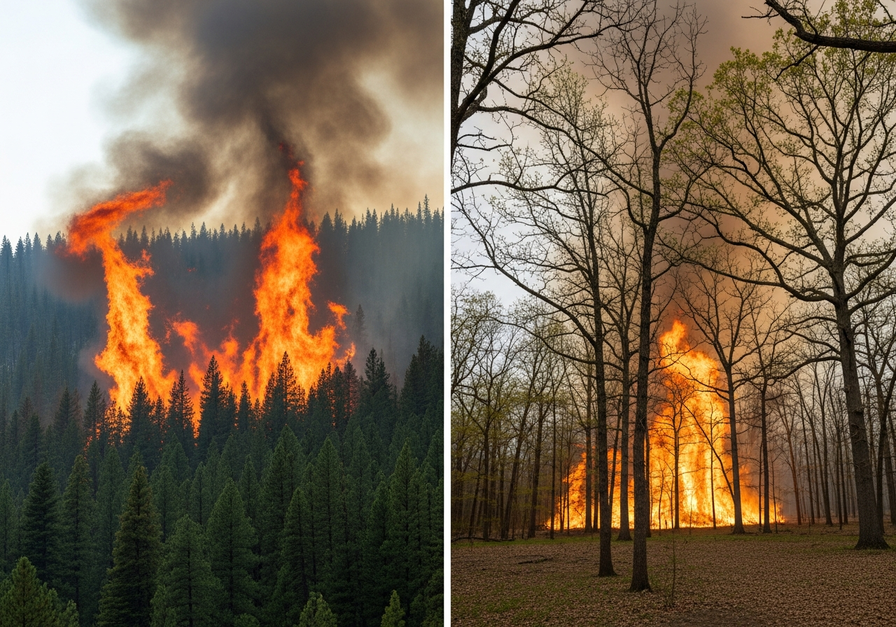
Here, the image powerfully illustrates how a wildfire’s destructive force can be a density-independent factor. The intense flames and smoke are equally devastating in both the dense forest and the sparse woodland, highlighting that the fire’s impact is not lessened by lower population density.
- Volcanic Eruptions: Ashfall and lava flows can obliterate entire landscapes and the populations within them, regardless of how many individuals were present.
- Earthquakes and Tsunamis: These events can cause widespread habitat destruction and direct mortality, affecting all organisms in the affected zone.
Human Activities
While many human impacts have density-dependent aspects, some can act in a density-independent manner, especially when they are broad and pervasive.
- Widespread Pollution: A large oil spill or a widespread release of toxic chemicals can affect all organisms in a contaminated area, regardless of their population density.
- Habitat Destruction: The clear-cutting of a forest or the draining of a wetland for development can eliminate entire populations, irrespective of how dense they were before the event.
The Impact on Population Dynamics and Stochasticity
Density-independent factors introduce a significant element of unpredictability into population dynamics. This unpredictability is often referred to as stochasticity, meaning randomness. While ecologists can model population growth based on birth and death rates, these models often struggle to account for the sudden, arbitrary impacts of density-independent events.
For large, robust populations, a density-independent event might cause a temporary dip in numbers, from which the population can eventually recover. However, for small or already vulnerable populations, these events can be catastrophic, pushing them towards extinction.
Stochasticity and Small Populations
Small populations are particularly susceptible to density-independent factors. A single severe storm or an unexpected frost can wipe out a significant portion, or even all, of a small, isolated group of organisms. This is because there are fewer individuals to buffer the impact, and the loss of even a few individuals can have a disproportionate effect on the population’s viability.
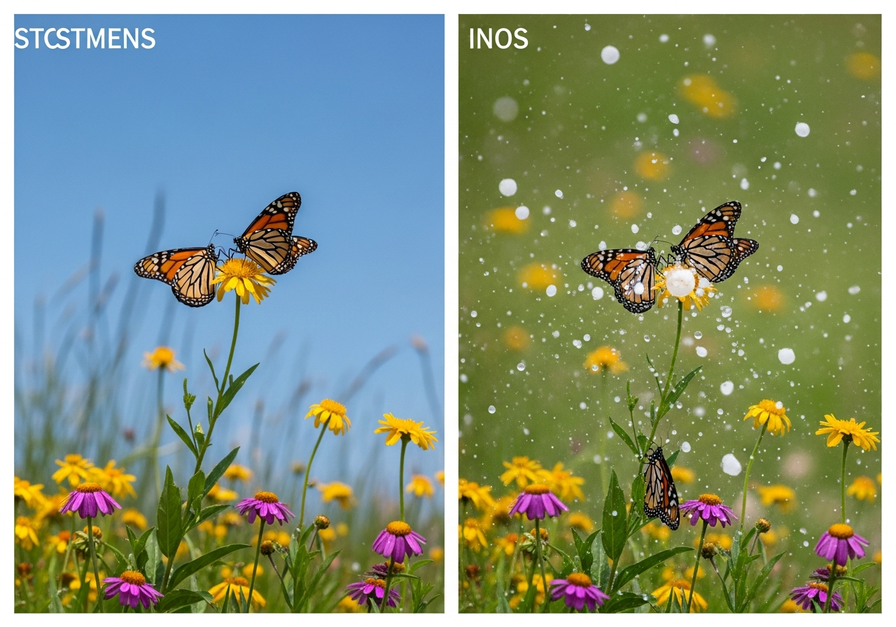
This image poignantly illustrates the concept of stochasticity and its profound impact on small populations. A vibrant cluster of monarch butterflies is shown before a sudden hailstorm, and then the same meadow is depicted after the storm, with the butterflies gone. This highlights how random, extreme events, which are density-independent, can disproportionately devastate tiny populations, leaving the surrounding landscape largely unchanged but the specific population wiped out.
Consider a population of 100,000 birds. If a storm kills 1,000 birds, it is a loss, but the population remains large. Now consider a population of only 100 birds. If the same storm kills 10 birds, that is a 10% reduction, a much more significant blow that could threaten its long-term survival. If the storm kills 50 birds, the population might not recover.
Ecological Significance and Conservation Challenges
Understanding density-independent factors is critical for several reasons in ecology and conservation.
Shaping Ecosystems
These factors are powerful agents of natural selection and ecosystem change. They can create “bottlenecks” in populations, reducing genetic diversity and favoring individuals that are more resilient to specific environmental stresses. Over long periods, repeated density-independent events can shape the distribution and abundance of species across landscapes, leading to adaptations that help organisms cope with recurring challenges like droughts or fires.
Conservation Planning
For conservationists, density-independent factors present a unique challenge. While efforts can be made to manage density-dependent factors like habitat loss or disease spread, it is much harder to mitigate the effects of a hurricane or a severe drought. Conservation strategies must therefore account for the potential impact of these unpredictable events, especially for endangered species.
- Habitat Redundancy: Protecting multiple, geographically separated populations can reduce the risk of a single density-independent event wiping out an entire species.
- Genetic Diversity: Maintaining high genetic diversity within populations can increase the chances that some individuals will possess traits that allow them to survive extreme events.
- Resilience Building: Restoring ecosystem health and function can make habitats more resilient to disturbances, even if the disturbance itself is density-independent. For example, healthy wetlands can buffer the impact of floods.
Interaction with Density-Dependent Factors
It is important to note that density-independent and density-dependent factors often interact in complex ways. A density-independent event, like a severe drought, might weaken a population, making it more susceptible to density-dependent factors such as disease or predation. Conversely, a population already stressed by high density and limited resources might be hit even harder by an extreme weather event.
The interplay between these two types of factors creates a dynamic and often unpredictable environment for all living things, highlighting the intricate web of life.
Conclusion
Density-independent factors are the impartial, often powerful forces of nature that shape populations without regard for their size or crowding. From the scorching heat of a wildfire to the biting chill of a sudden frost, these events remind us of the raw power of the environment. Understanding their mechanisms and impacts is not just an academic exercise; it is crucial for comprehending the dynamics of life on Earth and for developing effective strategies to protect biodiversity in an increasingly unpredictable world. As our climate continues to change, the frequency and intensity of many density-independent events are projected to shift, making this ecological concept more relevant than ever for the future of our planet.