The ground beneath our feet, often taken for granted, is far more than just dirt; it is the living skin of our planet, a complex ecosystem teeming with life and essential for nearly all terrestrial existence. This vital layer, known as soil, is unfortunately vulnerable to a relentless natural process: soil erosion. Understanding soil erosion is not merely an academic exercise; it is crucial for safeguarding our food supply, protecting our environment, and ensuring a sustainable future for all.
What is Soil Erosion?
Soil erosion is the natural process by which the top layer of soil, known as topsoil, is dislodged and transported from one location to another. This movement is primarily driven by powerful natural forces such as water and wind. While erosion is a natural geological process that has shaped landscapes over millennia, human activities have dramatically accelerated its pace, turning a slow, constructive force into a destructive environmental challenge.
Topsoil is the most fertile part of the soil, rich in organic matter, nutrients, and microorganisms that support plant growth. Its loss directly impacts agricultural productivity, biodiversity, and water quality. When topsoil erodes, it takes with it the very foundation of life, leaving behind less fertile, compacted, or barren land.
The Primary Agents of Erosion: Water and Wind
The two most significant forces responsible for soil erosion are water and wind. Each operates through distinct mechanisms, yet both can lead to severe land degradation.
Water Erosion: The Force of Flow
Water erosion occurs when rainfall, runoff, or flowing water detaches and transports soil particles. Its severity depends on factors like rainfall intensity, slope steepness, soil type, and vegetative cover. Water erosion manifests in several forms, each progressively more damaging:
- Splash Erosion: This is the initial stage, where individual raindrops strike bare soil, dislodging particles and splashing them into the air.
- Sheet Erosion: After splash erosion, water begins to flow over the land surface as a thin, uniform layer, carrying away dislodged soil particles. This type of erosion is often insidious because it removes a uniform layer of topsoil, making it difficult to detect until significant damage has occurred.
- Rill Erosion: As sheet flow concentrates, it forms small, well-defined channels called rills. These channels are typically shallow enough to be removed by normal tillage operations.
- Gully Erosion: If rills are left unchecked, they can deepen and widen into larger, more permanent channels known as gullies. Gullies are too large to be removed by ordinary farm equipment and represent a severe form of land degradation. They can carve deep into the landscape, making land unusable and impacting infrastructure.
The visual impact of water erosion can be striking, transforming productive fields into barren landscapes.
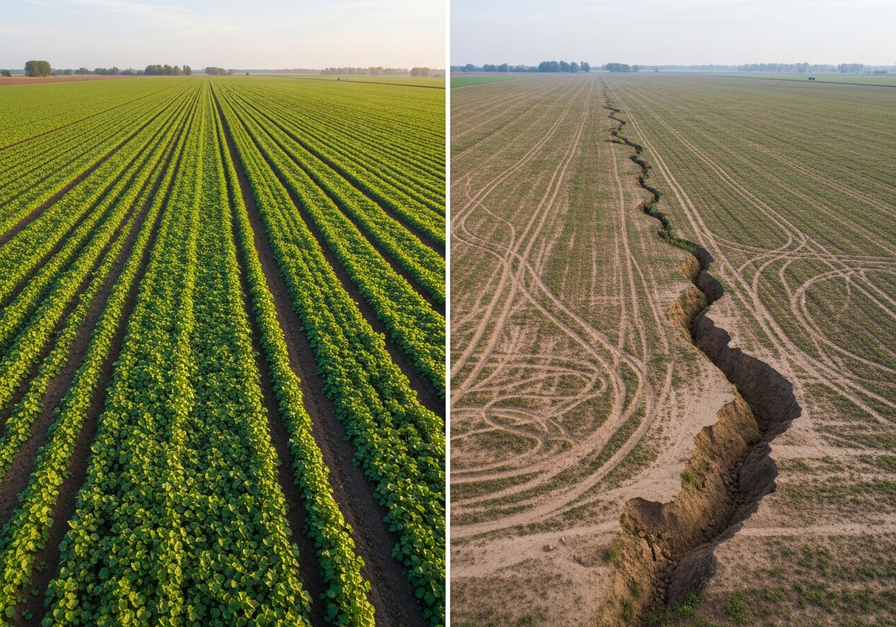
This image powerfully illustrates the article’s discussion of sheet, rill, and gully erosion and the loss of topsoil that reduces agricultural productivity. On one side, a thriving field; on the other, the stark reality of topsoil washed away, revealing the fragility of our agricultural lands.
When water erosion progresses to its most severe form, the landscape itself can be dramatically altered.
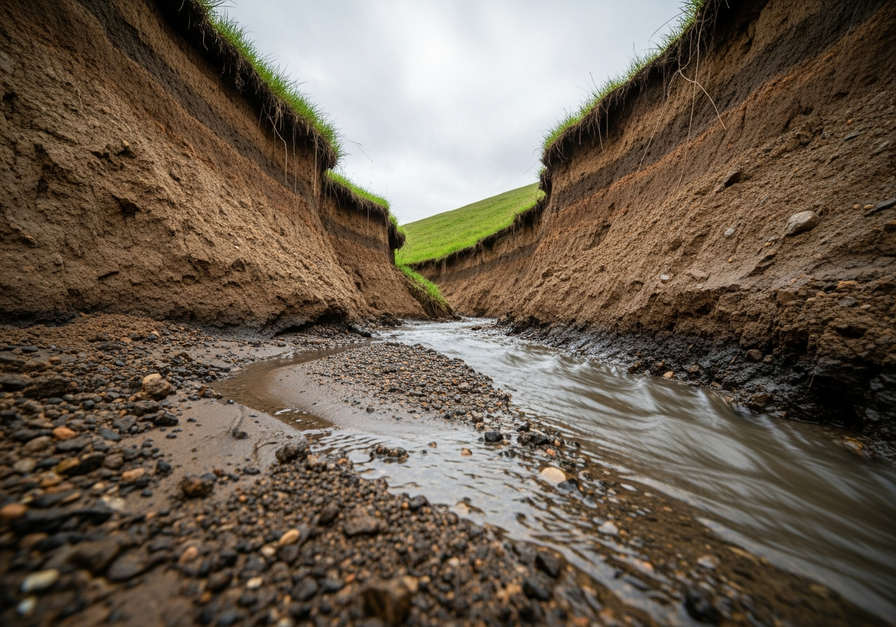
This photograph shows the consequences of unchecked water erosion described in the article, including land degradation and infrastructure damage. The deep channels carved by water demonstrate the immense power of this natural force when soil is left unprotected.
Wind Erosion: The Invisible Thief
Wind erosion occurs when strong winds lift and transport loose soil particles. It is particularly prevalent in arid and semi-arid regions, as well as in agricultural areas with dry, bare soil. Wind erosion also has several forms:
- Surface Creep: Larger soil particles are rolled or slid along the ground by the force of the wind.
- Saltation: Medium-sized particles are lifted into the air for short distances, bouncing along the surface and dislodging other particles upon impact. This accounts for the majority of wind-eroded soil.
- Suspension: Very fine particles are lifted high into the atmosphere and can be carried for hundreds or thousands of kilometers, creating dust storms.
Wind erosion not only removes fertile topsoil but also reduces air quality, damages crops, and can bury infrastructure. The sight of a dust plume is a clear indicator of this destructive process.
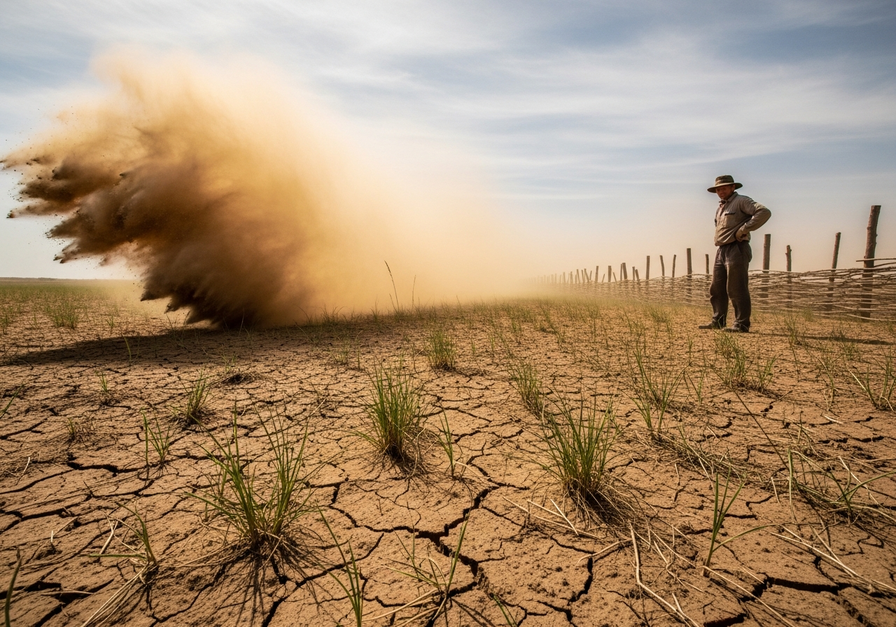
This image demonstrates wind erosion, one of the article’s main agents, and highlights the importance of vegetative cover to protect soil. The visible dust plume underscores the vulnerability of loose soils in drylands.
Why Does Soil Erode? Contributing Factors
While water and wind are the agents, several factors influence the susceptibility of soil to erosion. These can be broadly categorized into natural and human-induced factors.
Natural Factors
- Topography: Steeper slopes increase the velocity of water runoff, leading to greater erosive power. Longer slopes also allow more water to accumulate, increasing its erosive potential.
- Climate: High-intensity rainfall, especially after dry periods, can cause significant water erosion. Strong, persistent winds in dry regions exacerbate wind erosion. Freezing and thawing cycles can also loosen soil particles.
- Soil Type: Soils with a high proportion of silt and fine sand are generally more susceptible to erosion than those with more clay or organic matter, which bind particles together. Poorly structured soils are also more vulnerable.
- Vegetation Cover: Natural vegetation, such as forests, grasslands, and wetlands, plays a critical role in protecting soil. Plant roots bind soil particles, while leaves and stems intercept rainfall, reducing its impact and slowing runoff.
Human-Induced Factors
Human activities often disrupt the natural balance, accelerating erosion rates far beyond what would occur naturally.
- Deforestation: The removal of forests for agriculture, logging, or development leaves soil exposed to the elements. Without the protective canopy and root systems, soil becomes highly vulnerable to both water and wind erosion.
- Unsustainable Agricultural Practices:
- Plowing up and down slopes: Creates channels for water to flow, accelerating rill and gully formation.
- Monoculture: Growing a single crop year after year can deplete soil nutrients and reduce organic matter, making the soil less stable.
- Over-tillage: Excessive plowing breaks down soil structure, pulverizing aggregates and making soil particles more easily dislodged by wind and water.
- Lack of cover crops: Leaving fields bare between growing seasons exposes the soil to erosion.
- Overgrazing: Too many livestock on a pasture can strip away vegetation, compact the soil, and expose it to erosion. The hooves of animals can also break up soil structure.
- Urbanization and Construction: Development projects often involve clearing large areas of vegetation and disturbing soil, leading to increased runoff and erosion during construction phases. Impervious surfaces like roads and buildings also increase runoff velocity.
- Mining: Surface mining operations can remove vast amounts of topsoil and expose subsoil, which is often less fertile and more prone to erosion.
The Devastating Consequences of Soil Erosion
The impacts of soil erosion are far-reaching, affecting ecosystems, economies, and human well-being.
- Loss of Fertile Topsoil and Reduced Agricultural Productivity: This is perhaps the most direct and significant consequence. When the nutrient-rich topsoil is lost, agricultural yields decline, requiring increased use of fertilizers, which can have further environmental impacts. In severe cases, land can become completely unproductive.
- Water Quality Degradation: Eroded soil particles, along with attached nutrients and pesticides, are carried into rivers, lakes, and oceans. This sedimentation can clog waterways, reduce water storage capacity in reservoirs, and harm aquatic ecosystems. Nutrient runoff can lead to eutrophication, causing algal blooms that deplete oxygen and kill fish.
- Desertification: In arid and semi-arid regions, severe soil erosion, combined with climate change and unsustainable land use, can lead to desertification, the process by which fertile land becomes desert. This reduces arable land and exacerbates food insecurity.
- Infrastructure Damage: Gully erosion can undermine roads, bridges, and buildings. Sedimentation can fill drainage systems, leading to increased flooding.
- Ecological Impacts: Erosion can destroy habitats, reduce biodiversity, and disrupt ecological processes. The loss of topsoil also reduces the soil’s capacity to store carbon, contributing to climate change.
- Economic and Social Costs: Farmers face reduced incomes, communities may experience water shortages, and governments incur costs for dredging waterways and repairing damaged infrastructure. In extreme cases, soil degradation can lead to displacement and migration.
Fighting Back: Solutions and Prevention Strategies
Fortunately, soil erosion is not an irreversible process. A variety of conservation practices and land management strategies can effectively mitigate erosion and restore soil health.
Sustainable Agricultural Practices
- Contour Plowing: Plowing across the slope, rather than up and down, creates furrows that act as small dams, slowing water runoff and allowing it to infiltrate the soil.
- Terracing: On very steep slopes, constructing broad, level steps or terraces reduces the effective slope length and gradient, significantly minimizing water erosion.
- No-Till or Conservation Tillage: This practice involves planting crops directly into the residue of the previous crop without plowing. The crop residue acts as a protective cover, reducing splash erosion, slowing runoff, and improving soil organic matter.
- Cover Cropping: Planting non-cash crops, such as clover or rye, between main growing seasons keeps the soil covered, protecting it from erosion and adding organic matter.
- Crop Rotation: Alternating different crops in a sequence helps maintain soil fertility, break pest cycles, and improve soil structure, making it more resistant to erosion.
- Strip Cropping: Planting different crops in alternating strips, often along contours, can help trap soil and moisture, particularly when a dense crop is alternated with a row crop.
Vegetation Management
- Afforestation and Reforestation: Planting trees on degraded land or in areas prone to erosion helps stabilize soil with root systems and provides canopy cover.
- Windbreaks and Shelterbelts: Rows of trees or shrubs planted perpendicular to the prevailing wind direction can significantly reduce wind speed over fields, thereby minimizing wind erosion.
- Grassed Waterways: Establishing permanent grass cover in natural drainage paths prevents gully formation and filters runoff.
Gully Stabilization
For existing gullies, various techniques can be employed:
- Check Dams: Small dams made of rock, brush, or other materials are constructed across gullies to slow water flow, trap sediment, and encourage vegetation growth.
- Revegetation: Planting appropriate vegetation along gully banks helps stabilize the soil and prevent further deepening.
Policy and Land Management
- Integrated Land Use Planning: Developing comprehensive plans that consider soil conservation in urban, agricultural, and forest areas.
- Education and Outreach: Informing farmers, landowners, and the public about the causes and consequences of soil erosion and effective prevention strategies.
- Incentives for Conservation: Providing financial or technical support to encourage the adoption of soil conservation practices.
The Future of Our Soil
Soil erosion is a silent crisis, often overlooked until its effects become catastrophic. However, with informed action and a commitment to sustainable land management, we can protect this invaluable resource. The health of our soil is inextricably linked to the health of our planet and the well-being of future generations. By understanding the mechanisms of erosion and implementing effective conservation strategies, we can ensure that the living skin of the Earth continues to nourish life for centuries to come. Protecting our soil is not just an environmental imperative; it is an investment in our collective future.