The Fast Lane of Life: Understanding R-selected Species
Imagine a world where survival hinges on speed, numbers, and seizing every fleeting opportunity. This is the world of R-selected species, a fascinating group of organisms that have mastered the art of living fast and reproducing prolifically. From the humble dandelion to the buzzing mosquito, these species play a crucial, often unseen, role in shaping our planet’s ecosystems. Understanding R-selection is key to appreciating the incredible diversity of life and the ingenious strategies organisms employ to thrive.
What Exactly Are R-selected Species?
In ecology, species are often categorized by their life history strategies, essentially their approach to survival and reproduction. The concept of R- and K-selection helps us understand these diverse strategies. R-selected species are those that prioritize a high intrinsic rate of natural increase, denoted by the letter ‘r’. This means they are exceptionally good at producing many offspring quickly.
Think of it as a numbers game. Instead of investing heavily in a few offspring, R-selected species spread their bets by producing a vast quantity of young, hoping that at least a few will survive to adulthood. This strategy is particularly effective in environments that are unpredictable, unstable, or frequently disturbed.
Core Characteristics of R-selected Species
- High Fecundity: They produce a large number of offspring.
- Short Lifespan: Individuals typically live for a relatively brief period.
- Small Body Size: Most R-selected organisms are small.
- Rapid Maturation: They reach reproductive age quickly.
- Minimal Parental Care: Little to no investment in raising their young.
- Opportunistic: They are excellent at colonizing new or disturbed habitats.
The Reproductive Blitz: Quantity Over Quality
One of the most striking features of R-selected species is their incredible reproductive capacity. They are nature’s ultimate baby factories, churning out offspring at an astonishing rate. This strategy is a direct response to high mortality rates among their young. By producing thousands, even millions, of eggs or seeds, they increase the statistical probability that some will survive to continue the lineage.
Consider the common dandelion, a plant often seen as a nuisance but a master of R-selection. A single dandelion plant can produce thousands of seeds, each equipped with a tiny parachute for wind dispersal. This allows them to rapidly colonize new areas, like a freshly tilled garden bed or a crack in the pavement.

The image above beautifully illustrates the high fecundity and rapid dispersal characteristic of R-selected species. A tiny plant can release millions of seeds, dramatically increasing the odds of survival and colonization.
Another excellent example comes from the aquatic world: frogs. Many frog species lay massive clumps of eggs, sometimes thousands at a time, in ponds or other temporary water bodies. These eggs receive no parental care once laid; their survival relies purely on sheer numbers.
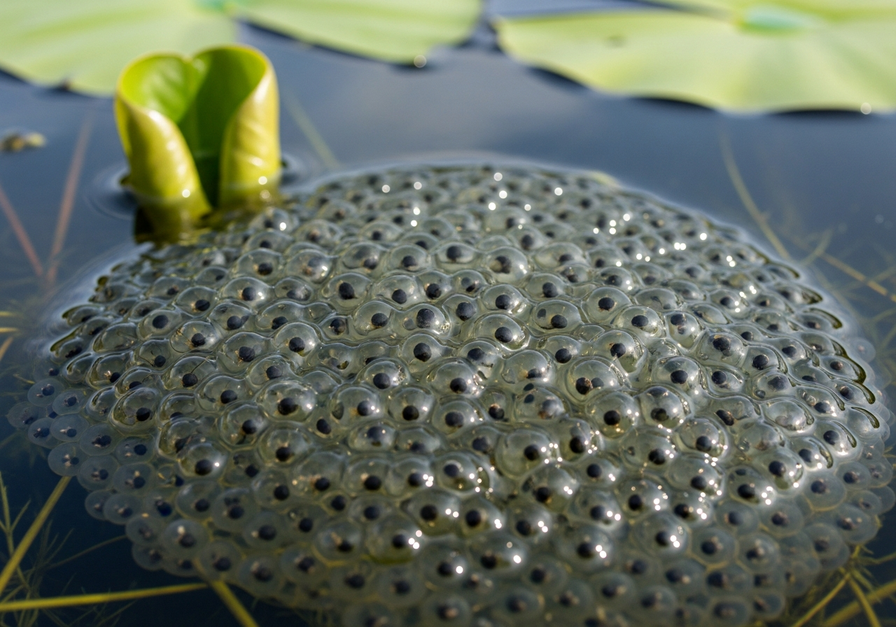
This photograph of a frog egg mass in a pond demonstrates the massive reproductive output and lack of parental care typical of R-selected species. It highlights how many offspring are produced in a single breeding event, a testament to their strategy of quantity over individual investment.
Living Fast, Dying Young: Short Lifespans and Rapid Growth
Because R-selected species invest so much energy into reproduction, they often have shorter lifespans. There is an evolutionary trade off: allocate resources to growing large and living long, or to reproducing quickly and abundantly. R-selected species choose the latter. They mature rapidly, reproduce, and then often die, making way for the next generation.
Their small body size is also a key adaptation. Smaller organisms generally require less time and fewer resources to grow to reproductive maturity. This allows them to complete their life cycle quickly, often within days or weeks, which is crucial in environments where conditions can change dramatically at any moment.
Mosquitoes are a prime example of this strategy. They are small, have very short lifespans, and reproduce at an astonishing rate. A single female mosquito can lay hundreds of eggs in a small pool of water, and these eggs can hatch and develop into adults in a matter of days, given the right conditions.
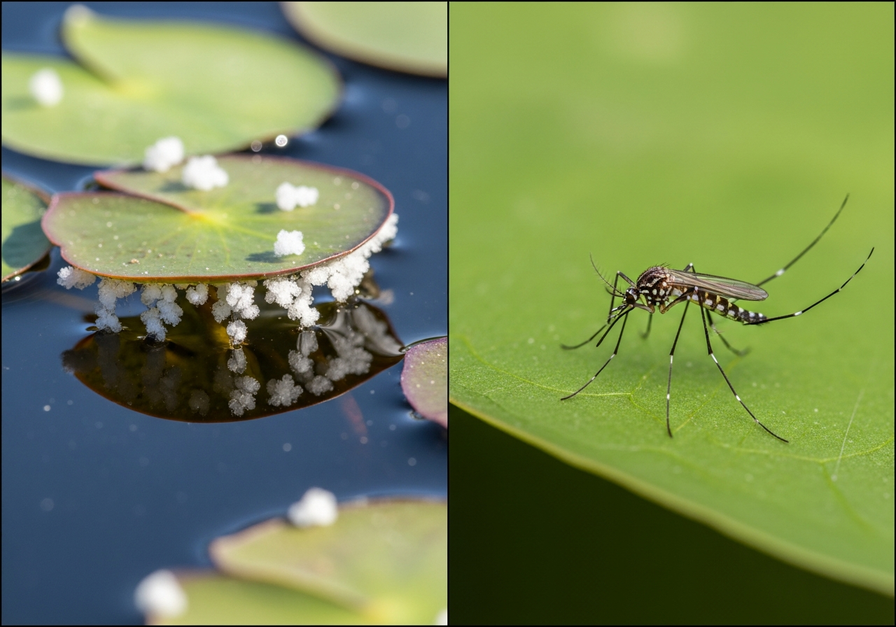
This composite image of a mosquito breeding site highlights the key R-selected traits of small body size, short lifespan, and rapid, prolific reproduction. It contrasts the tiny adult with the abundant eggs, showcasing their efficient life cycle.
Where Do R-selected Species Thrive? Opportunistic Colonizers
R-selected species are the pioneers of the natural world. They excel in environments that are unstable, unpredictable, or frequently disturbed. Think of areas like:
- Recently cleared forests
- Agricultural fields
- Temporary ponds
- Volcanic islands after an eruption
- Polluted waterways
In such places, the ability to quickly colonize, reproduce, and disperse is a huge advantage. They are often the first species to arrive, taking advantage of abundant resources before competitors or predators become established. Their rapid population growth allows them to quickly exploit new opportunities.
Examples of R-selected Species
- Insects: Mosquitoes, flies, aphids, many beetles
- Plants: Dandelions, thistles, many annual weeds
- Microorganisms: Bacteria, viruses
- Fish: Many small fish species, like guppies or minnows
- Amphibians: Many frog and toad species
- Rodents: Mice, rats (known for their rapid breeding)
The Ecological Importance of R-selected Species
Despite their often overlooked status, R-selected species are indispensable to healthy ecosystems. Their roles include:
- Pioneer Colonizers: They are crucial for ecological succession, being the first to inhabit and stabilize disturbed areas, paving the way for other species.
- Food Sources: Their sheer numbers make them a vital food source for a wide array of predators, from birds and fish to larger mammals.
- Nutrient Cycling: Many R-selected organisms, particularly bacteria and insects, play critical roles in decomposition and nutrient cycling, breaking down organic matter and returning vital elements to the soil.
- Pollination and Seed Dispersal: Many R-selected plants rely on insects for pollination, and their seeds are often dispersed by wind or animals, contributing to plant diversity.
- Indicators of Environmental Change: Their rapid life cycles and sensitivity to environmental shifts can make them useful indicators of ecosystem health.
R-selection Versus K-selection: A Deeper Look
While R-selected species thrive on quantity and speed, their counterparts, K-selected species, adopt a different strategy. K-selected species are characterized by traits that are advantageous in stable, predictable environments where populations are near the carrying capacity (‘K’) of the environment. They invest heavily in fewer, higher quality offspring, providing extensive parental care and having longer lifespans.
It is important to remember that R- and K-selection represent two ends of a continuum, not strict categories. Many species exhibit a mix of traits, leaning more towards one strategy than the other depending on their specific ecological niche and environmental pressures.
Here is a comparison of the general characteristics:
| Characteristic | R-selected Species | K-selected Species |
| Reproductive Rate | High, many offspring | Low, few offspring |
| Lifespan | Short | Long |
| Body Size | Small | Large |
| Maturation Time | Rapid | Slow |
| Parental Care | Little to none | Extensive |
| Population Growth | Rapid, often exponential | Slow, logistic |
| Habitat Stability | Unstable, unpredictable | Stable, predictable |
| Competitive Ability | Poor | Strong |
| Examples | Insects, weeds, bacteria | Elephants, whales, humans, oak trees |
Challenges and Adaptations of R-selected Life
Life as an R-selected species is not without its challenges. The high reproductive rate is often balanced by extremely high mortality rates among offspring. Environmental fluctuations, predation, and disease can wipe out entire generations. However, their rapid generation times also allow for quick evolutionary adaptation. If a new environmental pressure arises, a large population with short generations can evolve resistance or new strategies much faster than a slow reproducing, K-selected species.
This adaptability makes them incredibly resilient in the face of change, ensuring their continued presence in a dynamic world. They are the ultimate survivors, not through strength or longevity, but through sheer numbers and an unwavering commitment to reproduction.
Conclusion: The Unsung Heroes of Ecosystems
R-selected species, with their “live fast, die young, and make lots of babies” approach, are far more than just pests or weeds. They are fundamental architects of ecological succession, vital links in food webs, and powerful engines of adaptation. Their strategy of prolific reproduction and rapid dispersal allows them to exploit transient resources and colonize new territories, ensuring life persists even in the most challenging and unpredictable environments. By understanding these fascinating organisms, we gain a deeper appreciation for the intricate and diverse strategies that drive life on Earth.