Imagine a bustling city where everyone needs the same job, the same food, and the same apartment. Chaos would ensue, right? Nature faces a similar challenge: how do countless species coexist in the same environment without constantly clashing over limited resources? The answer lies in a fundamental ecological principle known as niche partitioning.
Niche partitioning is nature’s elegant solution to the problem of competition, allowing a rich tapestry of life to thrive side-by-side. It is a cornerstone of biodiversity, explaining why a single forest can host hundreds of different plant and animal species, each finding its own unique way to make a living.
Understanding the Ecological Niche
Before diving into partitioning, it is crucial to grasp the concept of an ecological niche. An organism’s niche is far more than just its habitat; it is its entire role in the ecosystem. Think of it as a species’ profession, including:
- The resources it consumes (food, water, nutrients).
- The space it occupies (habitat, nesting sites).
- The time of day or year it is active.
- Its interactions with other species (predators, prey, competitors).
- The physical and chemical conditions it can tolerate (temperature, pH).
Essentially, a niche describes how a species lives, what it needs, and how it impacts its environment.
The Shadow of Competitive Exclusion
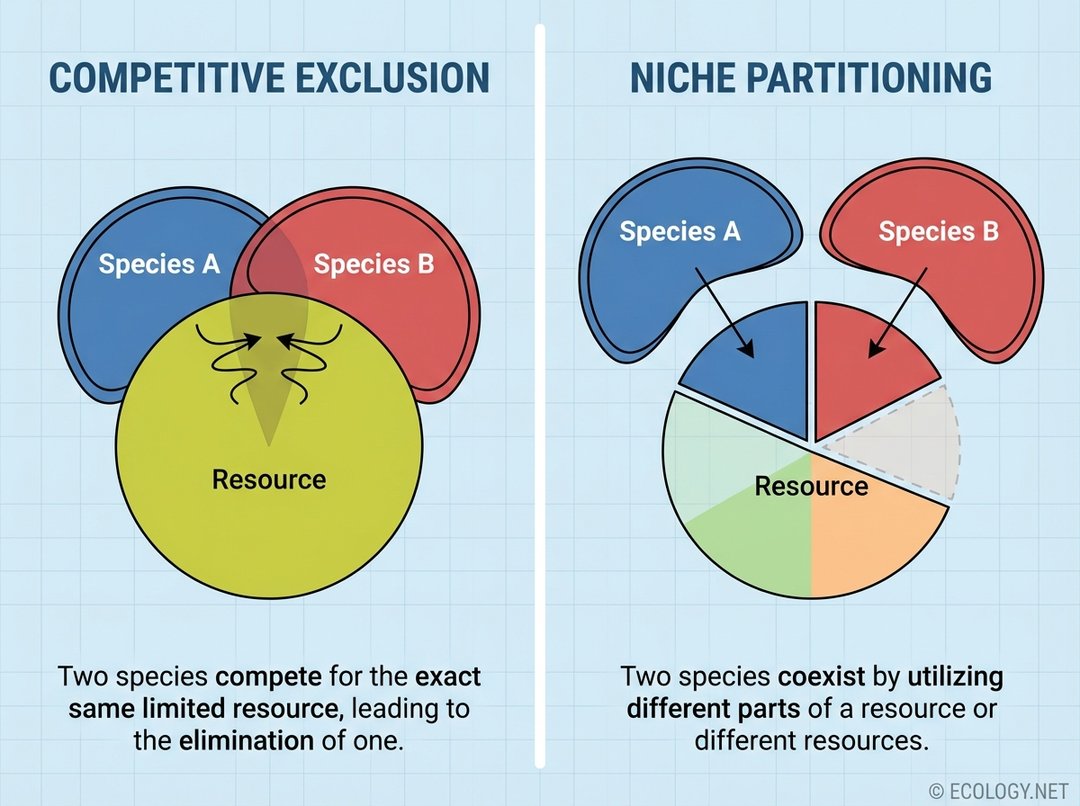
When two species attempt to occupy the exact same niche, they inevitably enter into direct competition. This intense rivalry often leads to a phenomenon known as the Competitive Exclusion Principle, also called Gause’s Law. This principle states that two species competing for the same limiting resource cannot coexist indefinitely. One species will eventually outcompete the other, leading to the exclusion or local extinction of the less successful competitor.
However, nature is full of examples of species that seem to share habitats and resources. This apparent contradiction is resolved by niche partitioning.
How Niche Partitioning Works: The Art of Coexistence
Niche partitioning is the process by which competing species use the environment differently in a way that allows them to coexist. Instead of direct, head-to-head competition, species evolve or adapt to utilize different aspects of a shared resource or habitat. This division reduces the overlap in their ecological niches, thereby minimizing competition and enabling multiple species to thrive in the same general area.
The beauty of niche partitioning lies in its subtlety and variety. Species find myriad ways to carve out their own unique space, often through evolutionary adaptations that favor specialized resource use. This can involve changes in morphology, behavior, or life history strategies.
Types of Niche Partitioning: Examples in Action
Niche partitioning manifests in several distinct forms, each offering a fascinating glimpse into the intricate strategies species employ to coexist.
Spatial Partitioning
Perhaps the most straightforward form of partitioning, spatial partitioning involves species using different physical areas or microhabitats within a larger environment. Even within a single tree or rock formation, different species can find their own unique zones.
A classic example involves several species of warblers in spruce forests of North America. Though they all feed on insects in the same trees, each warbler species tends to forage in a specific part of the tree canopy. One might prefer the upper, outer branches, another the mid-canopy, and a third the lower, inner branches near the trunk. This spatial separation reduces direct competition for food resources.

Dietary or Resource Partitioning
This type of partitioning occurs when species consume different types of food or utilize different parts of a food resource. Even if they eat the “same” general food, they might specialize in different sizes, species, or stages of that food.
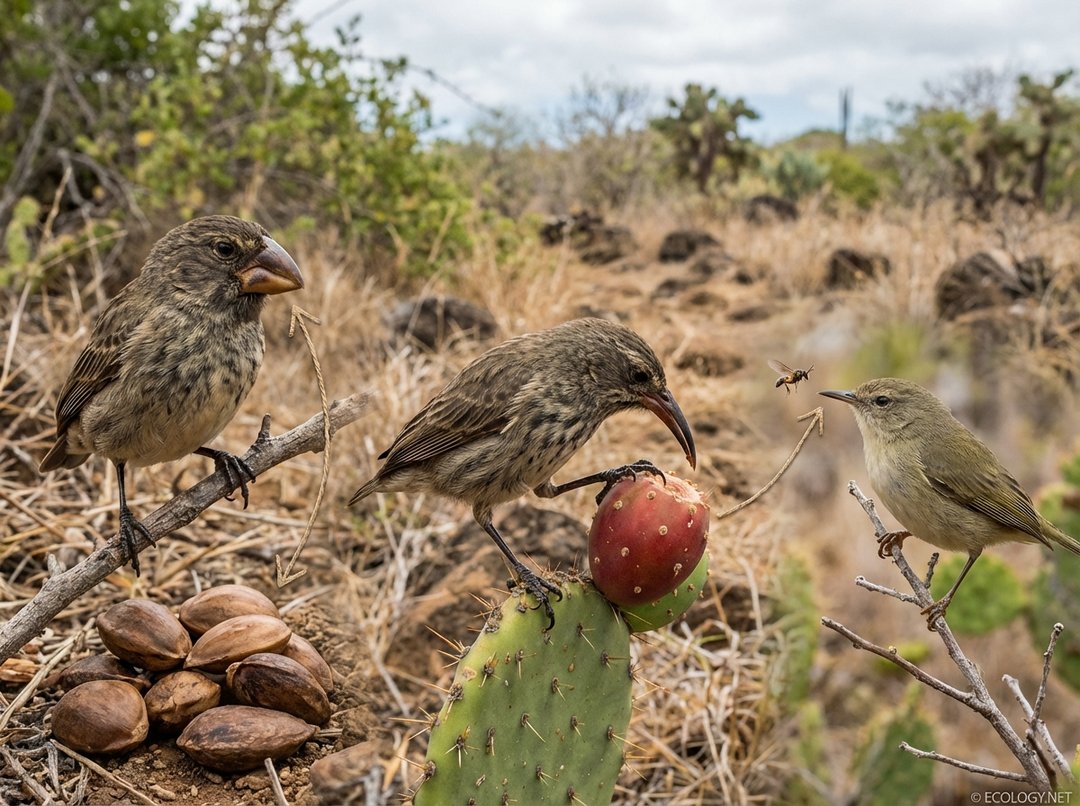
The iconic Darwin’s Finches of the Galápagos Islands provide a compelling illustration. While all are finches, different species have evolved distinct beak shapes and sizes, allowing them to specialize in different food sources:
- Large Ground Finches with robust beaks are adept at cracking open large, hard seeds.
- Cactus Finches possess longer, pointed beaks perfect for probing cactus flowers and fruits.
- Warbler Finches have slender beaks, ideal for gleaning insects from foliage.
This specialization in diet, facilitated by morphological differences, allows multiple finch species to coexist on the same islands.
Temporal Partitioning
Temporal partitioning involves species using the same resources or habitats but at different times. This can be on a daily cycle, seasonal cycle, or even across different life stages.
- Daily Cycles: Many predators, such as owls and hawks, hunt the same prey species but at different times of the day. Owls are nocturnal, while hawks are diurnal, effectively dividing the hunting “shift.”
- Seasonal Cycles: Different plant species in a meadow might flower and produce seeds at different times of the year, reducing competition for pollinators and nutrients.
- Life Stages: The larval and adult stages of many insects, like butterflies, often occupy completely different niches, consuming different foods and living in different environments, thus avoiding intraspecific competition.
Morphological Partitioning
Closely linked with dietary partitioning, morphological partitioning refers to differences in body structure or size that enable species to access different resources. The varied beaks of Darwin’s Finches are a prime example. Other instances include:
- Different leg lengths in wading birds, allowing them to forage in different water depths.
- Varying body sizes among predatory species, enabling them to target different sizes of prey.
Behavioral Partitioning
Species can also partition niches through differences in their behavior or foraging strategies. Even if two species are in the same area and eat similar food, how they obtain that food can differ significantly.
- Some insectivorous birds might glean insects from leaves, while others might hawk them from the air, and still others might probe bark crevices.
- Different species of deer might have distinct browsing preferences, selecting different plant species or parts of plants.
The Ecological Significance of Niche Partitioning
Niche partitioning is not merely an interesting biological phenomenon; it is a fundamental driver of ecological processes and biodiversity.
Maintaining Biodiversity
By allowing multiple species to coexist, niche partitioning directly contributes to the high levels of biodiversity observed in many ecosystems. Without it, competitive exclusion would lead to a much simpler, less diverse world.
Ecosystem Stability
Diverse ecosystems, often facilitated by niche partitioning, tend to be more stable and resilient to disturbances. If one species is affected by a change, others can often fill its role or adapt, preventing a complete collapse of the ecosystem.
Driving Evolution
The pressure to reduce competition through niche partitioning is a powerful evolutionary force. Over generations, species can evolve specialized traits, behaviors, or life histories that allow them to utilize resources more efficiently and avoid direct competition. This can lead to character displacement, where differences between similar species are accentuated in areas where they coexist.
Niche Partitioning in the Real World: Beyond the Textbook
The principles of niche partitioning extend far beyond classic examples. Understanding it is crucial for conservation efforts, especially in fragmented or human-modified landscapes. When habitats are reduced or resources become scarcer, the delicate balance of niche partitioning can be disrupted, leading to increased competition and potential species loss.
For instance, the introduction of invasive species often leads to competitive exclusion because the invader may occupy a niche that overlaps significantly with native species, without having co-evolved mechanisms for partitioning. Similarly, climate change can alter resource availability or timing, forcing species into greater competitive overlap.
Ecologists study niche partitioning to predict how ecosystems will respond to environmental changes, to design effective conservation strategies, and to understand the complex web of life that sustains our planet.
Conclusion
Niche partitioning is a testament to nature’s ingenuity. It is the elegant dance of coexistence, where competition, rather than leading to exclusion, often drives diversification and specialization. From the warblers in a spruce tree to the finches of the Galápagos, species have found countless ways to divide and conquer the challenges of shared resources, creating the rich, vibrant, and resilient ecosystems that define our world. Understanding this intricate ecological ballet is key to appreciating the complexity of life and our role in preserving its delicate balance.