Understanding Ecological Disturbance: Nature’s Reshaping Force
Ecosystems are dynamic, ever-changing tapestries of life, constantly adapting to a variety of influences. Among the most powerful of these influences is what ecologists call “disturbance.” Far from being merely destructive, ecological disturbance is a fundamental process that shapes landscapes, drives evolution, and maintains the incredible biodiversity we see across the planet. It is a concept central to understanding how nature functions and how resilient life truly is.
What Exactly is an Ecological Disturbance?
At its core, an ecological disturbance is any discrete event in time that disrupts an ecosystem, community, or population structure, changing resource availability or the physical environment. These events can vary immensely in scale, intensity, and frequency, from a single tree falling in a forest to a continent-spanning volcanic eruption. The key is that they alter the existing conditions, often initiating a cascade of changes.
Ecological disturbances are broadly categorized into two main types:
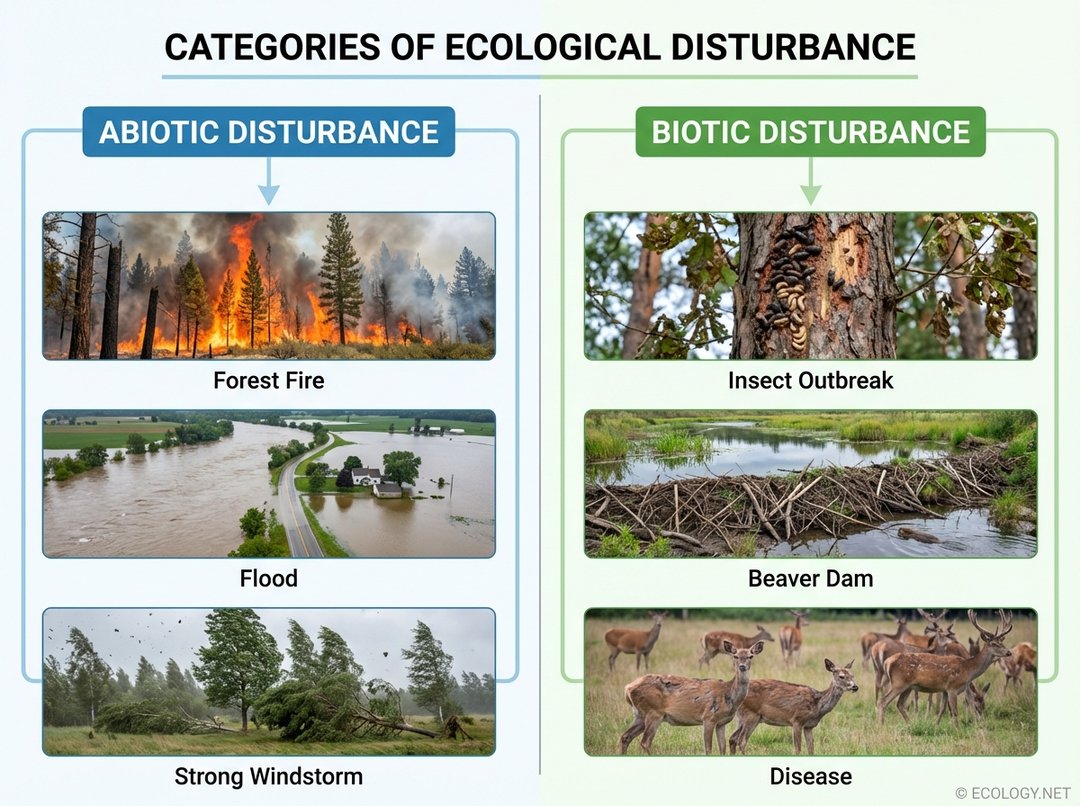
This image visually introduces the two primary classifications of ecological disturbances discussed in the article, providing concrete examples for each, making the initial definitions clearer and more engaging.
- Abiotic Disturbances: These are non-living, physical events. They are often driven by geological or climatic forces.
- Examples: Wildfires, floods, droughts, windstorms (like hurricanes or tornadoes), volcanic eruptions, earthquakes, landslides, and extreme temperature fluctuations.
- Biotic Disturbances: These disturbances are caused by living organisms.
Understanding these categories helps us appreciate the diverse array of forces that can reshape an ecosystem.
The Dual Nature of Disturbance: Destruction and Creation
It is easy to view disturbances solely through a lens of destruction. A wildfire can decimate a forest, a flood can wipe out riverside communities, and a disease can devastate a population. Indeed, disturbances often result in immediate loss of life, habitat, and resources. However, this perspective only tells half the story. In ecology, disturbance is also a powerful creative force, essential for maintaining healthy, vibrant ecosystems.
Disturbances clear the slate, so to speak, creating opportunities for new life and new ecological pathways. They prevent any single species from dominating indefinitely, open up space and resources, and often reset the clock for ecological processes. This creative aspect is most clearly seen in the process of ecological succession.
Disturbance and Ecological Succession: Nature’s Rebuilding Process
One of the most profound impacts of disturbance is its role in initiating ecological succession. Succession is the gradual process by which an ecosystem changes over time following a disturbance. It is nature’s way of rebuilding and reorganizing.
Consider a forest after a major wildfire. While the immediate aftermath appears barren, it is actually a fertile ground for new beginnings.
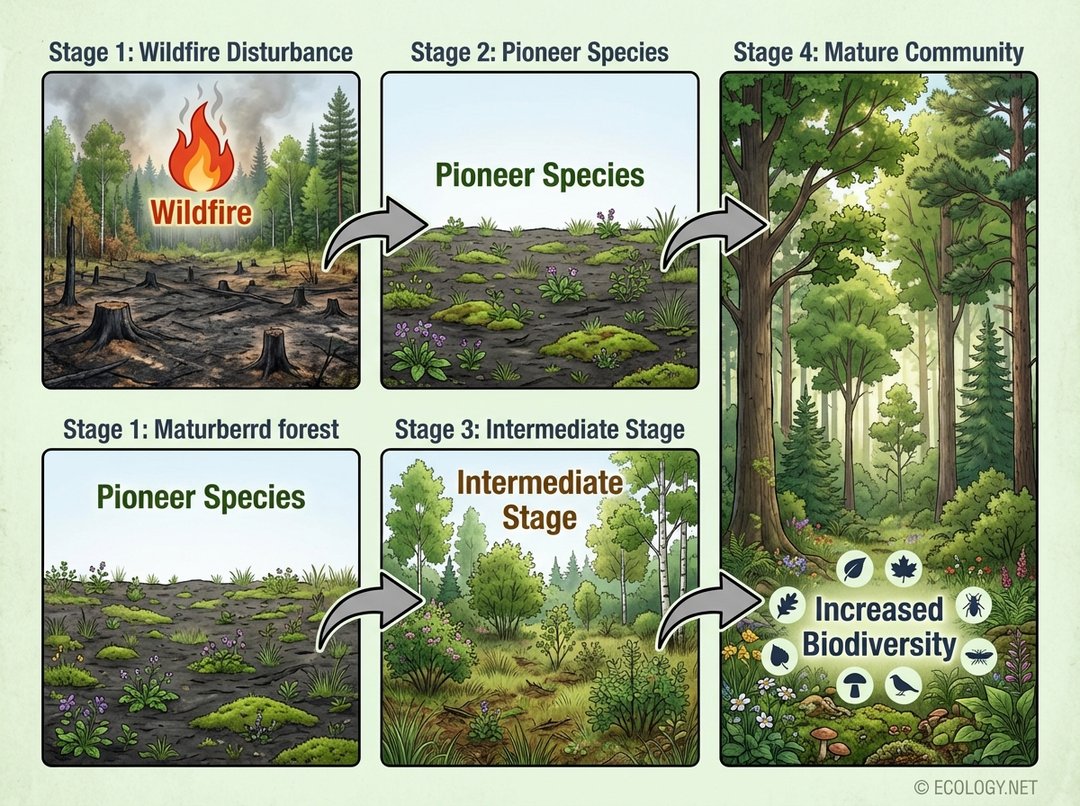
This image illustrates how disturbance is a “creative force” by visually explaining ecological succession, one of the key roles of disturbance in ecosystem dynamics, and how it leads to increased biodiversity.
The process typically unfolds in stages:
- Initial Disturbance: An event like a wildfire clears a significant area, removing existing vegetation and altering soil conditions.
- Pioneer Species: The first organisms to colonize the disturbed area are called pioneer species. These are often hardy, fast-growing plants like grasses, weeds, and mosses that can tolerate harsh conditions and poor soil. They begin to stabilize the soil and add organic matter.
- Intermediate Stage: As pioneer species establish, they create conditions suitable for other species. Shrubs and fast-growing trees begin to appear, outcompeting the pioneers. This stage sees an increase in structural complexity and a wider variety of animal life.
- Climax or Mature Community: Over many decades or even centuries, the ecosystem progresses towards a more stable, complex, and diverse community, often referred to as a mature or climax community. This stage is characterized by larger, longer-lived trees, a rich understory, and a high level of biodiversity.
This journey from bare ground to a mature ecosystem highlights how disturbance, far from being purely destructive, is a vital catalyst for renewal and increased biodiversity. It ensures that ecosystems do not become stagnant, constantly creating new niches and opportunities for different species to thrive.
The Intermediate Disturbance Hypothesis: Finding the Sweet Spot for Biodiversity
The relationship between disturbance and biodiversity is not linear. Too little disturbance can lead to a few dominant species monopolizing resources, reducing overall diversity. Too much disturbance can repeatedly reset the ecosystem, preventing species from establishing and maturing, also leading to low diversity. This intriguing concept is captured by the Intermediate Disturbance Hypothesis (IDH).
The Intermediate Disturbance Hypothesis posits that local species diversity is maximized when ecological disturbances are neither too rare nor too frequent, and neither too low nor too high in intensity.
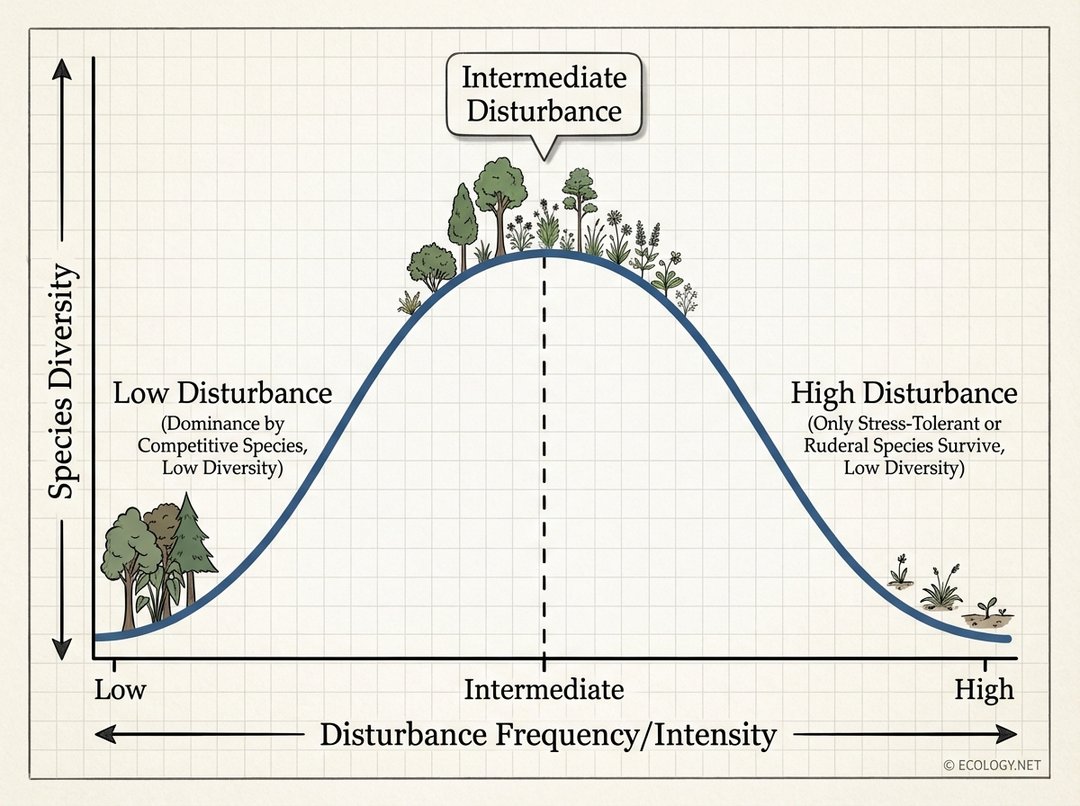
This image visually represents the “Intermediate Disturbance Hypothesis,” a crucial theoretical concept explained in the article, which posits that ecosystems achieve maximum biodiversity at intermediate levels of disturbance frequency and intensity.
Here is how it works:
- Low Disturbance: In environments with very infrequent or low-intensity disturbances, competitive exclusion tends to occur. A few highly competitive species dominate, outcompeting and eliminating less competitive species, leading to lower overall species diversity.
- High Disturbance: Conversely, in environments with very frequent or high-intensity disturbances, only a few highly tolerant, fast-reproducing species can survive. Most species are unable to establish or complete their life cycles before the next disturbance hits, resulting in low species diversity.
- Intermediate Disturbance: At intermediate levels of disturbance, a balance is struck. Disturbances are frequent enough to prevent competitive exclusion by dominant species, creating open niches and resources. However, they are not so frequent or intense that they eliminate most species. This allows a wide array of species, including both early colonizers and later successional species, to coexist, leading to the highest levels of biodiversity.
This hypothesis has been observed in various ecosystems, from coral reefs to grasslands and forests, providing a powerful framework for understanding and managing biodiversity.
Examples of Disturbance and Their Ecological Impacts
To truly grasp the significance of disturbance, it is helpful to look at specific examples:
- Wildfires: In many forest types, such as pine forests, fire is a natural and necessary disturbance. It clears out underbrush, recycles nutrients into the soil, and opens pine cones to release seeds. Some species, like the lodgepole pine, are even “serotinous,” meaning their cones only open to release seeds after being exposed to intense heat. Without fire, these forests can become overgrown, leading to more catastrophic, high-intensity fires when they eventually occur.
- Floods: Riverine ecosystems are profoundly shaped by periodic flooding. Floods deposit nutrient-rich sediments, create new channels and oxbow lakes, and maintain diverse wetland habitats. Many fish species rely on floodwaters for spawning, and riparian vegetation is adapted to these fluctuating water levels.
- Insect Outbreaks: While often perceived negatively, insect outbreaks, such as those of bark beetles in conifer forests, can act as natural thinning agents. They kill older or weaker trees, creating gaps in the canopy that allow sunlight to reach the forest floor, promoting the growth of new trees and understory plants. This process can increase structural diversity and create habitat for a wider range of wildlife.
- Volcanic Eruptions: These are extreme disturbances that can completely sterilize an area. However, they also create new landforms and expose fresh, nutrient-rich volcanic rock. The subsequent colonization of these barren landscapes by pioneer species, followed by a long process of primary succession, showcases nature’s incredible ability to reclaim and rebuild.
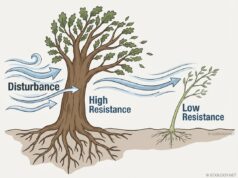
- Human-Induced Disturbances: While natural disturbances are often integral to ecosystem health, human-induced disturbances frequently differ in their scale, frequency, and nature. Logging, pollution, habitat fragmentation, and climate change can push ecosystems beyond their natural resilience, leading to long-term degradation and biodiversity loss. Understanding natural disturbance regimes is crucial for mitigating the negative impacts of human activities and for designing effective conservation strategies.
Conclusion: Embracing Nature’s Dynamic Rhythm
Ecological disturbance is not merely an unfortunate event but a fundamental, often beneficial, process that underpins the health and diversity of our planet’s ecosystems. From the destructive roar of a wildfire to the quiet work of a beaver, these events reshape landscapes, drive succession, and create the conditions for life to flourish in new and exciting ways. By understanding the intricate dance between disturbance and resilience, we gain a deeper appreciation for the dynamic rhythm of nature and can better inform our efforts to conserve and manage the incredible biodiversity that surrounds us. Recognizing disturbance as a creative force, rather than solely a destructive one, is key to truly comprehending the complexity and enduring power of the natural world.