Connecting Nature’s Pathways: Understanding Corridor Design for Wildlife Conservation
The natural world is a tapestry of interconnected ecosystems, but human development often fragments this intricate web. Roads, cities, and agricultural fields carve up once continuous habitats, leaving wildlife isolated in shrinking patches. This isolation poses a grave threat to biodiversity, limiting species movement, reducing genetic diversity, and making populations vulnerable to local extinction. Fortunately, ecological science offers a powerful solution: corridor design. This vital conservation strategy focuses on creating or restoring pathways that link isolated habitats, allowing wildlife to move safely and freely across landscapes.
What Exactly is Corridor Design?
At its core, corridor design involves the strategic planning and implementation of linear landscape features that facilitate the movement of organisms between otherwise isolated habitat patches. Think of them as nature’s highways, providing safe passage for animals, plants, and even genetic material. These corridors can vary greatly in size, shape, and composition, from narrow strips of vegetation to elaborate engineered structures. Their primary goal is to maintain or restore ecological connectivity, ensuring that wildlife can access resources, find mates, and adapt to environmental changes.
Why Are Corridors So Critically Important?
The benefits of well-designed corridors are far reaching, impacting everything from individual species survival to ecosystem resilience.
- Facilitating Movement: Corridors allow animals to move between habitat patches to find food, water, shelter, and breeding grounds. Without them, species can become trapped in small areas, unable to access vital resources.
- Promoting Genetic Diversity: By enabling individuals from different populations to interbreed, corridors prevent inbreeding and maintain a healthy genetic pool. This genetic exchange is crucial for a species’ long term adaptability and survival.
- Supporting Population Viability: Connecting populations reduces the risk of local extinctions. If a natural disaster or disease impacts one small, isolated population, a connected network allows for recolonization from healthier populations.
- Adapting to Climate Change: As climates shift, species need to move to more suitable habitats. Corridors provide the necessary routes for these climate induced migrations, helping species track their preferred environmental conditions.
- Enhancing Ecosystem Services: Beyond wildlife, corridors can also support the movement of pollinators, facilitate seed dispersal, and contribute to broader ecosystem health, such as water filtration and soil stabilization.
Diverse Pathways: Exploring Types of Corridors
Corridor design is not a one size fits all solution. The type of corridor implemented depends heavily on the landscape, the target species, and the specific conservation goals.
Natural and Semi-Natural Corridors
These corridors leverage existing landscape features or restore degraded ones to create continuous habitat.
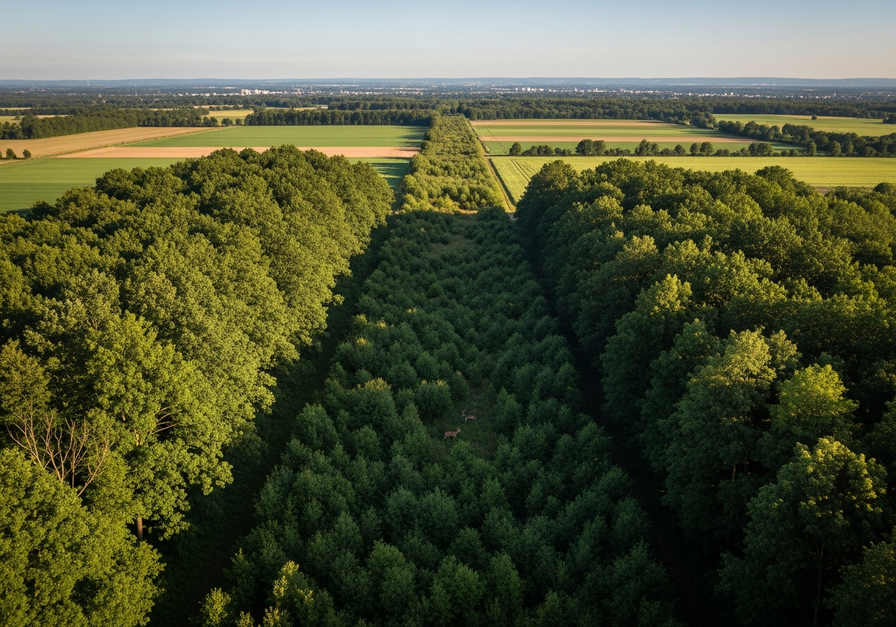
This image illustrates the concept of a forest corridor linking isolated habitat patches, visually emphasizing how such corridors mitigate isolation and support wildlife movement. A narrow strip of mature forest connects two larger, separate forest patches, with a small deer moving along its edge. The surrounding landscape shows developed farmland and a distant town, highlighting fragmentation.
- Forest Corridors: These are strips of woodland that connect larger forest blocks. They are crucial for forest dwelling species like deer, bears, and many bird species, allowing them to move between foraging areas and breeding sites.
- Riparian Corridors: Following rivers, streams, and wetlands, riparian corridors are incredibly rich in biodiversity. The water source itself, combined with the lush vegetation along its banks, creates a natural pathway for a vast array of species, from otters and beavers to migratory birds and amphibians.
- Hedgerows and Shelterbelts: In agricultural landscapes, hedgerows and lines of trees planted as windbreaks can serve as mini corridors, offering cover and movement routes for smaller mammals, insects, and birds between fields and remaining natural areas.
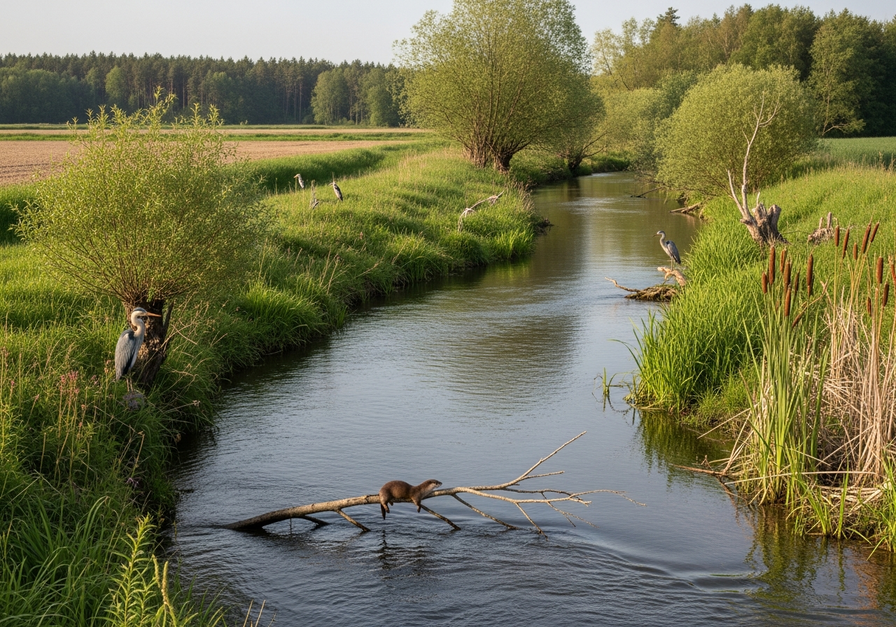
This photo shows a riparian corridor in situ, illustrating how watercourses serve as natural pathways that link isolated habitats and support diverse species, echoing the article’s description of corridor types. A gently flowing stream cuts through a mosaic of farmland and forested wetlands, its banks lined with willows and cattails, with an otter resting on a branch and birds nearby.
Engineered Corridors and Structures
In landscapes heavily altered by human infrastructure, natural corridors are often insufficient. Here, engineers and ecologists collaborate to build structures that allow wildlife to safely cross barriers.
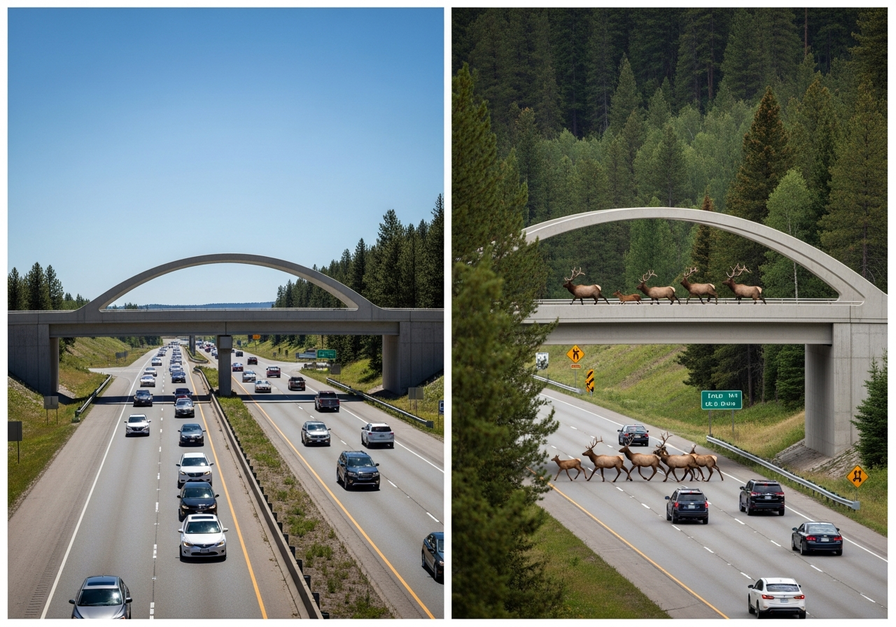
This split screen photo demonstrates how engineered structures like overpasses facilitate safe crossing of wildlife across road barriers, reinforcing the article’s discussion of corridor design in human dominated landscapes. The left panel shows a busy highway with an overpass, while the right panel shows elk crossing the overpass under natural forest cover.
- Wildlife Overpasses: These are bridges built over busy roads or highways, often vegetated to mimic natural terrain. They provide a safe crossing for large mammals like elk, bears, and even deer, significantly reducing wildlife vehicle collisions.
- Wildlife Underpasses: Tunnels or culverts built beneath roads serve a similar purpose, allowing smaller mammals, amphibians, and reptiles to pass safely without encountering traffic.
- Fish Ladders and Bypasses: Dams and other river obstructions can block fish migration. Fish ladders or bypass channels allow fish to navigate around these barriers, ensuring they can reach spawning grounds.
Stepping Stone Corridors
Sometimes, a continuous corridor is not feasible. In such cases, a series of smaller, isolated habitat patches, known as “stepping stones,” can serve as temporary refuges or resting points for species moving across a fragmented landscape. Imagine a series of small islands that a bird can hop between on a long journey.
Designing for Success: Principles of Effective Corridor Design
Creating a functional corridor requires careful planning and an understanding of ecological principles.
- Width Matters: Generally, wider corridors are more effective. They offer more interior habitat, greater protection from edge effects (such as noise, light, and predation from surrounding disturbed areas), and can support a wider range of species.
- Length and Connectivity: Corridors must be long enough to connect the target habitat patches and provide a viable route. The quality of the habitat within the corridor itself is also crucial; it should offer adequate food, water, and cover.
- Habitat Quality: A corridor is only as good as the habitat it contains. It should be composed of native vegetation, free from invasive species, and minimize human disturbance.
- Minimizing Barriers: Even within a corridor, internal barriers like fences or small roads can impede movement. Design should aim to remove or mitigate these obstacles.
- Target Species Consideration: The design should be tailored to the specific needs of the species it aims to benefit. A corridor for small rodents will look very different from one designed for large carnivores.
- Long Term Management: Corridors require ongoing maintenance, including invasive species control, habitat restoration, and monitoring to ensure their effectiveness.
Challenges and Future Directions in Corridor Design
While immensely beneficial, corridor design is not without its challenges. Land acquisition can be costly and complex, especially in developed areas. There are also ecological considerations, such as the potential for corridors to facilitate the spread of disease or invasive species between populations. Careful planning and monitoring are essential to mitigate these risks.
As human populations continue to grow and climate change accelerates, the importance of ecological connectivity will only increase. Corridor design is a dynamic field, constantly evolving with new research and technologies. From using remote sensing to identify optimal routes to employing genetic analysis to assess connectivity, ecologists and conservationists are continually refining their approaches to build a more connected and resilient natural world.
A Connected Future for Wildlife
Corridor design stands as a testament to our ability to mitigate the impacts of human development and foster a more harmonious coexistence with nature. By understanding and implementing these vital pathways, we can ensure that wildlife has the space to thrive, adapt, and continue to enrich our planet for generations to come. It is a proactive and hopeful approach to conservation, weaving together the fragmented pieces of our natural heritage into a stronger, more vibrant tapestry of life.