In the intricate tapestry of life, where survival often hinges on a razor’s edge, few strategies are as elegant and effective as camouflage. This remarkable adaptation allows organisms to blend seamlessly with their surroundings, becoming virtually invisible to predators or unsuspecting prey. Far from a simple trick, camouflage encompasses a dazzling array of techniques, each honed by countless generations of natural selection to perfect the art of disguise.
From the subtle patterns of a forest floor dweller to the dynamic transformations of a deep-sea marvel, understanding camouflage reveals the profound ingenuity of the natural world. It is a constant evolutionary arms race, a silent battle of wits and perception played out across every ecosystem on Earth.
The Fundamental Forms of Disguise
At its core, camouflage is about visual deception. Organisms employ various methods to achieve this, often combining several techniques for maximum effect. Three primary categories lay the groundwork for understanding this fascinating phenomenon.
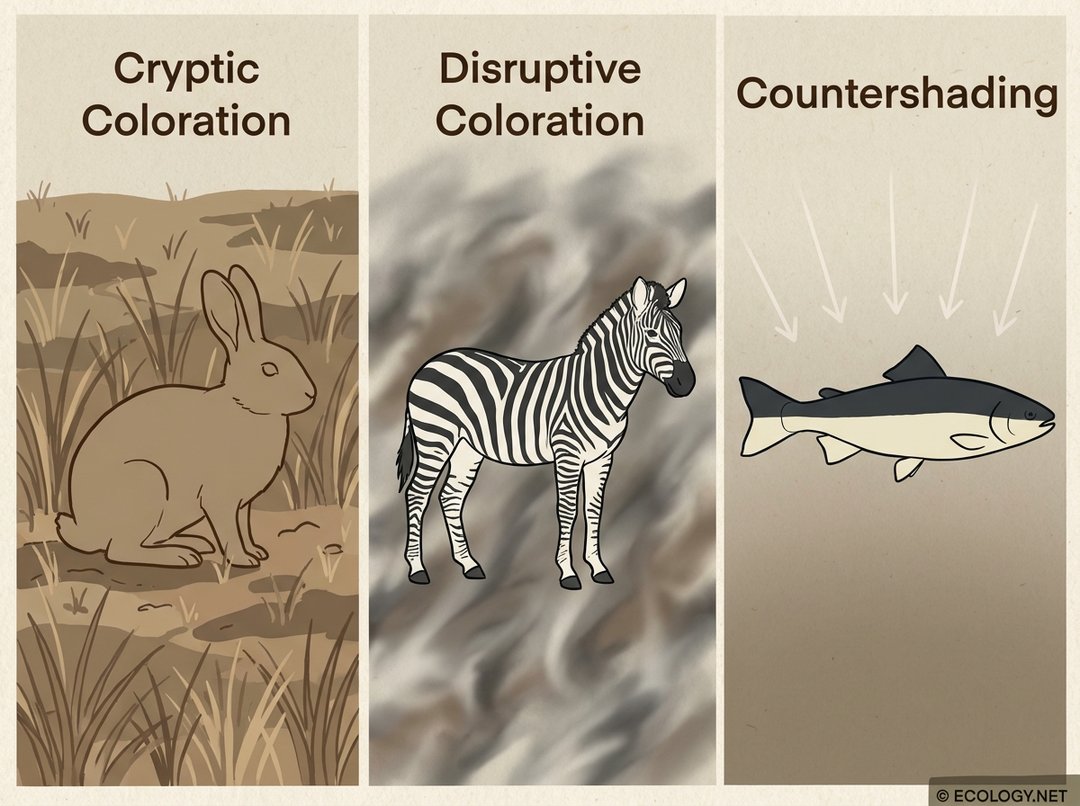
Cryptic Coloration: Blending In
Perhaps the most intuitive form of camouflage, cryptic coloration involves an animal’s colors and patterns matching its background. This makes the organism difficult to detect when it remains still. Think of a snow leopard against a snowy mountain, or a chameleon changing its hue to match a leaf. The goal is to become part of the scenery, to disappear into the visual noise of the environment.
- Examples:
- The mottled brown and grey feathers of an owl allow it to vanish against tree bark.
- Many insects, like grasshoppers, are colored to match the vegetation they inhabit.
- Arctic foxes develop a white coat in winter to blend with snow.
Disruptive Coloration: Breaking Up the Outline
Instead of blending perfectly, disruptive coloration works by breaking up an animal’s body outline, making it harder for a predator to recognize its shape. Bold, contrasting patterns, often stripes or spots, achieve this by drawing the eye away from the creature’s true form. When multiple animals with disruptive patterns group together, the effect is amplified, creating a confusing visual spectacle.
- Examples:
- The iconic stripes of a zebra, which make it difficult for predators like lions to single out an individual in a herd.
- Leopards and jaguars use their spots to break up their outline amidst dappled sunlight and foliage.
- Many fish species have vertical stripes that help them disappear among reeds or coral.
Countershading: The Art of Self-Shadowing
Countershading is a common form of camouflage where an animal’s upper surfaces are darker than its lower surfaces. This seemingly simple arrangement is a brilliant adaptation to the way light typically falls on an object. When light comes from above, it naturally illuminates the top of an animal and casts shadows on its underside. A uniformly colored animal would appear three-dimensional. However, with countershading, the darker top absorbs more light, and the lighter bottom reflects more light, effectively flattening the animal’s appearance and making it blend into its surroundings.
- Examples:
- Most fish exhibit countershading, with dark backs and light bellies, making them harder to spot from both above and below.
- Deer and many other mammals have darker fur on their backs and lighter fur on their undersides.
- Penguins, with their black backs and white bellies, are countershaded for life in the water.
These fundamental types of camouflage are often combined and refined, forming the basis for more complex strategies.
Beyond Simple Blending: Masquerade and Mimicry
While the basic forms of camouflage aim to make an organism disappear, some strategies take deception to an entirely new level, not just hiding the animal, but making it appear to be something else entirely.
Masquerade: Posing as an Object
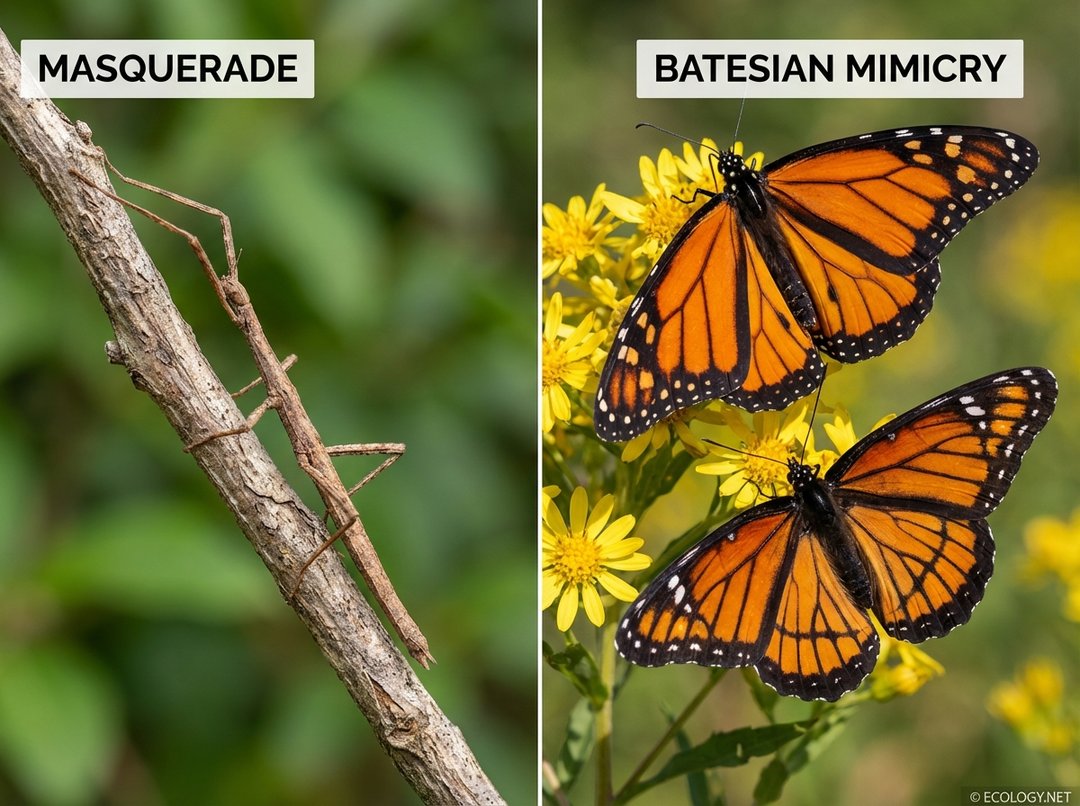
Masquerade is a specialized form of camouflage where an animal not only blends in but actively resembles an inanimate object or a non-food item in its environment. This requires not just matching colors and patterns, but also adopting specific shapes, textures, and behaviors to complete the illusion. The goal is to be seen, but not recognized as prey.
- Examples:
- Stick insects are masters of masquerade, perfectly mimicking twigs and branches, even swaying gently to simulate movement in the wind.
- Leaf insects resemble leaves, complete with veins and even bite marks.
- Some caterpillars mimic bird droppings, an unappetizing sight for many predators.
Mimicry: Impersonating Another Organism
Mimicry involves one species evolving to resemble another species, often to gain protection from predators. This is a powerful evolutionary strategy that leverages the existing defenses or unpalatability of another organism.
- Batesian Mimicry: In this form, a harmless species evolves to imitate a harmful or unpalatable species. Predators that have learned to avoid the dangerous model will also avoid the harmless mimic, even though the mimic lacks the actual defense.
- Examples:
- The viceroy butterfly, which is palatable to birds, closely resembles the monarch butterfly, which is toxic. Birds that have had a bad experience with monarchs will avoid viceroys.
- Many hoverflies, which are harmless, have evolved black and yellow stripes that mimic the warning coloration of stinging wasps and bees.
- Examples:
- Müllerian Mimicry: Here, two or more unpalatable or dangerous species evolve to resemble each other. This benefits all involved species because predators only need to learn to avoid one pattern to avoid all of them, reinforcing the warning signal more quickly.
- Examples:
- Various species of stinging bees and wasps often share similar black and yellow striped patterns.
- Several species of poisonous dart frogs in different regions can share similar bright warning colors.
- Examples:
Advanced Camouflage Techniques: The Cutting Edge of Deception
As we delve deeper into the natural world, we encounter camouflage strategies that push the boundaries of biological possibility, often involving dynamic changes or the manipulation of light itself.
Active Camouflage: The Masters of Transformation
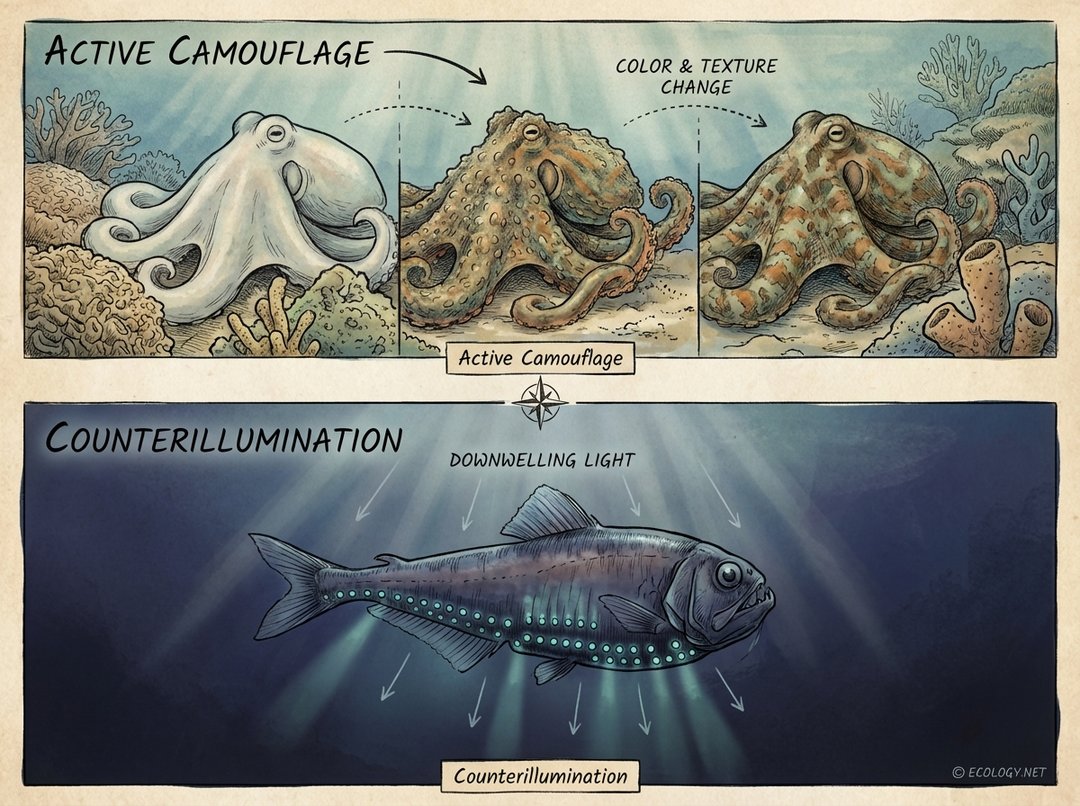
Active camouflage, also known as dynamic camouflage, refers to the ability of an animal to rapidly change its skin color, pattern, and even texture to match its immediate surroundings. This incredible feat is achieved through specialized pigment-containing cells called chromatophores, which can expand or contract in response to nerve signals. This allows for instantaneous blending, even as the animal moves across varied backgrounds.
- Examples:
- Octopuses, cuttlefish, and squids (cephalopods) are the undisputed champions of active camouflage. They can change their appearance in fractions of a second, mimicking rocks, sand, or even other animals.
- Some chameleons can also change their skin patterns and colors, though typically at a slower rate than cephalopods.
- Certain flatfish, like flounders, can adjust their skin patterns to match the seafloor.
Counterillumination: Hiding with Light
In the vast, dark expanse of the deep ocean, where sunlight barely penetrates, traditional countershading becomes less effective. Here, some organisms have evolved an astonishing form of camouflage called counterillumination. This involves producing light from their undersides, using specialized organs called photophores, to match the faint downwelling light from the surface. By emitting light of the same intensity and wavelength as the ambient light, they effectively eliminate their silhouette, making them invisible to predators looking up from below.
- Examples:
- Many deep-sea squid and fish species, such as the midshipman fish, use counterillumination to hide from predators.
- Some bioluminescent plankton also contribute to the ambient light, making this strategy even more effective for larger organisms.
The Evolutionary Arms Race: A Constant Battle
The development of camouflage is not a static achievement but a dynamic process driven by an ongoing evolutionary arms race. As prey species evolve more sophisticated ways to hide, predators simultaneously develop keener senses, sharper eyesight, or more cunning hunting strategies to detect them. This constant pressure pushes both sides to innovate, leading to ever more elaborate and effective forms of disguise and detection.
For instance, a bird that learns to spot a cryptic insect will exert selective pressure on that insect population, favoring individuals with even better blending abilities. Similarly, an octopus that can perfectly mimic its surroundings will be more successful, passing on its genes for advanced chromatophore control. This continuous cycle ensures that the art of camouflage remains one of nature’s most captivating and ever-evolving spectacles.
Conclusion: The Unseen Wonders of Nature
Camouflage is far more than just blending in; it is a testament to the boundless creativity of evolution. From the simple stripes of a zebra to the instantaneous transformations of an octopus and the light-bending magic of deep-sea creatures, these strategies highlight the relentless pursuit of survival in every corner of the planet. By understanding the diverse forms of camouflage, one gains a deeper appreciation for the intricate relationships between species and the subtle, yet profound, ways life adapts to thrive. The next time a creature seems to vanish before your eyes, remember the incredible science behind its disappearance, a silent marvel of natural engineering.