Unmasking the Ecological Hero: Why Fire is Essential for Life on Earth
For many, the word “fire” conjures images of destruction, loss, and devastation. We are taught to fear wildfires, to extinguish them at all costs, and to see them as an enemy of nature. Yet, this perception, while understandable in the face of human tragedy, often overlooks a profound ecological truth: fire is not always a destroyer. In countless ecosystems across the globe, fire is a vital, life-giving force, a natural sculptor that shapes landscapes, fosters biodiversity, and ensures the health and resilience of the natural world. This understanding forms the core of fire ecology, a fascinating field that reveals fire’s indispensable role in the grand tapestry of life.
What is Fire Ecology?
Fire ecology is the scientific study of the origins of wildland fire, its relationship to living organisms, and its role in the environment. It explores how plants, animals, and entire ecosystems have evolved with and adapted to fire, and how fire influences ecological processes such as nutrient cycling, succession, and species distribution. Far from being an anomaly, fire is a fundamental component of many natural systems, acting as a powerful agent of change and renewal.
Fire as a Natural Process: A History Etched in Ash
Before human intervention, fires ignited naturally through lightning strikes, volcanic activity, or even spontaneous combustion. These natural fires have shaped landscapes for millions of years, creating a dynamic equilibrium where many species not only tolerate fire but actively depend on it for their survival. From the vast savannas of Africa to the towering forests of North America, fire has been a constant presence, a natural rhythm that dictates growth, decay, and rebirth.
The Ecological Benefits of Fire: A Catalyst for Life
The benefits of fire are multifaceted and crucial for maintaining healthy ecosystems. Understanding these roles helps us appreciate fire not as a destructive force, but as a necessary one.
Nutrient Cycling and Soil Enrichment
One of fire’s most immediate impacts is its role in nutrient cycling. When vegetation burns, organic matter is rapidly converted into ash, releasing essential nutrients like nitrogen, phosphorus, and potassium back into the soil. This sudden influx of readily available nutrients acts as a powerful fertilizer, stimulating a burst of new growth in the aftermath of a fire. Without periodic fires, nutrients can become locked up in dense layers of dead plant material, making them inaccessible to living plants.
Seed Germination and Forest Regeneration
For many plant species, fire is the key to reproduction. Some trees, like the iconic Californian sequoias, possess specialized cones known as serotinous cones. These cones are sealed with a resin that requires intense heat to melt, releasing their seeds only after a fire has passed. The ash-enriched soil and reduced competition from other plants provide an ideal environment for these new seedlings to thrive.
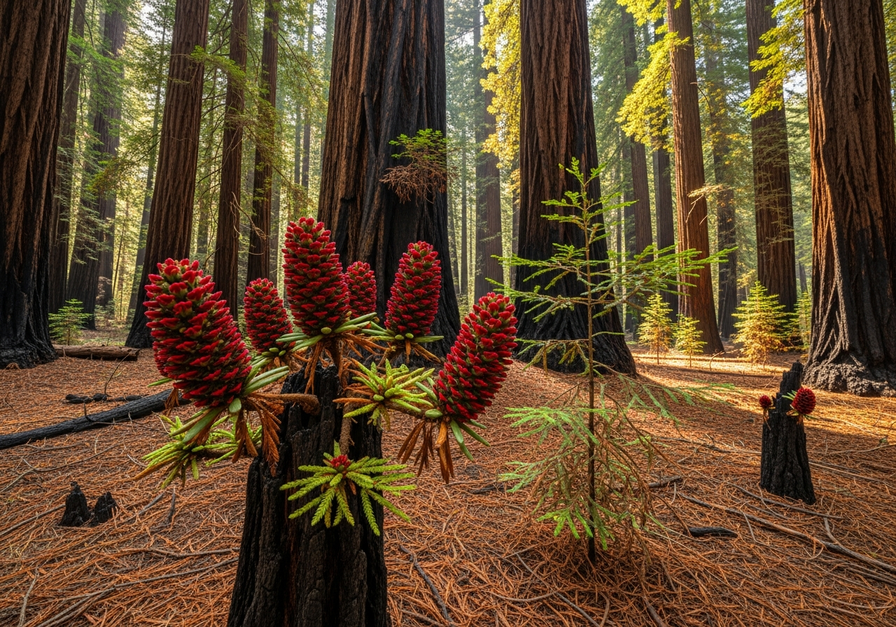
This image illustrates how fire is essential for sequoia reproduction and regeneration, highlighting the ecological benefit of serotinous cones and the rapid nutrient release that supports new growth. The towering redwood canopy remains largely intact, with the sun filtering through the gaps, while the forest floor is covered in orange ash and scorched needles, and fresh green sprouts emerge from the bark.
Other species have seeds that require smoke or heat scarification to break dormancy, ensuring that germination occurs precisely when conditions are most favorable for growth.
Maintaining Biodiversity and Preventing Shrub Encroachment
In many grassland and savanna ecosystems, frequent, low-intensity fires are crucial for maintaining an open landscape. These fires prevent the encroachment of woody shrubs and trees, preserving the habitat for a diverse array of grasses and wildflowers. This creates a mosaic of different successional stages, supporting a wider variety of animal species that depend on specific vegetation structures.
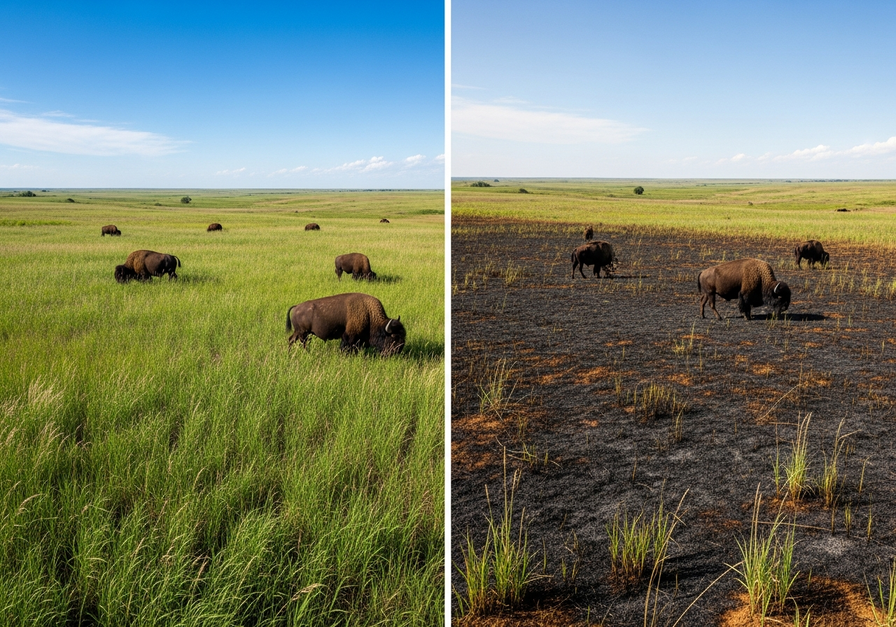
This image demonstrates how frequent, low-intensity fires maintain grassland biodiversity, prevent shrub encroachment, and stimulate nutrient cycling, creating a living mosaic of habitats. The left side shows a vibrant, unburned prairie with tall green grasses, while the right side shows the same prairie immediately after a low-intensity fire, with new green shoots already sprouting from the ash.
Pest and Disease Control
Fires can act as a natural sanitation agent, removing diseased or insect-infested trees and plants. By burning away dead and decaying biomass, fires can reduce populations of pests and pathogens, preventing their spread and promoting the health of the remaining vegetation. This natural thinning process also reduces competition for resources among surviving plants.
Fuel Reduction and Preventing Catastrophic Fires
Paradoxically, allowing natural, low-intensity fires to burn can prevent much larger, more destructive wildfires. By consuming accumulated dead leaves, needles, branches, and understory vegetation, these smaller fires reduce the “fuel load” in a forest. Without this natural thinning, fuel builds up over decades, leading to conditions ripe for extremely hot, fast-moving crown fires that can kill even fire-adapted trees and cause extensive damage.
Understanding Fire Regimes: Not All Fires Are Created Equal
The impact of fire on an ecosystem depends heavily on its “fire regime,” which describes the characteristic pattern of fire in a particular area. This includes factors such as:
- Frequency: How often fires occur.
- Intensity: The heat released by the fire.
- Severity: The impact of the fire on the ecosystem, particularly on soil and vegetation.
- Seasonality: The time of year fires typically occur.
- Size: The area affected by the fire.
Different ecosystems have evolved with distinct fire regimes.
- Low-Intensity, Frequent Fires: Common in grasslands and some pine forests, these fires burn quickly through undergrowth, leaving mature trees largely unharmed.
- High-Intensity, Infrequent Fires: Characteristic of boreal forests and some chaparral ecosystems, these fires can be stand-replacing, meaning they kill most of the mature trees, clearing the way for a new generation.
- Mixed-Severity Fires: These regimes involve a mosaic of low, moderate, and high-severity patches within a single fire event, creating diverse habitats.
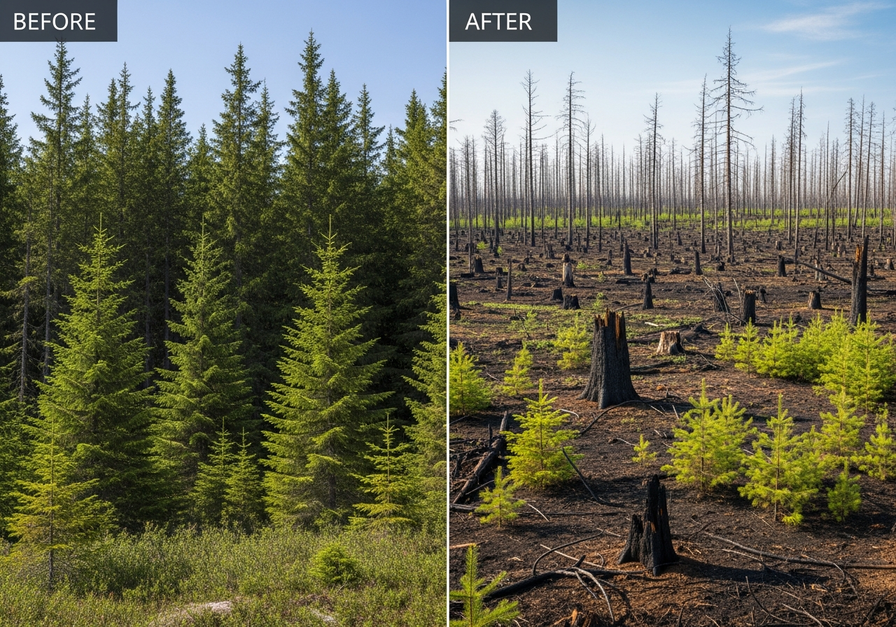
This image highlights how fire regimes create a heterogeneous patchwork that supports diverse species, influences carbon cycling, and drives post-fire succession in boreal ecosystems. The left side shows a dense, dark green spruce canopy, while the right side displays the burned area with charred stumps, open clearings, and patches of bright green saplings emerging from the ash.
Evolutionary Adaptations to Fire
The long history of fire has led to remarkable adaptations in plants and animals.
- Serotiny: As seen in sequoias and lodgepole pines, cones remain closed until heat from a fire triggers them to open and release seeds.
- Thick Bark: Trees like ponderosa pines and cork oaks have evolved thick, insulating bark that protects their vital cambium layer from the heat of low-intensity fires.
- Resprouting: Many shrubs and trees possess dormant buds beneath their bark or in their root crowns that can sprout rapidly after a fire, allowing the plant to quickly regenerate. Eucalyptus trees are famous for this ability.
- Fire-Stimulated Flowering: Some herbaceous plants and orchids only flower or produce seeds after a fire, taking advantage of the sudden nutrient flush and reduced competition.
- Fire-Resistant Seeds: Certain seeds have hard coats that are scarified by fire, allowing water to penetrate and initiate germination.
Animals also adapt. Some species, like certain beetles, are attracted to smoke and freshly burned wood, where they lay their eggs. Others, like deer and elk, benefit from the flush of nutritious new growth that appears after a fire.
Human Influence and the Future of Fire Ecology
For centuries, indigenous peoples around the world understood and utilized fire as a land management tool. They conducted controlled burns to clear underbrush, promote game animals, enhance agricultural productivity, and reduce the risk of destructive wildfires. However, with European settlement came a policy of aggressive fire suppression, driven by a fear of fire and a desire to protect timber resources.
This century-long policy of ” Smokey Bear” fire suppression has had unintended consequences. In many fire-adapted ecosystems, the absence of natural fires has led to an unnatural accumulation of fuel, creating conditions for increasingly severe and uncontrollable wildfires. Climate change further exacerbates this problem, with hotter temperatures, prolonged droughts, and altered weather patterns contributing to more frequent and intense fire seasons.
Today, fire ecology informs modern fire management strategies, emphasizing a shift from total suppression to a more nuanced approach that includes:
- Prescribed Burns: Deliberately set, carefully managed fires used to reduce fuel loads, restore ecological processes, and mimic natural fire regimes.
- Wildland Fire Use: Allowing naturally ignited fires to burn under specific conditions, within predetermined boundaries, to achieve ecological objectives.
- Fuel Treatments: Mechanical removal of vegetation to reduce fuel loads in areas where prescribed burning is not feasible or safe.
Understanding fire ecology is paramount for effective conservation and land management in a changing world. It challenges us to rethink our relationship with fire, moving beyond fear to embrace its essential role in maintaining the health and resilience of our planet’s diverse ecosystems. By learning to live with fire, rather than against it, we can foster healthier landscapes and mitigate the risks of catastrophic wildfires, ensuring a more sustainable future for both nature and humanity.