Unveiling Earth’s Grand Tapestry: The Latitudinal Diversity Gradient
Imagine a journey from the sweltering, vibrant heart of the Amazon rainforest to the icy, desolate expanses of the Arctic tundra. What striking differences would you observe? Beyond the obvious shifts in temperature and landscape, one profound pattern emerges: the sheer abundance and variety of life. This remarkable phenomenon, where biodiversity flourishes near the equator and steadily diminishes towards the poles, is known as the Latitudinal Diversity Gradient. It is one of ecology’s most fundamental and enduring observations, a testament to the intricate forces shaping life on Earth.
Understanding this gradient is not merely an academic exercise; it is crucial for comprehending how ecosystems function, how species evolve, and how we can best protect the planet’s invaluable biological heritage. Let us embark on an exploration of this fascinating ecological principle, from its basic definition to the complex mechanisms that drive it.
What is the Latitudinal Diversity Gradient?
At its core, the Latitudinal Diversity Gradient describes the consistent global pattern where the number of species, or species richness, is highest in tropical regions near the equator and progressively decreases as one moves towards higher latitudes, whether north or south. This pattern holds true for a vast array of life forms, from towering trees and delicate orchids to buzzing insects, colorful birds, and even microscopic organisms.
Think of it as a biological spectrum. The tropics, often bathed in consistent warmth and abundant rainfall, are teeming with an astonishing array of life. As you travel away from this equatorial belt, the climate becomes more variable, temperatures fluctuate more dramatically, and the overall richness of species begins to decline, reaching its lowest points in the harsh polar environments.
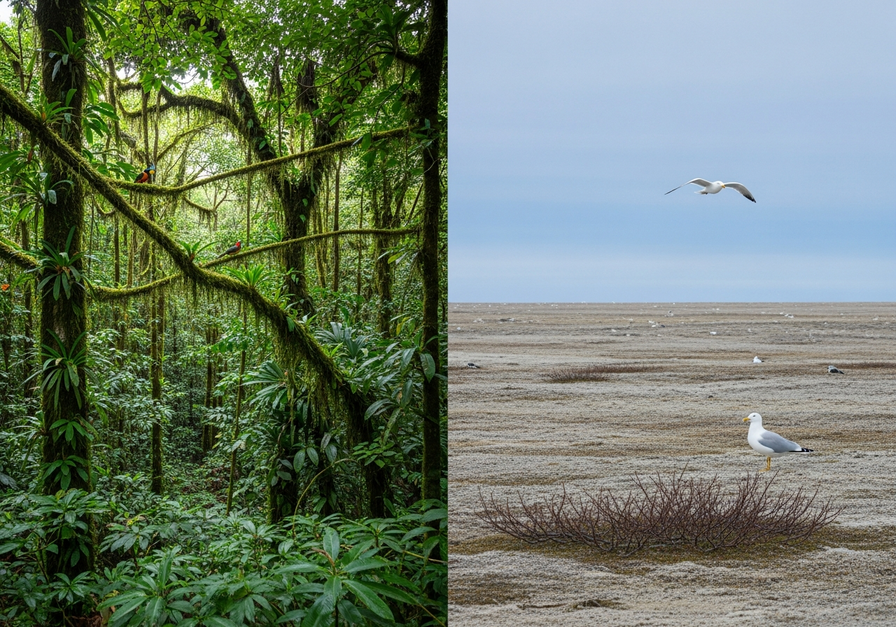
This image directly visualizes the core concept of the latitudinal diversity gradient by juxtaposing two extreme latitudes, reinforcing the article’s explanation of how biodiversity is highest near the equator and declines toward the poles.
Visualizing the Gradient: From Lush Tropics to Barren Poles
The most compelling way to grasp the Latitudinal Diversity Gradient is to see it. Consider the stark contrast between a tropical rainforest and a polar tundra. In a Costa Rican rainforest, every square meter bursts with life: towering trees draped in vines, bromeliads, and orchids; a dense understory of shrubs and ferns; and a cacophony of animal sounds from unseen creatures. A single tree can host hundreds of insect species, and a small patch of forest might contain more tree species than an entire temperate country.
Now, shift your gaze to the Arctic tundra. Here, the landscape is vast and open, dominated by low-growing mosses, lichens, and dwarf shrubs. Trees are absent, and the animal life, while specialized and resilient, is far less diverse. A solitary white-beaked gull might be one of the few signs of life against a pale sky. This dramatic visual difference is not an anomaly; it is the rule, powerfully illustrating the profound drop in species richness from the equator to the poles.
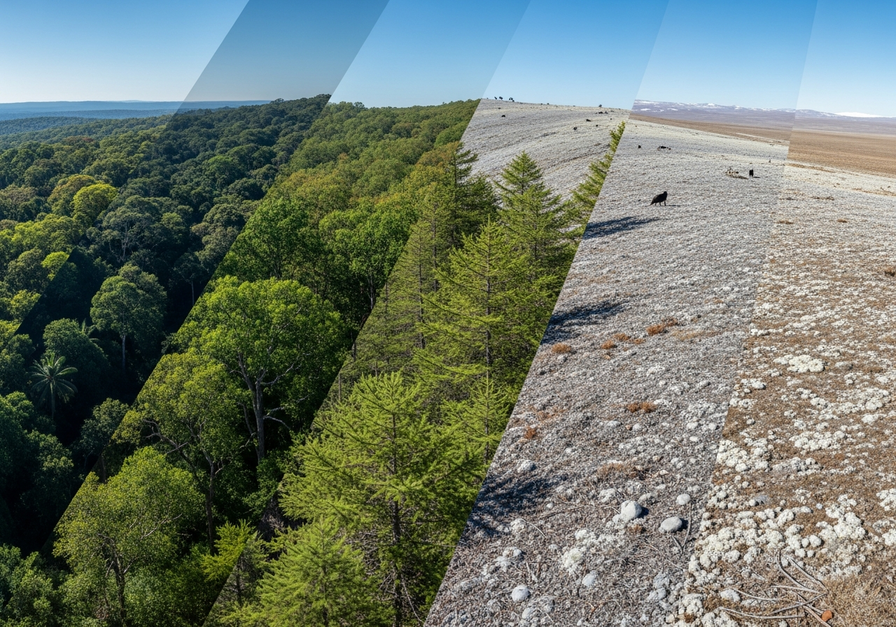
By presenting a continuous visual flow from tropical to polar environments, the photo embodies the article’s discussion of a steady decline in species richness with increasing latitude, allowing readers to see the gradient in a single, cohesive scene.
The Continuous Spectrum: A Gradual Decline
While the extremes offer a clear picture, the gradient is not a sudden drop but a continuous, gradual change. Imagine a panoramic view from a high vantage point, stretching across continents. You would observe a lush, dark green canopy of tropical rainforest slowly giving way to the vibrant greens of temperate deciduous forests, then transitioning to the needle-leafed conifers of boreal forests, and finally dissolving into the sparse, muted tones of the tundra. Each step along this latitudinal journey reveals a subtle but consistent reduction in vegetation density, the complexity of forest structure, and the overall variety of visible life.
This continuous visual flow underscores that the Latitudinal Diversity Gradient is a pervasive global pattern, not just a comparison of two isolated points. It is a fundamental organizing principle of life on Earth.
Why Does This Happen? Unraveling the Ecological Mysteries
The existence of the Latitudinal Diversity Gradient has puzzled and fascinated ecologists for centuries. While no single explanation fully accounts for it, a combination of interconnected ecological and evolutionary factors is believed to be at play. These mechanisms often reinforce each other, creating a powerful engine for biodiversity in the tropics.
Energy and Climate Stability
Perhaps the most intuitive explanation revolves around energy and climate. The tropics receive more direct and consistent solar radiation throughout the year. This translates into:
- Higher Primary Productivity: More sunlight means plants can photosynthesize more efficiently and for longer periods, leading to a greater abundance of biomass. This forms the base of the food web, supporting more herbivores, which in turn support more carnivores.
- Warmer Temperatures: Consistent warmth allows for faster metabolic rates in organisms, potentially accelerating growth, reproduction, and overall ecological activity.
- Greater Precipitation: Many tropical regions experience high and consistent rainfall, providing ample water for plant growth and reducing the stress of drought.
- Climate Stability: Unlike temperate and polar regions, which experience dramatic seasonal shifts, tropical climates are relatively stable year-round. This stability reduces environmental stress, allowing species to specialize and potentially reducing extinction rates. It also means less energy is expended on coping with extreme conditions, freeing up resources for growth and reproduction.
Evolutionary Rates: Speciation and Extinction
The tropics are not just rich in species; they may also be a cradle of new species. Several hypotheses suggest that evolutionary processes operate differently in tropical zones:
- Faster Speciation Rates:
- Higher Mutation Rates: Warmer temperatures can lead to higher metabolic rates, which might correlate with increased mutation rates, providing more raw material for evolution.
- Shorter Generation Times: Many tropical organisms have shorter generation times due to favorable conditions, allowing for faster evolutionary change and adaptation.
- Increased Ecological Interactions: The sheer density of species in the tropics leads to more intense competition, predation, and co-evolutionary arms races. These interactions can drive rapid diversification as species adapt to outcompete rivals or evade predators.
- Lower Extinction Rates: The stable climate and larger population sizes in the tropics might buffer species against extinction events. If a species has a wider geographic range or larger population, it is less vulnerable to localized disturbances.
- “Museum” Hypothesis: Some theories suggest that the tropics act as an “evolutionary museum,” where species accumulate over long periods because extinction rates are lower, allowing ancient lineages to persist alongside newly evolved ones.
Area and Habitat Heterogeneity
The sheer size and complexity of tropical regions also play a role:
- Larger Land Area: Historically, the tropical belt has encompassed a larger land area than other climatic zones, providing more space for species to evolve and coexist. Larger areas generally support more species.
- Greater Habitat Heterogeneity: Tropical rainforests, for example, are incredibly complex, with multiple vertical layers (canopy, understory, forest floor), diverse soil types, and varied microclimates. This creates a vast array of niches, allowing many different species to specialize and coexist without direct competition.
Ecological Interactions
The intricate web of life in the tropics fosters unique ecological dynamics:
- Intense Competition: With so many species vying for resources, competition is fierce. This can lead to niche partitioning, where species evolve to use slightly different resources or habitats, allowing more species to coexist.
- Predation and Herbivory: High levels of predation and herbivory can prevent any one species from dominating, thus opening up space for others and maintaining higher diversity. For example, if a particular plant species becomes too abundant, its specialized herbivores might thrive and keep its population in check, preventing it from outcompeting other plants.
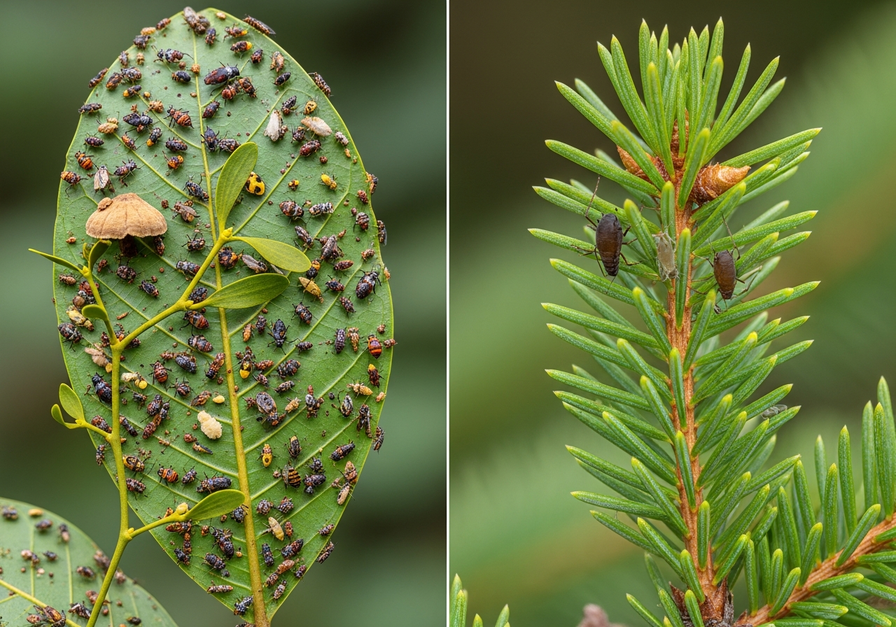
This microscopic view complements the article’s explanations of ecological mechanisms—energy availability, climate stability, and evolutionary rates—by showing how these factors translate into observable differences in species richness at the smallest scales.
A Closer Look: Microhabitat Diversity
The Latitudinal Diversity Gradient is not just about grand landscapes; it permeates even the smallest scales of life. Consider a close-up view of a single leaf. In a tropical rainforest, a broadleaf tree might host an entire miniature ecosystem: a vibrant array of tiny insects, a small colony of fungi, perhaps even a few mistletoe vines or epiphytic mosses. Each of these organisms represents a distinct species, thriving on the micro-resources available on that single leaf.
Now, compare this to a spruce needle from a temperate forest. While still part of a living ecosystem, a close inspection might reveal only a single aphid or a faint patch of fungus. The difference is striking. This microscopic view powerfully illustrates how the underlying ecological mechanisms—energy availability, climate stability, and evolutionary rates—translate into observable differences in species richness even at the smallest, most intimate scales of interaction.
Examples of the Gradient in Action
The Latitudinal Diversity Gradient is not a theoretical construct; it is a living, breathing reality observed across countless taxa and ecosystems:
- Plants:
- Trees: A single hectare of Amazonian rainforest can contain over 300 tree species, while a similar area in a temperate forest might have 20-30 species, and the Arctic tundra virtually none.
- Flowering Plants: The diversity of flowering plants, particularly orchids and bromeliads, explodes in the tropics.
- Animals:
- Insects: Tropical rainforests are biodiversity hotspots for insects, with estimates suggesting millions of undescribed species. A single tropical tree can host more ant species than all of Europe.
- Birds: Colombia, a tropical country, boasts over 1,900 bird species, more than North America and Europe combined. Canada, a high-latitude country, has around 450 species.
- Mammals: While large mammals might be more iconic in some temperate regions, the overall diversity of mammal species, especially small arboreal and nocturnal ones, is significantly higher in the tropics.
- Reptiles and Amphibians: These ectothermic (cold-blooded) animals thrive in warm, stable tropical environments, exhibiting immense diversity.
- Marine Life: The gradient is also evident in the oceans. Coral reefs, often called the “rainforests of the sea,” are found in tropical waters and are unparalleled in their marine biodiversity. Moving towards colder, polar waters, marine species richness, from fish to invertebrates, generally declines.
Implications and Importance: Why Does This Matter?
Understanding the Latitudinal Diversity Gradient is far more than an academic pursuit. It has profound implications for conservation, ecosystem management, and our ability to predict the future of life on Earth.
- Conservation Hotspots: The gradient highlights the critical importance of tropical regions as global biodiversity hotspots. Protecting these areas is paramount for preserving a disproportionately large share of Earth’s species.
- Ecosystem Services: Higher biodiversity often correlates with greater ecosystem stability and resilience. Diverse ecosystems provide a wider range of “ecosystem services,” such as pollination, water purification, climate regulation, and nutrient cycling, which are essential for human well-being.
- Predicting Future Changes: As global climates change, understanding the drivers of the Latitudinal Diversity Gradient helps scientists predict how species distributions might shift, which regions might be most vulnerable to biodiversity loss, and how ecosystems might respond to warming temperatures or altered precipitation patterns.
- Drug Discovery and Biotechnology: The vast, unexplored biodiversity of the tropics represents an immense reservoir of potential new medicines, agricultural solutions, and biotechnological innovations.
Challenges and Nuances: Beyond the Simple Rule
While the Latitudinal Diversity Gradient is a powerful general rule, ecology is rarely simple. There are nuances and exceptions that add to its complexity and our understanding.
- Exceptions to the Rule: Not all groups of organisms strictly follow the gradient. For example, some marine groups like penguins or seals are more diverse in polar regions. Certain parasitic groups might also show different patterns.
- Marine vs. Terrestrial Gradients: While both show a gradient, the specific drivers and magnitudes can differ between marine and terrestrial environments due to differences in physical properties (e.g., water currents, temperature stratification).
- Altitude Gradients: Similar to latitude, biodiversity often decreases with increasing altitude on mountains. This “altitudinal diversity gradient” is driven by factors like temperature, oxygen levels, and habitat area, mirroring some of the latitudinal effects.
- Historical Factors: The geological history of continents, past glaciations, and continental drift have all played a role in shaping current biodiversity patterns, adding another layer of complexity to the gradient.
Conclusion: A Call to Appreciate Earth’s Richness
The Latitudinal Diversity Gradient is a magnificent testament to the power of ecological and evolutionary forces. It paints a vivid picture of a planet where life’s exuberance is not uniformly distributed but peaks in the warm, stable embrace of the tropics, gradually tapering towards the colder, more challenging environments of the poles. This fundamental pattern underscores the interconnectedness of climate, energy, and life itself.
As we continue to explore and understand this gradient, we gain invaluable insights into the intricate workings of our planet. It serves as a powerful reminder of the immense value of biodiversity, particularly in the tropics, and the urgent need for its conservation. By appreciating the Latitudinal Diversity Gradient, we deepen our understanding of Earth’s grand tapestry of life and our responsibility to protect its vibrant threads for generations to come.