Unveiling the Hidden Dimensions of Life: A Deep Dive into Beta Diversity
When the word “biodiversity” comes to mind, many envision a vibrant rainforest teeming with countless species, or perhaps a coral reef bursting with marine life. This immediate thought often focuses on the sheer number of species in a single place, a concept ecologists call alpha diversity. But what if we told you that counting species in one spot only tells half the story? The true richness of life on Earth lies not just in how many species exist, but in how those species change from one place to another. This crucial, yet often overlooked, dimension of biodiversity is known as beta diversity.
Imagine two forests, each home to 50 different tree species. At first glance, they might seem equally diverse. However, if those 50 species in the first forest are entirely different from the 50 species in the second forest, then the overall regional diversity is much higher than if they shared many species. Beta diversity is precisely about these differences, the unique species compositions that make each habitat special.
What Exactly is Beta Diversity? The Foundation of Ecological Variation
Beta diversity quantifies the variation in species composition between different sites or habitats within a larger region. It is essentially a measure of species turnover. Think of it as the ecological “change of scenery” as you move from one location to another.
Consider a simple analogy: You have two different bookshelves. Each shelf has 20 books (alpha diversity). If the first shelf has 20 mystery novels and the second shelf has 20 science fiction novels, the beta diversity between them is very high because the book types are completely different. If, however, the second shelf also has 18 mystery novels and only 2 new science fiction books, the beta diversity is much lower. In ecology, instead of book genres, we are looking at species.
Beta diversity reveals how species composition shifts across a landscape, highlighting the unique ecological identity of different habitats.
This concept is fundamental to understanding how ecosystems function and how species are distributed across the planet. It complements alpha diversity (species richness within a single site) and gamma diversity (total species richness across an entire region). Beta diversity acts as the bridge between these two, showing how local diversity contributes to regional diversity through compositional differences.
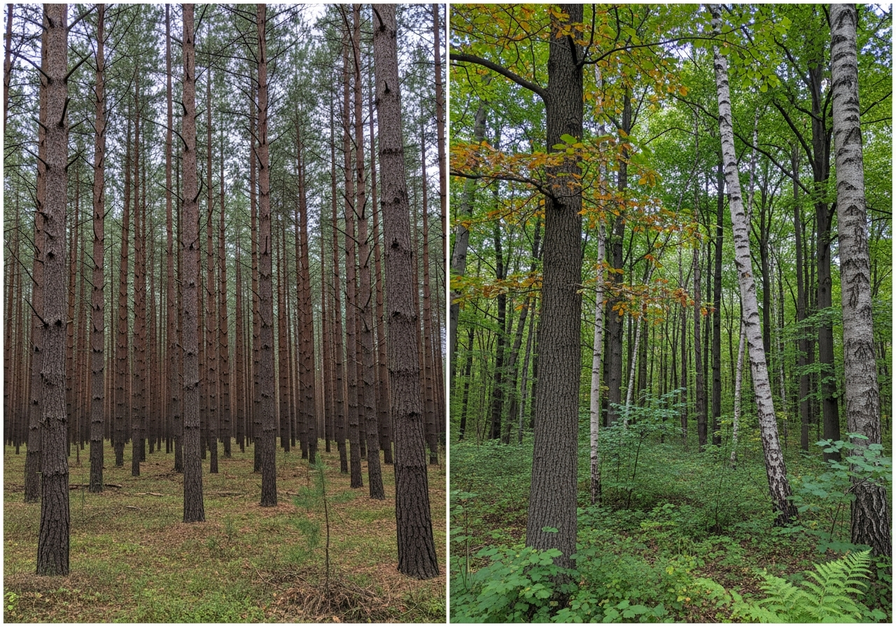
This split-screen image vividly illustrates how two habitats can possess similar species richness (alpha diversity) but dramatically different species compositions, a core principle of beta diversity. The uniform pine stand on the left contrasts sharply with the mixed hardwood forest on the right, showcasing distinct tree types, understory, and overall structure.
Why Does Beta Diversity Matter So Much?
Understanding beta diversity is not merely an academic exercise; it has profound implications for conservation, ecosystem management, and our overall appreciation of the natural world.
- Conservation Prioritization: When deciding which areas to protect, knowing only alpha diversity can be misleading. A region with many sites of high alpha diversity but low beta diversity might mean those sites share many of the same species. Conversely, a region with moderate alpha diversity but high beta diversity indicates many unique communities, each contributing distinct species to the regional pool. Protecting areas with high beta diversity ensures a broader representation of unique species and ecological processes.
- Ecosystem Resilience: A landscape with high beta diversity often implies a mosaic of different habitats, each potentially supporting different species that respond uniquely to environmental changes or disturbances. This diversity of responses can enhance the overall resilience of the regional ecosystem to challenges like climate change or disease outbreaks.
- Understanding Ecological Processes: Beta diversity helps ecologists unravel the forces that shape communities. Is species turnover driven by environmental gradients (changes in temperature, moisture, soil)? Or is it due to dispersal limitations, where species simply cannot reach certain suitable habitats? Beta diversity provides clues to these fundamental ecological questions.
- Ecosystem Services: Different species provide different ecosystem services, from pollination and pest control to water purification and nutrient cycling. A landscape with high beta diversity is more likely to offer a wider array of these vital services, benefiting human societies.
Witnessing Species Turnover: Examples in the Wild
Beta diversity is all around us, often unnoticed. Let us explore some tangible examples.
Ecological Transects: A Journey Through Changing Habitats
Imagine walking a long trail that traverses different environmental conditions. As you move, the species you encounter change. This is beta diversity in action.
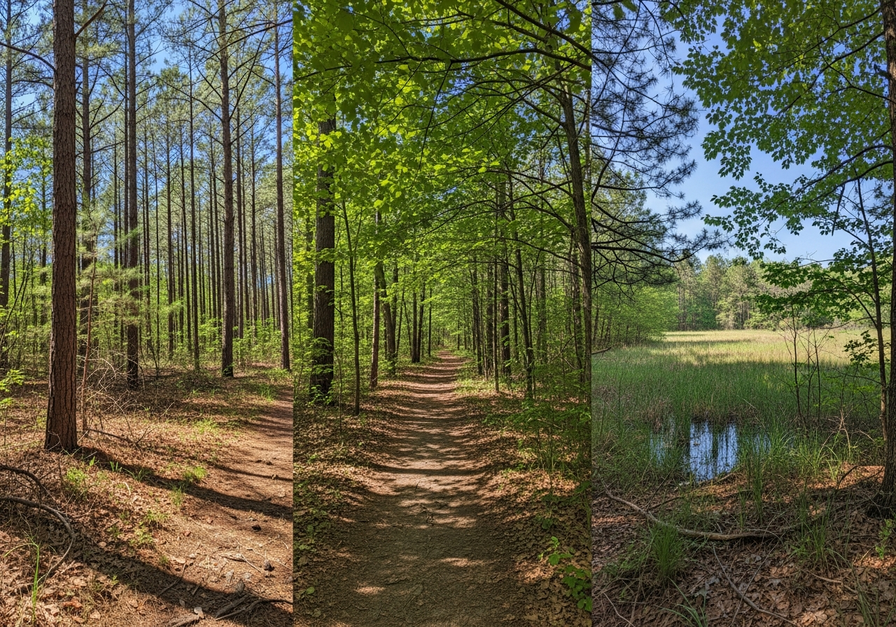
This wide-angle photograph captures an ecological transect, visually demonstrating species turnover across a landscape. From the dry pine scrub on the left, through a moist mixed hardwood forest in the middle, to a wet meadow on the right, the image clearly shows how community composition changes with varying environmental conditions.
- Mountain Slopes: As you ascend a mountain, temperature drops, and moisture levels change. You might start in a deciduous forest, transition to coniferous trees, then alpine meadows, and finally sparse tundra. Each elevation band harbors a distinct set of species, reflecting high beta diversity along the elevational gradient.
- Coastal Zones: Moving from a sandy beach inland, you might encounter dune grasses, then salt-tolerant shrubs, followed by maritime forests. The species composition shifts dramatically over a relatively short distance due to changes in salinity, wind exposure, and soil stability.
- River Systems: From the fast-flowing, oxygen-rich headwaters to the slow, meandering lower reaches, the fish, insect, and plant communities change significantly. Species adapted to turbulent waters give way to those thriving in calmer, often warmer, conditions.
Habitat Mosaics: Contrasting Worlds Side-by-Side
Sometimes, beta diversity is starkly evident when vastly different ecosystems exist in close proximity.
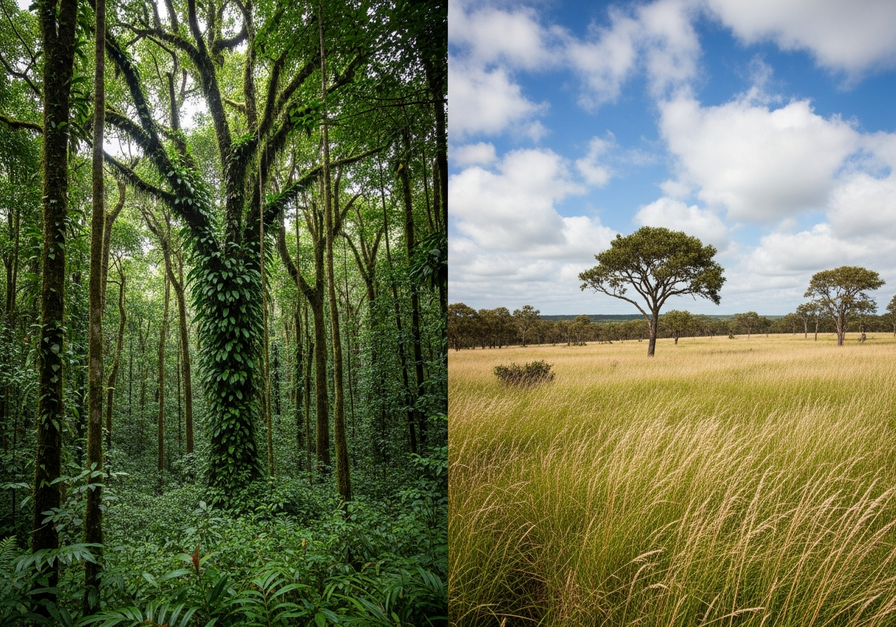
This split-screen photograph strikingly contrasts two distinct ecosystems: a lush tropical rainforest on the left and a temperate grassland on the right. The dramatic differences in vegetation structure, species composition, and overall ecological character underscore how beta diversity can be exceptionally high between fundamentally different habitat types.
- Forest Edges and Open Fields: The transition zone between a dense forest and an open grassland or agricultural field often hosts a unique mix of species adapted to both environments, distinct from the species found deep within either habitat.
- Wetlands and Uplands: A marsh or swamp bordering a dry forest will have completely different plant and animal communities due to the drastic difference in water availability and soil conditions.
- Urban Green Spaces: Even within a city, a manicured park, a wild urban woodland, and a community garden will exhibit different plant and insect communities, contributing to urban beta diversity.
Factors Shaping Beta Diversity
The patterns of species turnover we observe are not random. They are the result of complex interactions between species and their environment, influenced by a variety of ecological and historical factors.
Environmental Gradients
Perhaps the most intuitive driver, environmental gradients refer to gradual changes in physical conditions across a landscape. These include:
- Climate: Temperature, rainfall, and seasonality dictate which species can survive and thrive.
- Topography: Elevation, slope, and aspect (which way a slope faces) influence light, moisture, and temperature regimes.
- Soil Composition: Nutrient availability, pH, and water retention capacity determine plant communities, which in turn affect animal communities.
- Hydrology: The presence and movement of water are critical, especially in aquatic and wetland environments.
Geographic Distance and Dispersal Limitations
The farther apart two sites are, the less likely they are to share species, simply because it is harder for species to travel between them. Barriers like mountains, rivers, or oceans can further restrict dispersal, leading to unique species assemblages on either side.
Habitat Heterogeneity
A landscape with a greater variety of microhabitats (e.g., sunny patches, shady spots, wet depressions, dry mounds) will generally support higher beta diversity because each microhabitat can host a specialized set of species.
Disturbance Regimes
Natural disturbances like fires, floods, or strong winds can create patches of different successional stages, leading to a mosaic of habitats and increased beta diversity. For example, a forest that experiences periodic fires might have areas of young growth alongside mature stands, each with different species.
Historical Factors
Long-term geological processes, past climate shifts, and evolutionary history all play a role in shaping current species distributions and, consequently, beta diversity patterns. Areas with a long history of isolation, for instance, often harbor unique endemic species, contributing to high beta diversity when compared to other regions.
Beta Diversity in Conservation: Beyond Species Counts
For conservationists, beta diversity offers a powerful lens through which to view and protect biodiversity. It moves beyond simply tallying species to understanding the irreplaceable value of unique ecological communities.
- Identifying Irreplaceable Habitats: By analyzing beta diversity, conservationists can identify habitats that harbor species not found elsewhere in the region, even if their alpha diversity is not exceptionally high. Protecting these unique sites is crucial for safeguarding regional biodiversity.
- Designing Effective Protected Area Networks: Instead of creating isolated reserves, a network designed with beta diversity in mind aims to connect different habitat types, ensuring that a wide range of ecological communities and their associated species are protected. This approach often involves establishing corridors that facilitate species movement and maintain ecological connectivity.
- Assessing Fragmentation Impacts: Habitat fragmentation, where large natural areas are broken into smaller, isolated patches, can significantly alter beta diversity. It can lead to a loss of unique species in some patches and an increase in generalist species in others, homogenizing communities and reducing overall regional diversity.
- Monitoring Climate Change Effects: As species shift their ranges in response to climate change, beta diversity patterns will also change. Monitoring these shifts can provide early warnings of ecological disruption and inform adaptive conservation strategies.
Delving Deeper: Advanced Concepts in Beta Diversity
For those with a deeper curiosity, the study of beta diversity extends into more nuanced measurements and analytical approaches.
Different Faces of Beta Diversity
Ecologists employ various metrics to quantify beta diversity, each emphasizing a slightly different aspect:
- Whittaker’s Beta Diversity: One of the earliest concepts, often calculated as gamma diversity divided by average alpha diversity. It gives a sense of how many “average” communities fit into the regional species pool.
- Jaccard and Sørensen Indices: These are similarity indices that can be inverted to measure dissimilarity (beta diversity). They focus on the proportion of unique species between two sites compared to the total number of species observed.
- The Jaccard index considers only the shared species relative to the total number of species in both sites.
- The Sørensen index gives more weight to shared species.
- Turnover vs. Nestedness: Modern beta diversity metrics often decompose the total beta diversity into two components:
- Species Turnover: The replacement of one species by another between sites. This is the “change of scenery” aspect.
- Nestedness: Occurs when species in less diverse sites are a subset of the species found in more diverse sites. It suggests a hierarchical pattern of species loss or gain.
Multivariate Approaches
Beyond simple indices, ecologists use powerful statistical tools to analyze complex beta diversity patterns across many sites simultaneously. Techniques like Non-metric Multidimensional Scaling (NMDS) or Permutational Multivariate Analysis of Variance (PERMANOVA) allow researchers to visualize and test for differences in species composition among multiple communities, revealing underlying ecological gradients and drivers.
The Concept of “Dark Diversity”
An intriguing advanced concept is “dark diversity,” which refers to species that are absent from a particular site but could potentially live there, given the environmental conditions and their regional distribution. Understanding dark diversity helps us assess the completeness of a community and its potential for species colonization, adding another layer to our understanding of species turnover.
Conclusion: Appreciating the Tapestry of Life
Beta diversity reminds us that life on Earth is not a uniform blanket, but a rich, intricate tapestry woven from countless unique threads. Each habitat, each ecological community, contributes its own distinct pattern to this grand design. By understanding and valuing beta diversity, we move beyond simple species counts to appreciate the profound ecological differences that make every corner of our planet special.
From the subtle shifts in a forest understory to the dramatic contrasts between a desert and a wetland, beta diversity is a constant, dynamic force shaping the living world. Recognizing its importance empowers us to make more informed conservation decisions, foster greater ecological resilience, and deepen our wonder at the boundless creativity of nature. The next time you step into a new environment, take a moment to observe not just the species present, but how they differ from what you saw before. You will be witnessing beta diversity in its most beautiful and fundamental form.