The Earth is a dynamic planet, constantly evolving through natural cycles that have shaped its landscapes and climates over millennia. However, in recent centuries, a new and powerful force has emerged, accelerating changes at an unprecedented rate: global warming. This phenomenon, often discussed alongside climate change, refers specifically to the long-term heating of Earth’s climate system observed since the pre-industrial period, primarily due to human activities, especially fossil fuel burning, which increases heat-trapping greenhouse gas levels in Earth’s atmosphere.
Understanding global warming is not just for scientists; it is crucial for everyone. It impacts our weather, our food, our health, and the very ecosystems that sustain life. This article will demystify global warming, exploring its fundamental causes, its far-reaching consequences, and the innovative solutions being developed to address this planetary challenge.
The Earth’s Natural Thermostat: Understanding the Greenhouse Effect
To grasp global warming, we must first understand the greenhouse effect. Imagine a greenhouse, a structure designed to grow plants, even in cold weather. Its glass panels allow sunlight to enter, warming the interior. The glass then traps some of that heat, keeping the plants warm. Our planet has a similar natural mechanism.
Earth’s atmosphere contains certain gases, known as greenhouse gases, which act much like the glass in a greenhouse. When sunlight reaches Earth, some of it is absorbed by the land and oceans, warming the planet’s surface. This warmth is then radiated back towards space as infrared heat. Greenhouse gases, such as carbon dioxide (CO2), methane (CH4), nitrous oxide (N2O), and water vapor (H2O), absorb some of this outgoing infrared radiation, preventing it from escaping directly into space. Instead, they re-emit it in all directions, including back towards Earth’s surface, further warming the planet.
This natural greenhouse effect is absolutely vital for life on Earth. Without it, our planet would be a frozen wasteland, with an average temperature far below freezing, making it uninhabitable. It is this delicate balance that has allowed life to flourish for billions of years.
The Enhanced Greenhouse Effect: When Balance is Lost
The problem arises when human activities significantly increase the concentration of these greenhouse gases in the atmosphere, leading to an “enhanced” or “anthropogenic” greenhouse effect. More greenhouse gases mean more trapped heat, causing the planet’s average temperature to rise. This is the essence of global warming.
The primary driver of this increase is the burning of fossil fuels (coal, oil, and natural gas) for energy production, transportation, and industrial processes. These fuels contain carbon that has been stored underground for millions of years. When burned, this carbon is released into the atmosphere as carbon dioxide.
Human Influence: The Accelerating Factors
While natural factors can influence Earth’s climate, the rapid warming observed over the last century is overwhelmingly attributed to human activities. Several key areas contribute to the surge in greenhouse gas emissions:
- Fossil Fuel Combustion: This is the largest contributor. Power plants, factories, vehicles, and homes all rely heavily on burning coal, oil, and natural gas, releasing vast quantities of CO2.
- Deforestation: Forests are vital carbon sinks, meaning they absorb CO2 from the atmosphere as they grow. When forests are cut down or burned, not only do they stop absorbing carbon, but the stored carbon is also released back into the atmosphere.
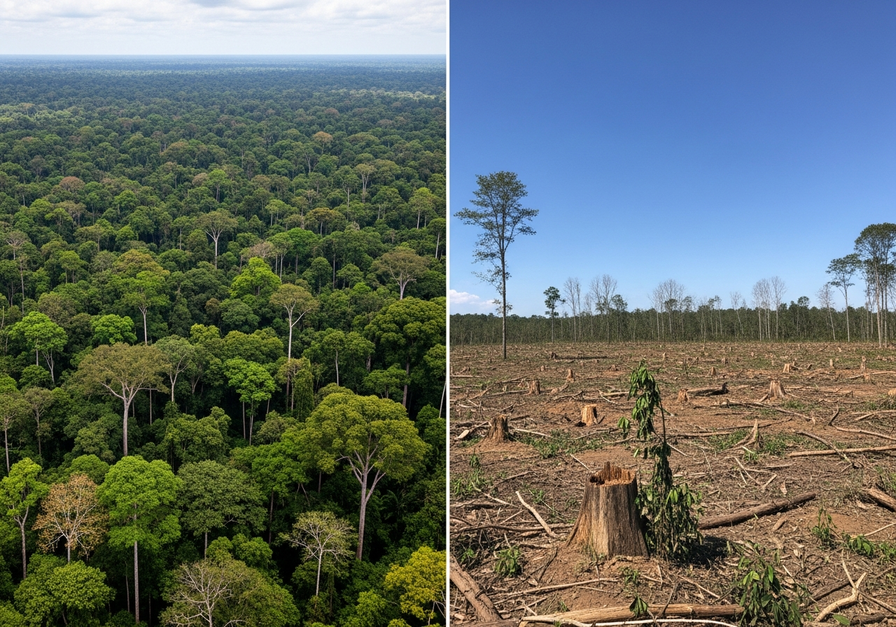
This image visually demonstrates the human influence section of the article, highlighting how deforestation contributes to increased atmospheric CO2 and amplifies the greenhouse effect.
- Industrial Processes: Certain industrial activities, such as cement production and chemical manufacturing, release greenhouse gases as byproducts.
- Agriculture: Livestock farming produces significant amounts of methane through digestive processes. The use of synthetic fertilizers releases nitrous oxide, another potent greenhouse gas. Rice cultivation in flooded paddies also contributes methane.
- Waste Management: Landfills produce methane as organic waste decomposes in anaerobic (oxygen-free) conditions.
Visible Changes: The Impacts of a Warming World
The consequences of global warming are not abstract future predictions; they are already being observed around the globe, affecting natural systems and human societies.
Rising Temperatures and Heatwaves
The most direct impact is the increase in global average temperatures. While a few degrees might not sound like much, it has profound implications. Warmer temperatures lead to more frequent and intense heatwaves, posing risks to human health, agriculture, and infrastructure. Cities, with their abundance of concrete and asphalt, often experience an “urban heat island” effect, where temperatures are significantly higher than surrounding rural areas.

This illustration connects to the article’s section on extreme weather and heatwaves, showing how urban environments intensify heat retention and affect human comfort and health.
Melting Ice and Rising Sea Levels
One of the most dramatic visual indicators of global warming is the melting of glaciers and ice sheets. From the Arctic to the Antarctic, and in mountain ranges worldwide, ice is disappearing at an alarming rate. This meltwater, along with the thermal expansion of ocean water as it warms, contributes to rising sea levels.
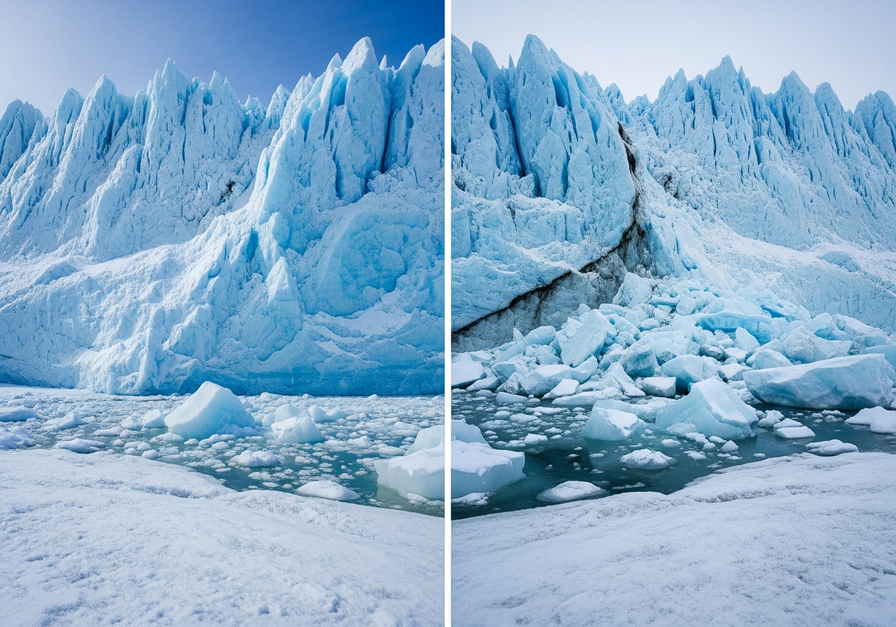
The image provides concrete visual evidence of the article’s discussion on ice melt and its role in sea-level rise, emphasizing the rapid changes occurring in polar regions.
Coastal communities face increased risks of flooding, erosion, and saltwater intrusion into freshwater supplies. Low-lying islands and coastal cities are particularly vulnerable.
Extreme Weather Events
Global warming is altering weather patterns, leading to more frequent and intense extreme weather events. This includes:
- More intense storms: Warmer oceans provide more energy for tropical storms and hurricanes, potentially increasing their destructive power.
- Droughts and wildfires: Prolonged periods of high temperatures and reduced rainfall contribute to severe droughts, increasing the risk and intensity of wildfires in many regions.
- Heavy precipitation: A warmer atmosphere can hold more moisture, leading to more extreme rainfall events and associated flooding in other areas.
Ocean Acidification
The oceans absorb a significant portion of the CO2 released into the atmosphere. While this helps to mitigate atmospheric warming, it comes at a cost. When CO2 dissolves in seawater, it forms carbonic acid, making the oceans more acidic. This process, known as ocean acidification, threatens marine life, particularly organisms with shells and skeletons made of calcium carbonate, such as corals, oysters, and plankton, which form the base of many marine food webs.
Impacts on Ecosystems and Biodiversity
Rising temperatures and altered weather patterns disrupt ecosystems. Species that cannot adapt quickly enough may face extinction. This includes:
- Habitat shifts: Animals and plants may be forced to migrate to cooler regions or higher altitudes, but many cannot.
- Disrupted life cycles: Changes in temperature can alter the timing of seasonal events like flowering, migration, and breeding, leading to mismatches between species and their food sources.
- Coral bleaching: Warmer ocean temperatures stress corals, causing them to expel the algae living in their tissues, leading to bleaching and often death.
Beyond the Surface: Deeper Dive into Climate Science
For those seeking a more in-depth understanding, climate science reveals complex interactions and potential future scenarios.
Climate Feedback Loops
Global warming is not a simple linear process. It involves intricate feedback loops that can either amplify or dampen the initial warming. Positive feedback loops accelerate warming, while negative ones slow it down. Key examples of positive feedback loops include:
- Ice-albedo feedback: Ice and snow are highly reflective (high albedo), bouncing sunlight back into space. As global warming melts ice, darker land and ocean surfaces are exposed. These darker surfaces absorb more sunlight, leading to further warming and more melting, creating a vicious cycle.
- Permafrost thaw: Permafrost, permanently frozen ground in polar regions, contains vast amounts of trapped organic matter. As permafrost thaws due to warming, this organic matter decomposes, releasing potent greenhouse gases like methane and carbon dioxide, which further accelerate warming.
- Water vapor feedback: A warmer atmosphere can hold more water vapor. Water vapor is itself a powerful greenhouse gas. So, as temperatures rise, more water evaporates, increasing atmospheric water vapor, which traps more heat, leading to further warming.
Climate Models and Projections
Scientists use sophisticated climate models, complex computer simulations, to understand past climate changes and project future ones. These models incorporate physics, chemistry, and biology to simulate Earth’s climate system. While projections always carry some uncertainty, the fundamental trends predicted by multiple independent models consistently point towards continued warming under current emission trajectories.
Tipping Points
A “tipping point” in the climate system refers to a threshold beyond which a small perturbation can lead to large, often irreversible, changes. Examples include the collapse of major ice sheets, the dieback of the Amazon rainforest, or the disruption of ocean currents. Crossing such tipping points could lead to abrupt and severe consequences, making it even more challenging to mitigate the impacts of global warming.
Addressing the Challenge: Solutions and Mitigation
Despite the scale of the challenge, there are numerous strategies and technologies available to mitigate global warming and adapt to its impacts. Collective action is paramount.
Reducing Greenhouse Gas Emissions
- Transition to Renewable Energy: Shifting away from fossil fuels to clean energy sources like solar, wind, hydropower, and geothermal energy is perhaps the most critical step.
- Energy Efficiency and Conservation: Using less energy through improved insulation, efficient appliances, public transportation, and mindful consumption significantly reduces emissions.
- Sustainable Land Use and Forestry: Protecting existing forests, reforestation (planting new trees), and adopting sustainable agricultural practices can enhance carbon sequestration and reduce emissions from land use change.
- Carbon Capture and Storage (CCS): Technologies that capture CO2 emissions from industrial sources or directly from the atmosphere and store them underground are being developed, though their widespread deployment faces challenges.
Adaptation Strategies
Even with aggressive mitigation efforts, some degree of global warming and its impacts are unavoidable. Adaptation strategies focus on preparing for and responding to these changes:
- Building resilient infrastructure: Designing buildings and infrastructure to withstand extreme weather events, such as sea walls for rising sea levels or improved drainage systems for heavy rainfall.
- Developing drought-resistant crops: Breeding crops that can thrive in drier conditions or with altered growing seasons.
- Early warning systems: Implementing systems for heatwaves, floods, and storms to protect communities.
- Ecosystem restoration: Restoring natural habitats like wetlands and mangroves can provide natural defenses against coastal flooding and storm surges.
A Collective Future
Global warming is a defining challenge of our era, demanding attention and action from individuals, communities, governments, and industries worldwide. It is a complex issue, but one that is well understood by science. The path forward involves a concerted effort to reduce our carbon footprint, innovate sustainable solutions, and build resilience in the face of a changing climate.
By embracing renewable energy, protecting our natural resources, and fostering a deeper understanding of our planet’s delicate balance, humanity can navigate this challenge. The future of our planet, and the well-being of generations to come, depends on the choices we make today to address global warming with urgency and determination.