The movement of people across borders is a phenomenon as old as humanity itself, shaping cultures, economies, and landscapes throughout history. This profound journey, often driven by a complex interplay of hope and necessity, is known as emigration. It is more than just a change of address; it is a transformative process for individuals, communities, and the global ecosystem.
Emigration refers to the act of leaving one’s country of origin or region to settle permanently in another. It is the counterpart to immigration, which describes the act of entering a new country. Together, these movements represent the dynamic flow of human populations across the planet, a constant reshuffling that reflects global challenges and opportunities.
Understanding emigration requires looking at both the departure and the arrival, the push factors that compel people to leave and the pull factors that attract them to new destinations. This journey is often marked by significant transitions, from familiar surroundings to unknown territories, from established routines to new beginnings.

This image visually illustrates the core concept of emigration presented in the article: the act of leaving one’s homeland and the arrival in a new country, emphasizing both the departure and arrival stages that define the migratory journey.
Why Do People Emigrate? The Driving Forces
The decision to emigrate is rarely simple, often stemming from a confluence of factors that make staying in one’s homeland untenable or less appealing than the prospect of a new life elsewhere. These drivers can be broadly categorized:
Economic Factors
Economic considerations are among the most powerful motivators for emigration. Individuals and families often seek better economic opportunities, higher wages, or improved living standards that are unavailable in their home countries. This can include:
- Poverty and Unemployment: A lack of jobs or insufficient income to support a family can push people to seek work abroad.
- Better Job Prospects: The allure of specific industries or higher-paying positions in another country can be a strong pull.
- Remittances: The desire to earn money to send back to family members in the home country is a significant driver for many.
For example, a skilled worker in a rural area might see limited prospects for advancement or even basic employment, while a bustling city in another country offers a wealth of opportunities in their field.

This image represents the economic drivers of emigration discussed in the article. It portrays a skilled worker preparing to leave a rural setting for better opportunities in an urban environment, highlighting the personal and economic motivations behind migration.
Environmental Factors
In an era of rapid climate change and increasing environmental degradation, ecological factors are becoming increasingly prominent drivers of emigration. These can include:
- Natural Disasters: Earthquakes, floods, hurricanes, and droughts can render areas uninhabitable, forcing populations to relocate.
- Climate Change Impacts: Rising sea levels, desertification, and extreme weather events can destroy livelihoods and homes, leading to climate migration.
- Resource Scarcity: Depletion of natural resources like water or fertile land can make it impossible for communities to sustain themselves.
Coastal communities, for instance, might face the existential threat of rising sea levels, compelling residents to seek safer ground inland or in other countries.
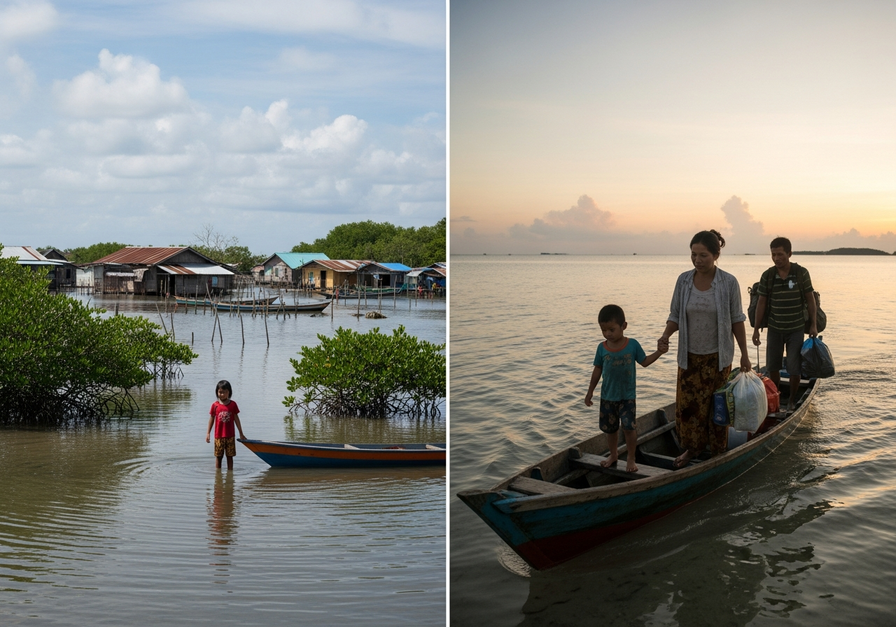
This illustration reflects the article’s discussion of environmental factors driving emigration, such as rising sea levels and resource scarcity. It visualizes the migration corridor created by climate change, emphasizing the urgent and human aspect of this contemporary trend.
Social and Political Factors
Beyond economics and environment, social and political conditions play a crucial role in emigration decisions:
- Conflict and Persecution: War, civil unrest, political instability, and persecution based on ethnicity, religion, or political beliefs often force people to flee their homes as refugees or asylum seekers.
- Lack of Freedom and Human Rights: Oppressive regimes or societies that deny basic freedoms can prompt individuals to seek refuge in more democratic nations.
- Family Reunification: Many emigrate to join family members who have already settled in another country, maintaining familial bonds across borders.
- Educational Opportunities: The pursuit of higher education or specialized training unavailable in one’s home country is a significant pull factor for younger generations.
The Emigration Process: A Journey of Transformation
The act of emigrating is a multi-stage process, often requiring extensive planning and resilience:
- Decision Making: This initial phase involves weighing the push and pull factors, assessing risks and benefits, and making the momentous choice to leave.
- Preparation: This includes obtaining necessary documents like passports and visas, selling property, arranging travel, and often learning a new language.
- The Journey: The physical act of traveling from the home country to the destination, which can range from a short flight to a perilous, multi-stage trek.
- Integration: Upon arrival, emigrants face the challenge of adapting to a new culture, finding housing and employment, navigating new legal systems, and building a new social network. This stage can be particularly demanding, involving culture shock and the potential for discrimination.
The Far-Reaching Impacts of Emigration
Emigration has profound effects, not only on the individuals who move but also on the countries they leave and the countries they adopt.
Impacts on Emigrants
- Opportunities: Access to better jobs, education, healthcare, and a higher quality of life.
- Challenges: Culture shock, language barriers, discrimination, separation from family and friends, and the emotional toll of displacement.
- Personal Growth: Developing new skills, perspectives, and resilience through adapting to a new environment.
Impacts on Origin Countries
- Brain Drain: The loss of skilled workers and educated professionals can hinder economic development and innovation.
- Remittances: Money sent home by emigrants can be a vital source of income for families and a significant contributor to the national economy.
- Cultural Exchange: Emigrants often maintain ties with their homeland, facilitating cultural exchange and influencing both societies.
Impacts on Host Countries
- Labor Force: Emigrants often fill labor shortages, contributing to economic growth and innovation.
- Cultural Diversity: New populations enrich the cultural fabric of the host country, bringing new traditions, foods, and perspectives.
- Social and Economic Challenges: Integration can present challenges related to housing, social services, and potential social tensions if not managed effectively.
Emigration Through an Ecological Lens
From an ecological perspective, human emigration can be viewed as a form of species dispersal, albeit one driven by complex social, economic, and political factors rather than purely biological imperatives. This movement has significant ecological implications:
- Resource Distribution: Emigration shifts human populations, altering the demand for resources like water, food, and energy in both origin and destination regions. A decrease in population in one area might lead to ecological recovery, while an increase in another can intensify resource strain.
- Land Use Change: In destination areas, particularly urban centers, an influx of emigrants can accelerate urbanization, leading to habitat loss, increased impervious surfaces, and altered local ecosystems.
- Ecological Footprint: The lifestyle and consumption patterns of emigrants in their new homes contribute to the overall ecological footprint of the host nation. This can be particularly pronounced if emigrants move from low-consumption regions to high-consumption ones.
- Climate Migration Corridors: As climate change intensifies, specific “migration corridors” are emerging, where populations are forced to move from environmentally degraded areas to more stable ones. Understanding these corridors is crucial for future ecological planning and conservation efforts.
- Biodiversity Impacts: While less direct, large-scale human movements can indirectly affect biodiversity through changes in land use, resource extraction, and the potential introduction of non-native species (though this is more common with trade and travel than direct human migration).
The study of human emigration, when viewed through an ecological lens, reveals a complex interplay between human societies and the natural world. It underscores how environmental pressures can drive human movement, and how, in turn, human movement can reshape environments.
Conclusion
Emigration is a multifaceted and enduring aspect of the human experience, driven by a spectrum of factors ranging from the deeply personal to the globally systemic. It is a journey of both profound challenge and immense opportunity, shaping individual lives, national identities, and the very distribution of human populations across the globe.
As the world continues to evolve, influenced by economic shifts, political landscapes, and the undeniable force of climate change, understanding emigration becomes ever more critical. It is a phenomenon that demands empathy, informed policy, and a holistic perspective that recognizes the interconnectedness of human societies and the ecological systems upon which they depend.