Uninvited Guests: Understanding Introduced Species and Their Ecological Footprint
Earth’s ecosystems are intricate tapestries woven over millennia, each thread representing a species playing its unique role. But what happens when new threads are suddenly introduced from distant lands? These are known as introduced species, organisms that have been moved by human activity, either intentionally or accidentally, beyond their native range. While many such introductions are benign, some become ecological disruptors, transforming landscapes and threatening native life. Understanding these “uninvited guests” is crucial for safeguarding our planet’s biodiversity.
What Exactly is an Introduced Species?
An introduced species, also referred to as a non-native, exotic, or alien species, is any organism that has been transported by humans to an area outside its historical, natural geographic range. This movement can span continents or simply cross a significant natural barrier like a mountain range or ocean. The key differentiator is human involvement in their relocation.
It is important to distinguish between an “introduced species” and an “invasive species.” Not all introduced species cause harm. Many coexist peacefully with native flora and fauna, or even provide benefits, such as agricultural crops or ornamental plants. However, an introduced species becomes an invasive species when it establishes a self-sustaining population in its new environment and causes significant ecological or economic harm, or poses a threat to human health. These are the species that truly concern ecologists.
The Journeys: How Species Migrate Beyond Their Borders
The pathways for species introduction are diverse, reflecting the vast reach of human activity across the globe. These pathways can be broadly categorized into intentional and accidental introductions.
Intentional Introductions: A History of Hope and Unforeseen Consequences
For centuries, humans have deliberately moved species for various reasons, often with good intentions.
- Agriculture and Horticulture: Many of our staple crops, livestock, and garden plants are introduced species. Wheat, corn, cattle, and roses are all examples of species cultivated far from their original homes.
- Erosion Control and Landscaping: Some plants were introduced to stabilize soil or beautify landscapes. A classic example is kudzu. Originally brought to the United States from Japan in the late 1800s for ornamental purposes and later promoted for erosion control, it quickly became a notorious invasive species.
- Biological Control: Sometimes, a species is introduced to control another pest. This can be a risky strategy, as the introduced “controller” can itself become a problem.
- Pets and Game Animals: Exotic pets that escape or are released can establish wild populations. Game animals like pheasants or wild boar have also been introduced for hunting.

The image above vividly illustrates the dramatic impact of an intentionally introduced species like kudzu. On one side, a vibrant, diverse native forest thrives. On the other, the same landscape is suffocated by a dense blanket of kudzu, demonstrating how a species introduced for seemingly beneficial purposes can rapidly dominate and alter an entire ecosystem. This visual contrast embodies the article’s discussion of intentional introductions that become invasive and the profound ecological impacts they cause.
Accidental Introductions: Hidden Hitchhikers and Unseen Threats
Many introduced species arrive without human intent, often as stowaways in global trade and travel.
- Ballast Water: Ships take on ballast water in one port to maintain stability and discharge it in another. This water can contain thousands of marine organisms, from microscopic plankton to fish larvae. Zebra mussels, native to Eastern Europe, were introduced to the Great Lakes of North America via ballast water and have since spread widely.
- Shipping Containers and Packaging: Pests can hide in cargo, crates, or even the soil of potted plants. The emerald ash borer, a destructive beetle, is believed to have arrived in North America this way.
- Vehicle and Aircraft Transport: Organisms can cling to the undersides of vehicles, in wheel wells, or even inside aircraft.
- Contaminated Goods: Seeds, insects, or pathogens can be transported within agricultural products, timber, or other commodities.

This image powerfully illustrates one of the primary pathways for accidental introductions: ballast water. The dense clusters of zebra mussels clinging to the discharge pipe highlight the unseen threat of stowaway species. These tiny invaders, transported across oceans, can establish themselves in new freshwater ecosystems, underscoring the critical need for stringent ballast water management to prevent widespread ecological disruption.
The Ripple Effect: Ecological and Economic Impacts
When an introduced species becomes invasive, the consequences can be far-reaching and devastating, affecting both natural ecosystems and human economies.
Ecological Consequences
- Biodiversity Loss: Invasive species are a leading cause of species extinction worldwide. They can outcompete native species for resources, prey upon them, or introduce diseases.
- Habitat Degradation and Alteration: Invasive plants can form monocultures, changing soil chemistry, fire regimes, and water availability. Invasive animals can alter physical habitats, such as burrowing animals destabilizing soil.
- Disruption of Food Webs: New predators or competitors can upset the delicate balance of an ecosystem, leading to declines in native populations that are not adapted to the new threat.
- Hybridization: Invasive species can sometimes interbreed with native species, leading to hybrids that may dilute the genetic integrity of the native population.
- Disease Transmission: Introduced species can carry pathogens or parasites to which native species have no immunity, leading to widespread disease outbreaks.
Economic and Social Costs
The financial burden of invasive species is staggering, costing billions of dollars annually in damages and control efforts.
- Agricultural Losses: Invasive weeds, insects, and pathogens can devastate crops and livestock, leading to reduced yields and increased production costs.
- Infrastructure Damage: Species like zebra mussels can clog water intake pipes, damage boat engines, and foul industrial equipment. Invasive plants can undermine roads and buildings.
- Management and Control Costs: Governments and private organizations spend enormous sums on eradication, containment, and control programs.
- Impacts on Recreation and Tourism: Invasive species can degrade natural areas, making them less appealing for fishing, hunting, boating, and other recreational activities.
- Human Health Impacts: Some introduced species can be vectors for diseases or cause allergic reactions.
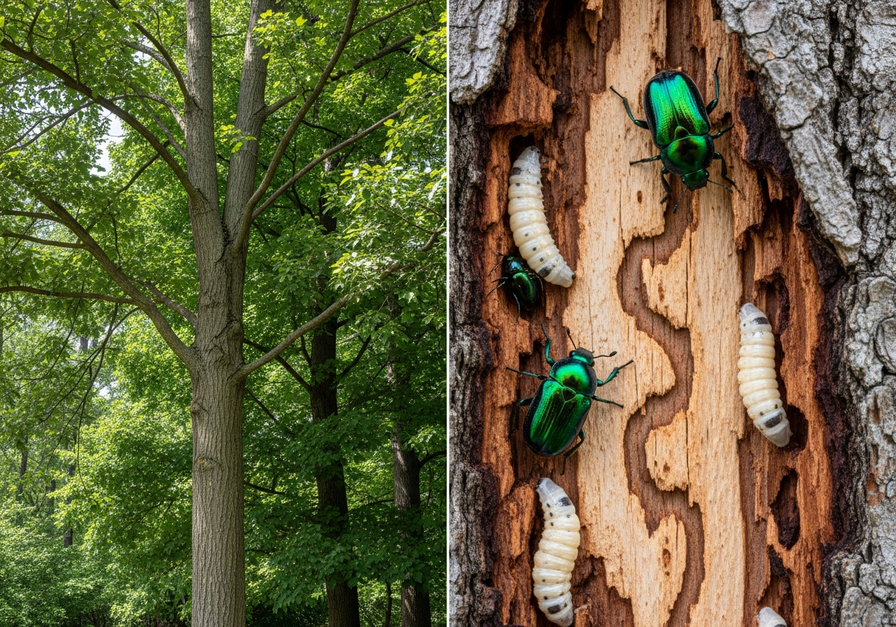
This illustration powerfully conveys the devastating impact of the emerald ash borer, an invasive insect, on native trees. The stark contrast between the healthy ash tree on the left and the borer-scarred bark on the right highlights the severe ecological and economic consequences of such introductions. It directly links to the article’s discussion of biodiversity loss, habitat degradation, and the critical importance of early detection and management in protecting our forests.
Notable Examples of Invasive Species
The world is full of cautionary tales regarding introduced species that have turned invasive.
- Kudzu (Pueraria montana var. lobata): Often called “the vine that ate the South,” kudzu was introduced to the United States in 1876. Its rapid growth rate, up to a foot a day, allows it to smother native vegetation, trees, and even abandoned buildings, blocking sunlight and altering forest ecosystems.
- Zebra Mussels (Dreissena polymorpha): These small freshwater mussels, introduced to the Great Lakes in the 1980s, filter vast amounts of water, removing plankton that native species rely on. They also attach to virtually any hard surface, clogging pipes and covering native mussels and crayfish.
- Emerald Ash Borer (Agrilus planipennis): Discovered in Michigan in 2002, this beetle has since killed tens of millions of ash trees across North America. Its larvae tunnel under the bark, disrupting the tree’s ability to transport water and nutrients, leading to widespread tree mortality and significant economic costs for removal and replacement.
- Lionfish (Pterois volitans/miles): Native to the Indo-Pacific, these venomous fish were likely released from aquariums into the Atlantic Ocean. With no natural predators in their new range, they reproduce rapidly and consume vast quantities of native reef fish, threatening coral reef ecosystems.
- Cane Toad (Rhinella marina): Introduced to Australia in 1935 to control sugarcane pests, the highly toxic cane toad has become a major pest itself. Its poison kills native predators, and it competes with native amphibians for food.
Mitigation and Management: A Proactive Approach
Addressing the challenge of introduced species requires a multi-faceted approach, focusing on prevention, early detection, and effective control.
Prevention: The First Line of Defense
Preventing new introductions is by far the most cost-effective strategy.
- Strict Regulations and Inspections: Governments implement regulations on imported goods, agricultural products, and ballast water discharge. Port and border inspections aim to intercept potential invaders.
- Public Awareness and Education: Educating the public about the risks of releasing pets, transporting firewood, or moving plants can significantly reduce accidental introductions. Campaigns like “Don’t Let It Loose” or “Buy Local, Burn Local” are vital.
- Horticultural Industry Vigilance: Promoting the use of native plants and discouraging the sale of known invasive ornamentals helps prevent their spread.
Early Detection and Rapid Response (EDRR)
If an introduced species manages to bypass prevention measures, early detection is critical.
- Monitoring Programs: Regular surveys and monitoring of vulnerable areas, such as ports, waterways, and natural parks, can help identify new invaders quickly.
- Citizen Science: Engaged communities and citizen scientists can play a crucial role in reporting unusual sightings, providing valuable early warnings.
- Rapid Response: Once detected, a swift and coordinated response is essential for eradication or containment before the species becomes widely established and impossible to control.
Control and Management
When eradication is no longer feasible, management strategies aim to control populations and mitigate their impacts.
- Mechanical Control: This involves physical removal, such as hand-pulling invasive plants, trapping animals, or using specialized machinery.
- Chemical Control: Herbicides for invasive plants or pesticides for invasive insects can be effective, but their use must be carefully managed to minimize harm to native species and the environment.
- Biological Control: Introducing a natural enemy from the invasive species’ native range can be a highly effective, long-term solution. However, this method requires extensive research to ensure the biocontrol agent will not itself become invasive or harm non-target species.
- Habitat Restoration: After control efforts, restoring native plant communities and habitats is crucial for ecosystem recovery.
Our Role in a Connected World
The issue of introduced species highlights the interconnectedness of our global ecosystems and the profound impact of human actions. From the smallest seed carried on a shoe to the largest ship crossing an ocean, every movement has the potential to reshape environments. By understanding the pathways of introduction, recognizing the ecological and economic threats, and supporting proactive prevention and management efforts, we can all contribute to protecting the delicate balance of life on Earth. The future of biodiversity depends on our collective vigilance and responsible stewardship.