Understanding Habitat Loss: The Silent Crisis Threatening Our Planet
Imagine losing your home, not just a room, but your entire neighborhood, your food source, and your safe haven. This is the grim reality faced by countless species across the globe due to a phenomenon known as habitat loss. It is arguably the single greatest threat to biodiversity, driving species towards extinction at an alarming rate and fundamentally altering the delicate balance of Earth’s ecosystems.
What Exactly is Habitat Loss?
At its core, habitat loss refers to the destruction or degradation of the natural environment where a particular species lives. A habitat provides everything an organism needs to survive and reproduce: food, water, shelter, and space. When these essential components are removed or severely altered, the species dependent on that habitat can no longer thrive and often cannot survive.
It is not always about complete obliteration. Habitat loss can manifest in several ways:
- Habitat Destruction: This is the most obvious form, where an entire habitat is converted to another land use, such as a forest being cleared for agriculture or a wetland being drained for development.
- Habitat Fragmentation: This occurs when a large, continuous habitat is broken into smaller, isolated patches. Think of a highway cutting through a vast forest, dividing it into smaller, disconnected sections.
- Habitat Degradation: This involves a reduction in the quality of a habitat, making it less suitable for species. Pollution, invasive species, or altered natural processes like fire regimes can degrade a habitat without physically destroying it.
The Primary Drivers of Habitat Loss
Human activities are overwhelmingly the cause of habitat loss. Our growing population and increasing demand for resources place immense pressure on natural environments. Let us explore the main culprits:
Agricultural Expansion
The need to feed a global population has led to vast tracts of land being converted into farms and pastures. Forests are felled, grasslands plowed, and wetlands drained to make way for crops and livestock. This transformation often results in monocultures, which are far less biodiverse than the natural ecosystems they replace.
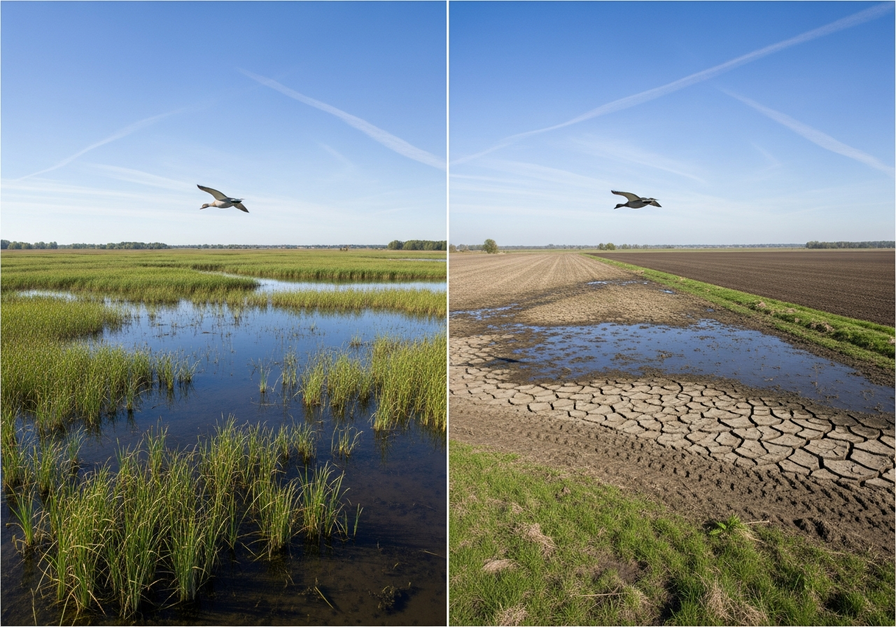
This photo underscores the impact of agricultural drainage on wetlands, illustrating the loss of critical ecosystem services as described in the article. Wetlands are vital ecosystems, acting as natural filters, flood regulators, and nurseries for countless species. When they are drained for agriculture, these crucial functions are lost, along with the unique flora and fauna that call them home.
Deforestation
Forests, particularly tropical rainforests, are biodiversity hotspots. They are cleared for timber, paper, cattle ranching, and palm oil plantations. This wholesale removal of trees not only destroys the homes of countless species but also contributes to climate change by releasing stored carbon dioxide into the atmosphere.
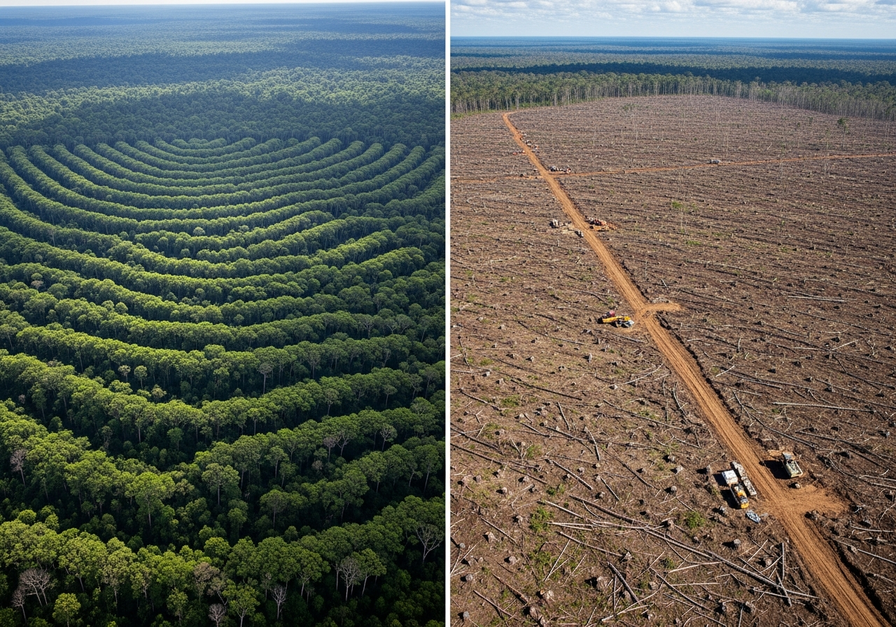
This image visually contrasts intact forest habitat with the loss caused by deforestation, one of the primary drivers of habitat loss highlighted in the article. The stark difference reveals the immediate and devastating impact on the intricate web of life that depends on these forests.
Urbanization and Infrastructure Development
As human populations grow, cities expand, and new roads, railways, and industrial zones are built. This development directly consumes natural habitats, replacing them with concrete and steel. The remaining natural areas often become isolated and degraded, struggling to support their original inhabitants.
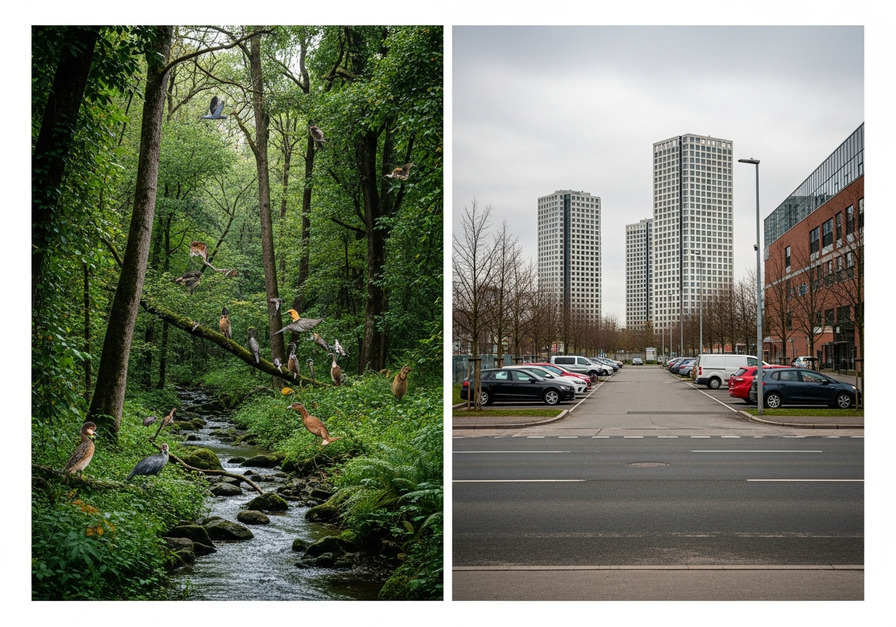
This illustration demonstrates how urbanization fragments habitats and displaces natural ecosystems, a key point discussed in the section on urban expansion. The encroachment of human infrastructure leaves little room for wildlife and disrupts ecological processes.
Pollution
While not always a direct physical destruction, pollution can render a habitat uninhabitable. Chemical runoff from agriculture and industry, plastic waste, and air pollution can poison ecosystems, making them toxic for plants and animals. For example, oil spills devastate marine and coastal habitats, while persistent organic pollutants can accumulate in food chains, harming top predators.
Climate Change
Climate change is an increasingly significant driver of habitat loss. Rising global temperatures alter weather patterns, leading to more frequent and intense droughts, floods, and wildfires. These changes can shift entire ecosystems, forcing species to migrate or face extinction if they cannot adapt quickly enough. Melting glaciers and sea level rise also destroy unique polar and coastal habitats.
The Profound Consequences of Losing Habitats
The implications of habitat loss extend far beyond the disappearance of a single species. It unravels the very fabric of life on Earth, with cascading effects that impact all living things, including humans.
- Biodiversity Loss: This is the most immediate and tragic consequence. When habitats vanish, so do the species that live within them. Each extinction represents an irreversible loss of unique genetic material and ecological roles, weakening the resilience of ecosystems.
- Disruption of Ecosystem Services: Healthy habitats provide invaluable services that support human life. Forests regulate climate and purify air, wetlands filter water, and insects pollinate crops. When these habitats are lost, these services diminish, leading to poorer air and water quality, increased vulnerability to natural disasters, and reduced food security.
- Increased Disease Risk: Intact ecosystems often regulate disease transmission. When habitats are fragmented and wildlife populations are stressed, the risk of zoonotic diseases, those that jump from animals to humans, can increase.
- Economic Impacts: The loss of natural resources and ecosystem services can have significant economic repercussions, affecting industries like fisheries, agriculture, and tourism.
Delving Deeper: Habitat Fragmentation and Edge Effects
While complete habitat destruction is easily understood, the more nuanced concepts of habitat fragmentation and degradation are equally critical, especially for conservation ecologists.
Habitat Fragmentation
Imagine a large, continuous forest. Now, picture roads, power lines, or agricultural fields cutting through it, breaking it into smaller, isolated patches. This is habitat fragmentation. The remaining patches are often too small to support viable populations of many species, particularly those requiring large territories or specific conditions found only in interior habitats.
- Reduced Population Sizes: Smaller patches can only support fewer individuals, making populations more vulnerable to random events like disease outbreaks or natural disasters.
- Genetic Isolation: With barriers between patches, individuals cannot easily move and interbreed, leading to reduced genetic diversity and increased inbreeding, which weakens a population’s ability to adapt.
- Barriers to Movement: Roads and developed areas act as physical barriers, preventing animals from accessing food, mates, or seasonal migration routes.
Edge Effects
When a habitat is fragmented, the boundaries between the natural habitat and the altered landscape are called “edges.” These edges experience different environmental conditions than the interior of the habitat, a phenomenon known as “edge effects.”
For example, forest edges are often:
- Drier and hotter: Due to increased sunlight and wind exposure.
- More susceptible to invasive species: Non-native plants and animals can more easily colonize edge areas.
- More accessible to predators: Predators from the surrounding altered landscape can more easily access the interior of the habitat.
- Noisier and more polluted: From human activities adjacent to the habitat.
These edge effects can penetrate deep into a habitat patch, effectively shrinking the amount of “core” habitat available for species that are sensitive to these changes. A small, fragmented forest might appear to have a large area on a map, but much of it could be compromised by edge effects, leaving very little true interior habitat.
Addressing the Crisis: Pathways to Conservation
Tackling habitat loss requires a multi-faceted approach involving governments, organizations, communities, and individuals.
- Protected Areas: Establishing national parks, wildlife refuges, and other protected areas is crucial for safeguarding critical habitats and the species within them.
- Sustainable Land Use Planning: Implementing policies that promote sustainable agriculture, responsible forestry, and smart urban development can minimize habitat destruction.
- Habitat Restoration: Efforts to restore degraded or destroyed habitats, such as reforestation projects, wetland reconstruction, and riparian zone rehabilitation, can help bring ecosystems back to health.
- Reducing Consumption: Individual choices, such as reducing meat consumption, buying sustainably sourced products, and minimizing waste, can lessen the demand for resources that drive habitat loss.
- Policy and Enforcement: Strong environmental laws and effective enforcement are essential to prevent illegal logging, poaching, and pollution.
- Community Engagement: Empowering local communities to participate in conservation efforts often leads to more sustainable and effective outcomes.
A Call to Action for Our Shared Future
Habitat loss is a complex and pressing issue, but it is not insurmountable. By understanding its causes and consequences, and by supporting and participating in conservation efforts, we can collectively work towards a future where both human societies and the natural world can thrive. The health of our planet, and indeed our own well-being, depends on the habitats that sustain life.