
Imagine a forest ravaged by fire, a coastline battered by a hurricane, or an ocean floor stripped bare by overgrazing. These scenes of devastation might seem like the end, yet time and again, nature surprises us with its remarkable capacity to bounce back. This incredible ability is what ecologists call ecosystem resilience.
Ecosystem resilience is essentially an ecosystem’s superpower: its capacity to absorb disturbances, reorganize, and continue to maintain its essential functions, structure, and identity. It is not merely about returning to an original state, but about the dynamic process of adapting and persisting in the face of change. Understanding this concept is crucial in our rapidly changing world, as it helps us appreciate the intricate workings of nature and guides our efforts to protect it.
What Makes an Ecosystem Resilient?
At its core, resilience is about stability in a dynamic world. Ecosystems are constantly facing challenges, from natural events like floods and droughts to human-induced pressures such as pollution and deforestation. A resilient ecosystem can withstand these shocks without collapsing into a fundamentally different state. This involves several key characteristics:
- Resistance: The ability to resist disturbance and remain largely unchanged. Think of a sturdy tree bending in a strong wind rather than breaking.
- Recovery: The speed and extent to which an ecosystem can return to its previous state or a new, functional state after a disturbance.
- Adaptability: The capacity to adjust to new conditions and find new ways to function effectively, rather than simply reverting to an old pattern.
These characteristics are not static. Resilience is a dynamic property, constantly shaped by the interactions between species, their environment, and the types of disturbances they encounter.
Nature’s Comeback Stories: Examples of Resilience in Action
The best way to grasp ecosystem resilience is to see it in action. Across the globe, diverse ecosystems demonstrate this vital trait in fascinating ways.
The Phoenix Forest: Post-Fire Regeneration
Wildfires, while destructive in the short term, are often a natural and even necessary part of many forest ecosystems. While the immediate aftermath can look bleak, these forests possess an inherent resilience that allows them to regenerate.
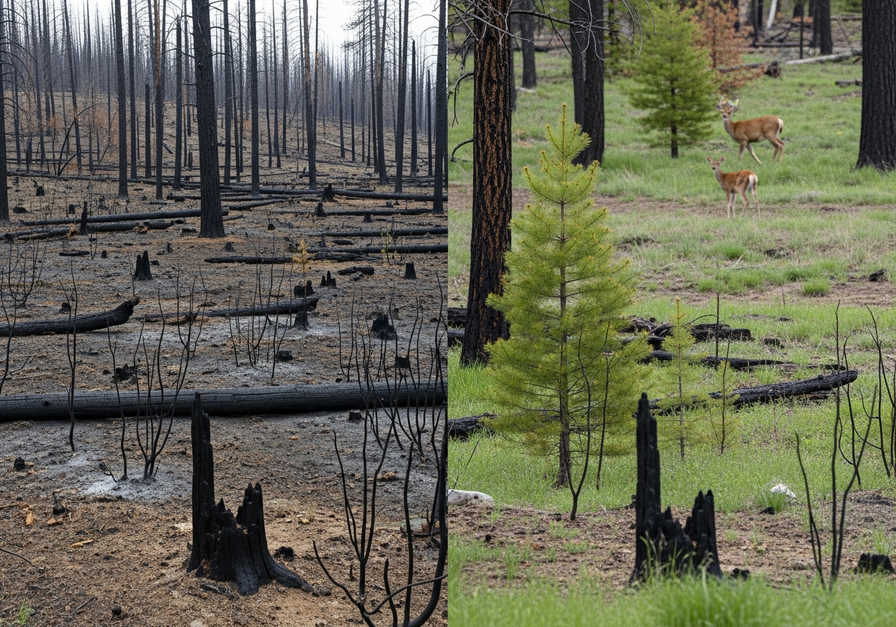
This image visually demonstrates the article’s explanation of ecosystem resilience by contrasting the immediate post-disturbance state with the recovered ecosystem, highlighting how biodiversity and functional redundancy enable the forest to re-organize and return to its essential functions. Many tree species have evolved strategies to cope with fire, such as thick bark that protects inner tissues, or cones that only release seeds after being exposed to intense heat. The ash left behind enriches the soil, providing nutrients for new growth. Pioneer species quickly colonize the burned areas, creating shade and stability for slower-growing trees to establish themselves. Over years, or even decades, the forest slowly but surely reclaims its vibrancy, often becoming even more diverse and robust than before the fire.
Mangrove Marvels: Coastal Protection and Recovery
Coastal ecosystems face unique challenges, particularly from powerful storms and rising sea levels. Mangrove forests are a prime example of resilience in these harsh environments.
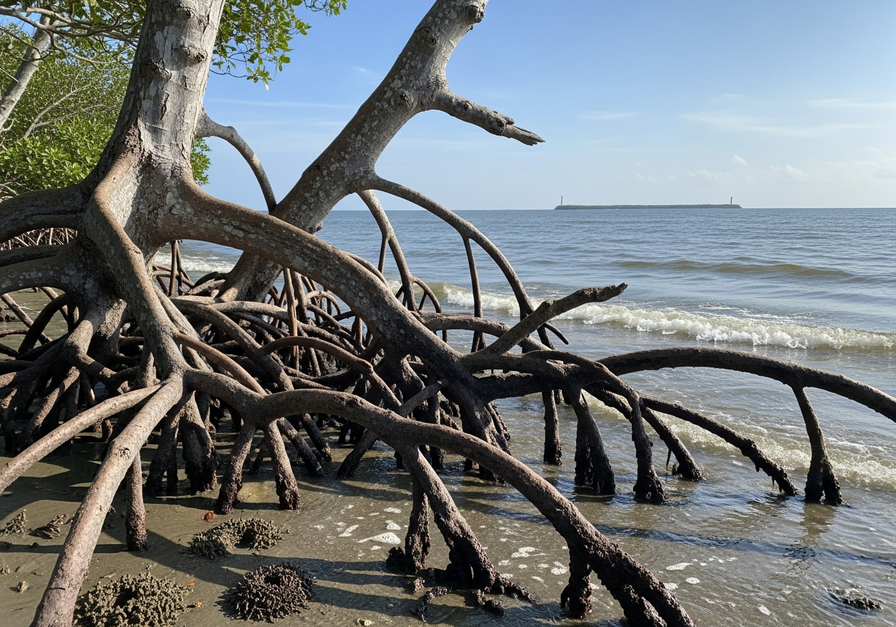
The picture exemplifies the article’s point that mangrove forests act as natural buffers against storm surges and can quickly regenerate after hurricanes, illustrating the functional redundancy and connectivity that underpin resilience. Their dense, tangled root systems not only anchor the trees firmly in the shifting mud but also dissipate wave energy, protecting inland areas from erosion and storm surges. When a hurricane strikes, mangroves may suffer damage, losing leaves and branches, but their robust root structures often remain intact. This allows for rapid regrowth and recovery, demonstrating their incredible capacity to absorb the shock of extreme weather events and continue providing vital ecosystem services, such as nurseries for marine life and carbon sequestration.
Kelp Forests and Keystone Predators: A Delicate Balance
Underwater ecosystems also showcase remarkable resilience, often maintained by intricate species interactions. Kelp forests, vital habitats along many coastlines, are a classic example.

This image captures the article’s example of kelp forest resilience, where predator–prey dynamics (sea otters controlling sea urchin populations) provide functional redundancy and prevent regime shifts, demonstrating how ecosystem resilience is maintained through species interactions. These towering underwater forests provide food and shelter for countless marine species. However, they are vulnerable to overgrazing by sea urchins. The resilience of kelp forests is often maintained by a keystone predator: the sea otter. By preying on sea urchins, otters keep their populations in check, preventing them from devouring the kelp and transforming the vibrant forest into barren “urchin barrens.” The presence of otters ensures the functional integrity of the kelp forest, illustrating how a single species can play a disproportionately large role in maintaining an ecosystem’s resilience.
The Deeper Mechanisms of Resilience
Beyond these compelling examples, ecologists delve into the underlying mechanisms that grant ecosystems their resilient properties. These are the intricate gears and levers that allow nature to adapt and persist.
Biodiversity: The Web of Life’s Insurance Policy
Perhaps the most fundamental driver of resilience is biodiversity, the sheer variety of life within an ecosystem. A diverse ecosystem is like a well-stocked toolbox, with many different tools available to tackle various problems. If one species is lost or one function is compromised, others can often step in to fill the void.
- Species Richness: A greater number of species generally means more varied responses to disturbance. Some species may be vulnerable to a particular stress, while others are tolerant or even thrive.
- Functional Diversity: This refers to the variety of roles or functions performed by different species within an ecosystem. For instance, a forest with multiple species of decomposers, pollinators, and predators is more resilient than one relying on just a few.
Functional Redundancy: Backup Systems for Nature
Closely related to biodiversity is functional redundancy. This occurs when multiple species perform similar ecological roles. If one species performing a particular function (like nitrogen fixation or seed dispersal) is lost, another species can take over that role, ensuring the ecosystem’s processes continue uninterrupted. It is nature’s way of building in backup systems, preventing a single point of failure from cascading into ecosystem collapse.
Connectivity: The Flow of Life
Ecosystems are rarely isolated. Connectivity, the degree to which different parts of a landscape or seascape are linked, is vital for resilience. This includes:
- Physical Connectivity: Corridors that allow animals to move between habitats, facilitating gene flow and population recovery after local disturbances.
- Ecological Connectivity: The flow of energy, nutrients, and species interactions across boundaries. For example, a river connecting upstream forests to downstream estuaries.
When ecosystems are fragmented, their ability to recover from disturbances is severely hampered, as populations cannot easily replenish or adapt.
Feedback Loops: Nature’s Self-Regulation
Ecosystems are governed by complex feedback loops, where the output of a process influences its own input. These can be:
- Negative Feedback Loops: These stabilize an ecosystem, pushing it back towards a stable state after a disturbance. For example, if prey populations increase, predator populations may also increase, eventually bringing prey numbers back down.
- Positive Feedback Loops: These can amplify change, potentially pushing an ecosystem towards a new state. For instance, deforestation can lead to soil erosion, which further hinders forest regrowth, creating a cycle of degradation.
Understanding these feedbacks is crucial for predicting how an ecosystem will respond to stress.
Thresholds and Regime Shifts: The Breaking Point
While ecosystems are resilient, their capacity to absorb disturbance is not infinite. Each ecosystem has thresholds, or tipping points, beyond which it can no longer return to its previous state. Crossing a threshold can lead to a regime shift, a rapid and often irreversible transformation into a fundamentally different ecosystem. For example, overfishing can push a healthy coral reef ecosystem past its threshold, leading to a shift towards an algal-dominated system that supports far less biodiversity. Recognizing these thresholds is paramount for effective conservation and management.
Humanity’s Role in Fostering Resilience
Human activities, from climate change to habitat destruction, are increasingly testing the limits of ecosystem resilience. However, humanity also holds the key to protecting and enhancing it.
Threats to Resilience
- Habitat Loss and Fragmentation: Reduces biodiversity and connectivity.
- Pollution: Degrades environmental quality, stressing species and disrupting ecological processes.
- Climate Change: Introduces novel disturbances and pushes ecosystems beyond their historical ranges of variability.
- Invasive Species: Outcompete native species, reducing biodiversity and altering ecosystem functions.
Strategies for Enhancing Resilience
By understanding the principles of resilience, we can implement strategies to help ecosystems cope with change:
- Protecting Biodiversity: Conserving species and their habitats is the most direct way to maintain functional redundancy and ecological insurance.
- Restoring Connectivity: Creating wildlife corridors and removing barriers allows for movement and genetic exchange, bolstering populations.
- Sustainable Resource Management: Managing fisheries, forests, and agricultural lands in ways that do not deplete natural capital or push ecosystems past their thresholds.
- Reducing Stressors: Mitigating climate change, reducing pollution, and controlling invasive species directly lessens the burden on ecosystems.
- Adaptive Management: Implementing flexible management strategies that learn from outcomes and adjust to changing conditions.
Conclusion
Ecosystem resilience is a testament to nature’s enduring power and adaptability. It is a complex, dynamic property that allows the living world to persist and thrive amidst constant change. From forests regenerating after fire to mangroves buffering coastlines and sea otters maintaining kelp forests, the examples are abundant and inspiring.
As stewards of this planet, our understanding of ecosystem resilience is not merely academic. It is a vital tool for navigating the environmental challenges of our time. By recognizing the intricate mechanisms that underpin resilience and by actively working to protect and restore these natural capacities, we can ensure that Earth’s diverse ecosystems continue to provide the essential services that sustain all life, including our own, for generations to come.