
Imagine a world without plants, algae, or certain bacteria. A world devoid of the very foundation that sustains nearly all life. This is the world we would inhabit without primary productivity, a fundamental ecological process that underpins every ecosystem on Earth. It is the engine that converts raw energy into the organic matter that fuels food webs, shapes landscapes, and even regulates our planet’s climate. Understanding primary productivity is not just for scientists, it is for anyone curious about how life thrives and persists.
What is Primary Productivity? The Foundation of Life
At its core, primary productivity is the rate at which energy is converted by producers into organic substances. Think of it as the initial creation of biomass, the living material that forms the base of the food chain. These producers, primarily plants on land and phytoplankton in the oceans, are masters of capturing energy from their environment and transforming it into usable forms for themselves and, subsequently, for every other organism that consumes them.
Without this crucial first step, there would be no food for herbivores, no herbivores for carnivores, and ultimately, no complex life as we know it. It is the ultimate source of energy for almost all ecosystems, making it a cornerstone concept in ecology.
The Architects of Life: Primary Producers
Who are these incredible organisms responsible for primary productivity? They are known as autotrophs, meaning “self-feeders.” They do not need to consume other organisms for energy. Instead, they produce their own food using external energy sources. The two main types of primary production are:
- Photosynthesis: This is the most common form, utilized by plants, algae, and cyanobacteria. They harness sunlight, carbon dioxide, and water to create glucose (a sugar) and oxygen. This process is responsible for the vast majority of the organic matter produced on Earth.
- Chemosynthesis: A less common but equally vital process, chemosynthesis occurs in environments where sunlight is absent, such as deep-sea hydrothermal vents. Certain bacteria use chemical energy, often from inorganic compounds like hydrogen sulfide, to produce organic matter. These chemosynthetic communities support unique and thriving ecosystems in the darkest parts of our oceans.
Gross vs. Net: Understanding the Two Faces of Productivity
When ecologists talk about primary productivity, they often distinguish between two important terms: Gross Primary Productivity (GPP) and Net Primary Productivity (NPP). These concepts help us understand not just how much energy is captured, but how much is actually available to the rest of the ecosystem.
Gross Primary Productivity (GPP) is the total amount of organic matter or energy produced by primary producers through photosynthesis or chemosynthesis in a given area and time. It is the raw output, the full extent of the energy captured from the sun or chemical reactions.
However, producers are living organisms too. They need energy to grow, maintain their cells, and reproduce. This energy is expended through a process called respiration. Just like animals, plants respire, consuming some of the organic matter they produce to fuel their own life processes.
Net Primary Productivity (NPP) is what remains after producers have used some of the GPP for their own respiration. In simpler terms, NPP is the amount of energy or organic matter that is actually available to consumers, such as herbivores, and decomposers. It is the biomass that can accumulate and be passed up the food chain.
The relationship is straightforward:
NPP = GPP – Respiration
NPP is a critical measure because it represents the actual energy available to support all other life forms in an ecosystem. A highly productive ecosystem will have a high NPP, meaning more food for everyone.
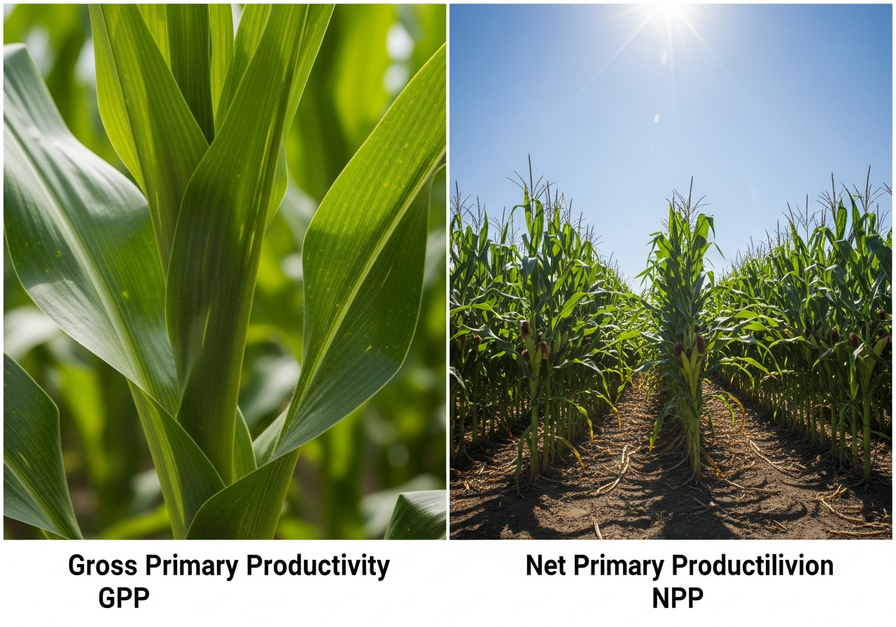
By juxtaposing the microscopic process of photosynthesis with the macroscopic result, the harvested corn, this image clarifies the concepts of GPP and NPP. The leaf represents the total energy captured (GPP), while the entire field represents the energy available for consumption after the plant’s own needs (NPP).
Factors Influencing Primary Productivity
The rate of primary productivity is not uniform across the globe. It varies dramatically depending on a host of environmental factors. These factors act as limiting resources, meaning that if one is scarce, it can restrict the overall productivity of an ecosystem, even if others are abundant.
Key Environmental Factors:
- Sunlight: The most obvious factor for photosynthetic organisms. More light generally means more photosynthesis, up to a certain saturation point. This is why tropical regions, with abundant sunlight year-round, often exhibit high productivity.
- Water: Essential for all life, water is a crucial reactant in photosynthesis and a medium for nutrient transport. Deserts, with their extreme lack of water, are among the least productive terrestrial ecosystems.
- Nutrients: Plants and algae require various nutrients, such as nitrogen, phosphorus, potassium, and micronutrients, for growth. Nutrient-poor soils or waters can severely limit productivity, even with ample sunlight and water.
- Temperature: Every organism has an optimal temperature range for its metabolic processes. Extremely cold or hot temperatures can slow down or halt enzyme activity, reducing productivity.
- Carbon Dioxide (CO2): As a key ingredient for photosynthesis, CO2 availability can sometimes be a limiting factor, though it is generally abundant in the atmosphere.
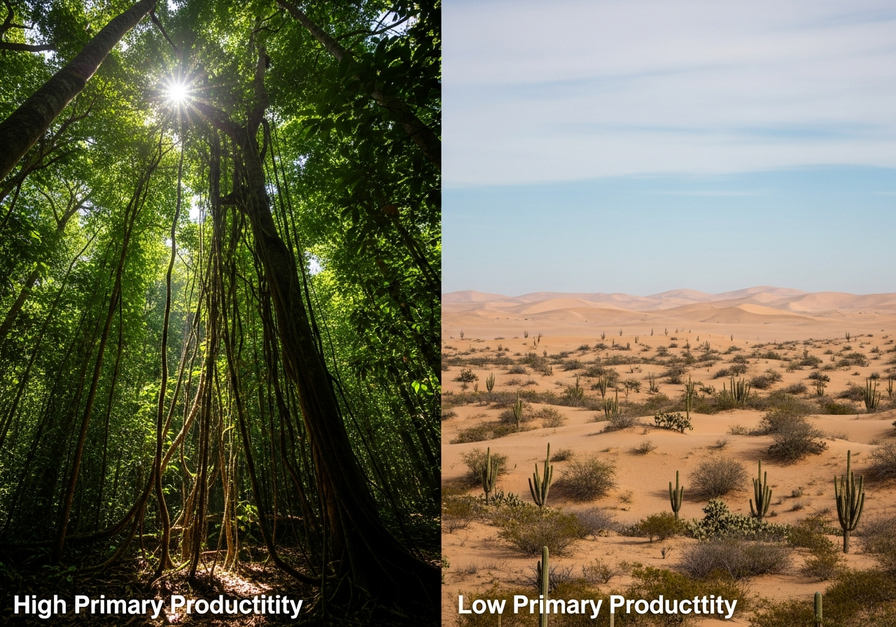
This image visually contrasts the extreme differences in primary productivity between lush forests and barren deserts, reinforcing how environmental factors like water and sunlight shape biomass creation.
Primary Productivity Across Ecosystems: Terrestrial and Aquatic
The interplay of these factors creates a mosaic of productivity levels across different ecosystems.
Terrestrial Ecosystems:
- Tropical Rainforests: With abundant sunlight, warmth, and rainfall, these are Earth’s most productive terrestrial ecosystems. They boast incredibly high GPP and NPP, supporting immense biodiversity.
- Temperate Forests and Grasslands: Productivity here is seasonal, peaking during warmer, wetter months. They are moderately productive, supporting large animal populations.
- Deserts and Tundras: These are among the least productive terrestrial ecosystems. Deserts are limited by water, while tundras are limited by cold temperatures, short growing seasons, and often nutrient-poor soils.
Aquatic Ecosystems:
Primary productivity in aquatic environments is largely driven by phytoplankton, microscopic algae that float in the water column, and by larger aquatic plants and seaweeds in coastal areas.
- Oceans:
- Coastal Zones and Upwelling Areas: These are highly productive due to ample sunlight penetration and nutrient-rich waters brought up from the deep by currents. Coral reefs, estuaries, and kelp forests are prime examples.
- Open Ocean: While vast, the open ocean is often nutrient-poor, especially in the central gyres. Productivity can be low, resembling a “desert” in terms of nutrient availability, despite abundant sunlight.
- Deep Ocean: Sunlight cannot penetrate beyond a few hundred meters, making photosynthesis impossible. Productivity here relies on organic matter sinking from above or chemosynthesis near hydrothermal vents.
- Freshwater Ecosystems: Lakes, rivers, and wetlands vary widely in productivity depending on nutrient input, light penetration, and temperature. Eutrophic (nutrient-rich) lakes can be highly productive, sometimes leading to algal blooms.
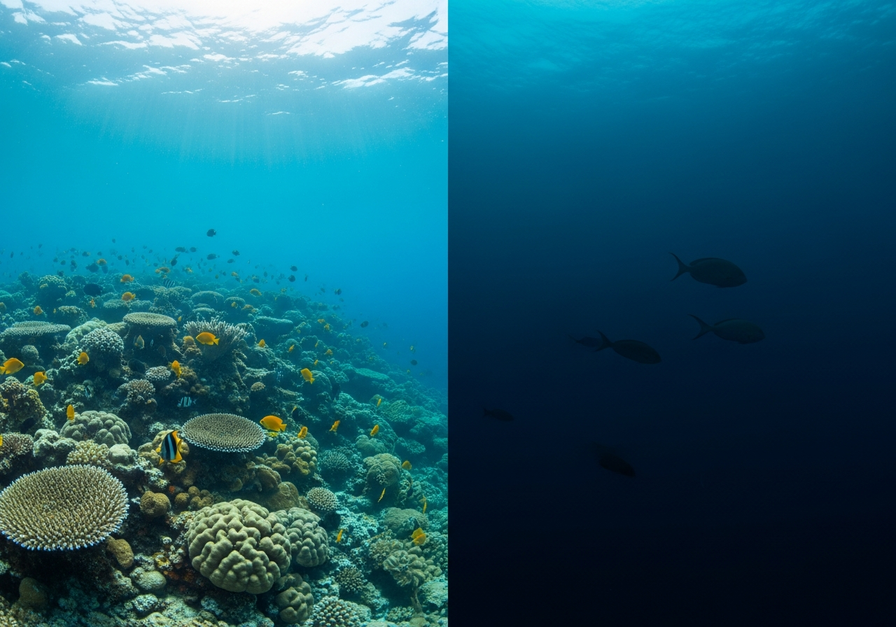
This contrast between a productive coral reef and the sparse deep ocean visually supports the explanation of how light penetration and nutrient availability drive marine primary productivity.
Measuring Primary Productivity: How Do Scientists Know?
Scientists employ various methods to measure primary productivity, ranging from simple observations to sophisticated technological approaches:
- Biomass Measurement: Directly harvesting and weighing plant material over a specific area and time provides a direct estimate of NPP.
- Oxygen Production/CO2 Consumption: In aquatic environments, the rate of oxygen produced or carbon dioxide consumed can be measured to infer photosynthetic activity.
- Satellite Remote Sensing: Satellites can detect the “greenness” of vegetation (chlorophyll content) over vast areas, providing estimates of global and regional productivity.
- Isotope Tracers: Using stable isotopes of carbon (e.g., carbon-13) allows scientists to track the uptake of carbon dioxide by plants and estimate productivity rates.
The Global Significance of Primary Productivity
The implications of primary productivity extend far beyond the immediate growth of plants. It is a fundamental process with global consequences:
- Foundation of Food Webs: Every animal, from the smallest insect to the largest whale, ultimately depends on primary producers for energy. Without them, food webs would collapse.
- Carbon Cycle Regulation: Primary producers absorb vast amounts of carbon dioxide from the atmosphere during photosynthesis. This process is crucial for regulating Earth’s climate and mitigating the effects of greenhouse gases. Changes in global primary productivity can have profound impacts on atmospheric CO2 levels.
- Oxygen Production: Photosynthesis releases oxygen as a byproduct, replenishing the atmospheric oxygen that is vital for the respiration of most living organisms.
- Habitat Creation: The biomass created by primary producers forms the physical structure of many habitats, from forests and grasslands to coral reefs and kelp beds, providing shelter and breeding grounds for countless species.
- Human Economy and Well-being: Agriculture, forestry, and fisheries are all directly dependent on primary productivity. Our food, timber, and many other resources are products of this essential ecological process.
Conclusion
Primary productivity is not merely a scientific concept, it is the pulse of our planet. It is the silent, continuous work of countless organisms transforming raw energy into the building blocks of life. From the microscopic phytoplankton in the ocean to the towering trees of a rainforest, primary producers are tirelessly creating the organic matter that sustains every breath, every meal, and every living thing on Earth. Understanding this fundamental process deepens our appreciation for the intricate web of life and highlights the critical importance of protecting the ecosystems that drive it. Our future, and the future of all life, is inextricably linked to the health and vitality of our planet’s primary producers.