Imagine a world where every living creature could thrive anywhere, under any conditions, with unlimited resources. While a fascinating thought, it is far from the reality of our planet. Every species, from the smallest bacterium to the largest whale, operates within specific boundaries dictated by its environment and interactions with other organisms. This concept is central to understanding how life organizes itself on Earth, and at its heart lies the distinction between a species’ potential and its actual living space: the fundamental versus the realized niche.
The term “niche” in ecology refers to the role and position a species has in its environment. It encompasses not just where an organism lives, but also what it eats, when it reproduces, and how it interacts with all the biotic (living) and abiotic (nonliving) factors around it. It is essentially a species’ ecological address and profession.
The Fundamental Niche: A World of Potential
Before delving into the complexities of real world limitations, it is important to grasp the idea of the fundamental niche. This concept describes the full range of environmental conditions and resources that a species *could* theoretically use and tolerate in the absence of any negative interactions with other species. Think of it as a species’ ideal habitat, where it could thrive if there were no competitors, predators, or diseases to contend with. It is a theoretical maximum, defined purely by the species’ physiological tolerances and resource requirements.
For example, a certain plant species might be able to grow in a wide range of soil types, light levels, and moisture conditions if left entirely to its own devices. A fish species might be able to survive in a broad spectrum of water temperatures and salinities. This fundamental niche represents the biological potential, a blueprint of what a species is capable of achieving.
The Realized Niche: Life’s Reality Check
However, the natural world is rarely ideal. Species do not exist in isolation. They constantly interact with other organisms and face various environmental challenges. These interactions and limitations prevent a species from occupying its entire fundamental niche. The portion of the fundamental niche that a species actually occupies in the presence of competitors, predators, and other ecological pressures is known as the realized niche.
The realized niche is a more accurate reflection of where and how a species lives in nature. It is the outcome of a complex interplay of factors that narrow down the species’ potential. Consider the classic example of barnacles on a rocky intertidal shore.
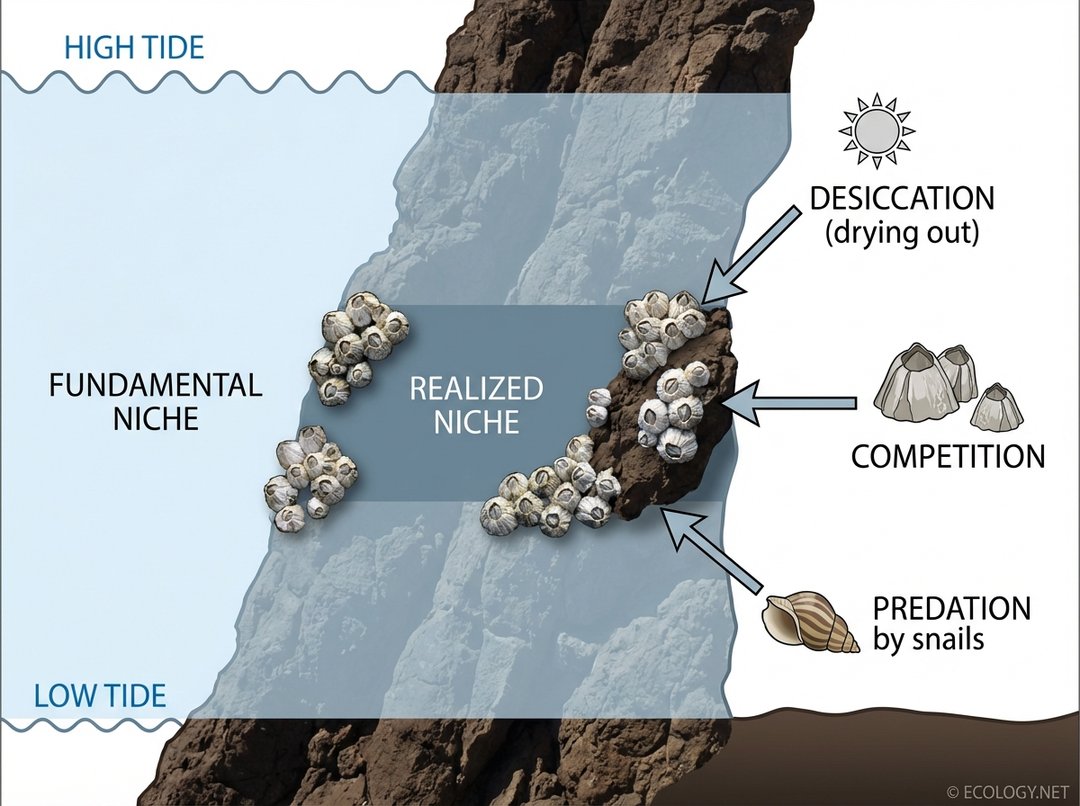
Barnacles are marine crustaceans that attach themselves to rocks in the intertidal zone, the area between high and low tide marks. Physiologically, many barnacle species can survive across a broad range of the intertidal zone, from high up near the splash zone to much lower, almost always submerged areas. This broad range represents their fundamental niche.
However, when observing barnacles in their natural habitat, one often finds them restricted to a much narrower band. Why is this? The answer lies in the factors that define their realized niche:
- Competition: Lower down in the intertidal zone, other species of barnacles or mussels might be superior competitors for space, outcompeting the observed species and preventing it from establishing itself.
- Predation: At lower tide levels, predators like sea snails (e.g., whelks) might be more abundant and effectively prey on the barnacles, limiting their distribution.
- Desiccation: Higher up on the rock face, the barnacles are exposed to air for longer periods during low tide. While they can tolerate some drying out, prolonged exposure leads to desiccation (drying out) and death, setting an upper limit to their realized niche.
Thus, the realized niche of the barnacles is a much smaller, specific band on the rock face, constrained by a combination of biological interactions and physical stresses.
Key Factors Shaping the Realized Niche
The barnacle example highlights just a few of the forces that sculpt a species’ realized niche. In reality, a multitude of ecological factors work in concert to define these boundaries. Understanding these factors is crucial for comprehending species distribution and community structure.
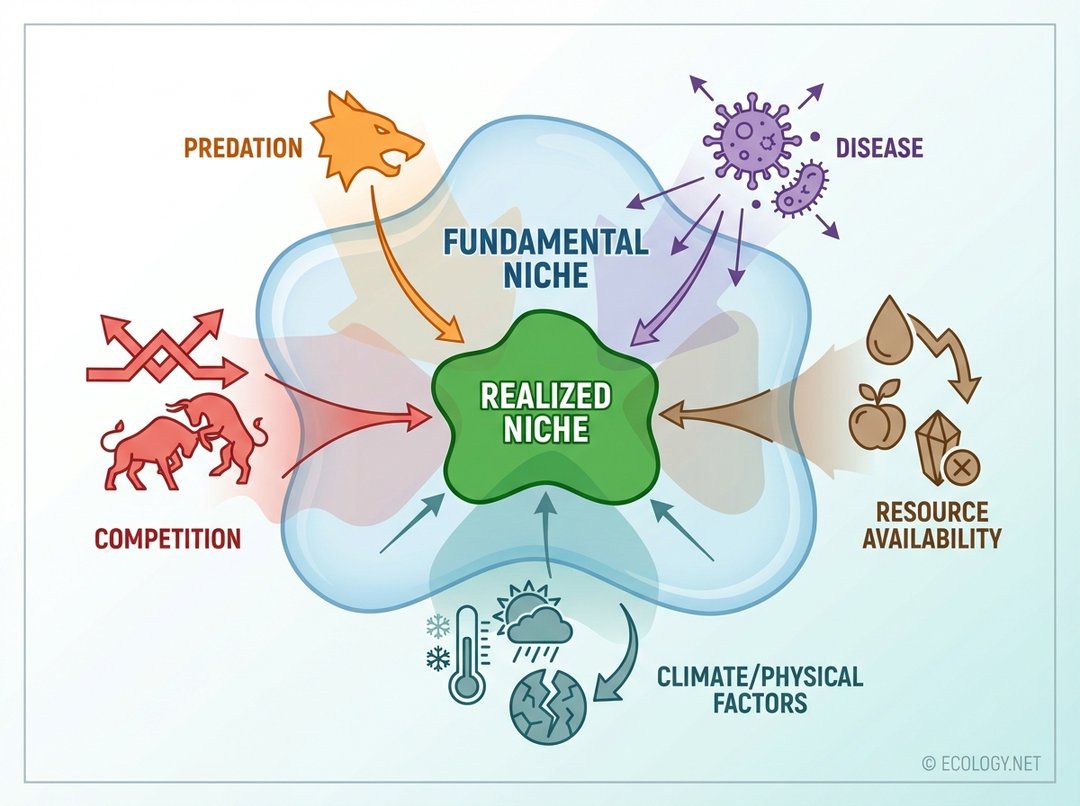
Here are some of the primary forces that push a species from its fundamental potential into its realized reality:
- Competition: This is perhaps one of the most significant factors.
- Intraspecific Competition: Competition among individuals of the same species for limited resources (food, space, mates).
- Interspecific Competition: Competition between different species for shared resources. If one species is a superior competitor, it can exclude another from parts of its fundamental niche.
- Predation and Herbivory: The presence of predators (animals that hunt and kill other animals) or herbivores (animals that eat plants) can severely restrict where and how a species can live. A prey species might avoid areas with high predator density, even if those areas are otherwise physiologically suitable.
- Disease and Parasitism: Pathogens and parasites can weaken or kill individuals, reducing population sizes and preventing a species from thriving in certain areas where disease transmission is high or host resistance is low.
- Resource Availability: While the fundamental niche assumes ideal resource availability, in reality, resources like food, water, light, and nutrients are often limited and unevenly distributed. A species’ realized niche will be confined to areas where these essential resources are sufficiently available.
- Climate and Physical Factors: Abiotic factors such as temperature, humidity, pH, salinity, and sunlight are fundamental determinants of a species’ physiological limits. While these define the fundamental niche, localized variations or extreme events can further restrict the realized niche. For instance, a species might tolerate a wide temperature range, but a specific microclimate within that range might be too harsh due to extreme winds or frost.
Niche Partitioning: A Strategy for Coexistence
The concept of the realized niche helps explain how multiple species can coexist in the same general area without one driving the others to extinction. This phenomenon is known as niche partitioning or resource partitioning. When species compete for similar resources, evolution often favors traits that allow them to specialize, thereby reducing direct competition and allowing them to occupy distinct realized niches.
A classic illustration of niche partitioning comes from Darwin’s Finches on the Galapagos Islands.
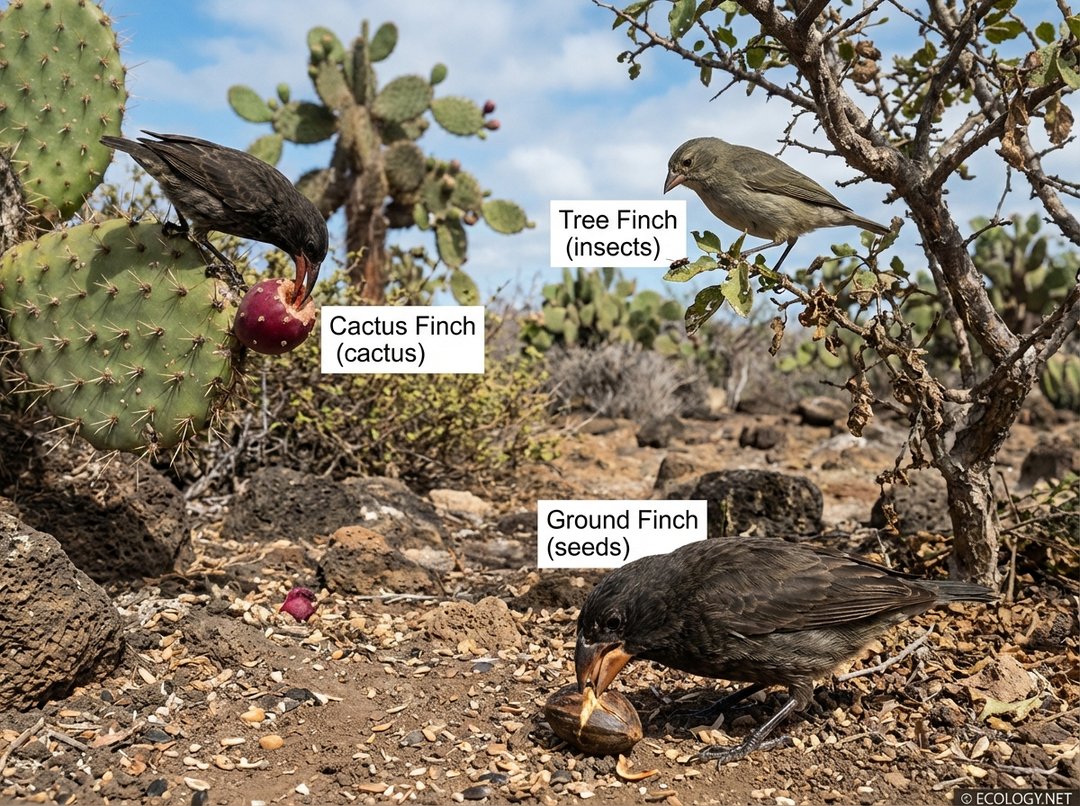
These finches descended from a common ancestor, but over time, they evolved different beak shapes and sizes, allowing them to exploit different food sources. For example:
- Ground Finches: With their robust, strong beaks, they specialize in cracking hard seeds found on the ground. Their realized niche includes foraging primarily on the forest floor.
- Tree Finches: Possessing more slender, pointed beaks, these finches are adept at foraging for insects and larvae on tree branches and leaves. Their realized niche is largely arboreal.
- Cactus Finches: Characterized by longer, more pointed beaks, they are specialized to feed on the fruits, flowers, and nectar of cacti. Their realized niche is closely tied to the distribution of cactus plants.
By partitioning resources in this way, each finch species occupies a distinct realized niche, minimizing interspecific competition and allowing them to coexist on the islands. This specialization is a powerful demonstration of how ecological pressures shape the actual living strategies of species.
Ecological Implications and Importance
The distinction between fundamental and realized niches is not merely an academic exercise; it has profound implications for understanding and managing ecosystems.
Conservation Efforts
For conservation biologists, understanding a species’ realized niche is critical. Knowing the actual environmental conditions and interactions that allow a species to persist helps in designing effective conservation strategies. If a species is endangered, identifying the limiting factors that constrain its realized niche can guide efforts to remove those constraints, such as controlling invasive predators or restoring critical habitat components.
Invasive Species
The concept also sheds light on the success of invasive species. An invasive species often thrives in a new environment because it escapes the predators, diseases, and competitors that limited its realized niche in its native range. This allows the invasive species to expand its realized niche, sometimes even approaching its fundamental niche, often to the detriment of native species.
Climate Change
Global climate change is causing shifts in temperature, precipitation patterns, and extreme weather events. These changes directly impact the abiotic factors that define both fundamental and realized niches. As conditions change, species may find their realized niches shrinking, shifting geographically, or even disappearing entirely. Predicting these shifts is vital for anticipating future ecological impacts and developing adaptation strategies.
Conclusion
The realized niche is a dynamic and ever evolving concept, reflecting the intricate dance of life in ecological communities. It is a testament to the constant negotiation between a species’ inherent potential and the environmental and biological realities it faces. From barnacles clinging to a rock face to finches specializing on different foods, the realized niche provides a powerful framework for understanding why species live where they do, how they interact, and how ecosystems maintain their delicate balance. By appreciating this fundamental ecological principle, we gain deeper insights into the complexity and resilience of the natural world.