Imagine a remote island, teeming with unique life found nowhere else on Earth. Now, picture another island, much smaller and farther away, with only a handful of hardy species clinging to existence. What explains these dramatic differences in biodiversity? The answer lies in a fascinating ecological concept known as Island Biogeography.
Island biogeography is the study of the factors that affect the species richness of isolated natural communities. While the name suggests oceanic islands, this powerful framework applies to any isolated habitat, from mountaintops to urban parks, and even patches of forest surrounded by farmland. It helps us understand how species arrive, persist, and ultimately disappear from these isolated havens, offering crucial insights for conservation in an increasingly fragmented world.
The Dance of Immigration and Extinction
At its heart, island biogeography is a story of balance. The number of species on an island is a dynamic equilibrium, a constant tug-of-war between two opposing forces: immigration and extinction. New species arrive on an island through various means, like birds carrying seeds, insects blown by winds, or even reptiles floating on natural rafts. This process is called immigration.
However, life on an island is also precarious. Species can disappear due to a lack of resources, competition with other species, disease, or simply random chance. This is extinction. The interplay between these two forces dictates the overall biodiversity of an island.
Consider two very different islands:
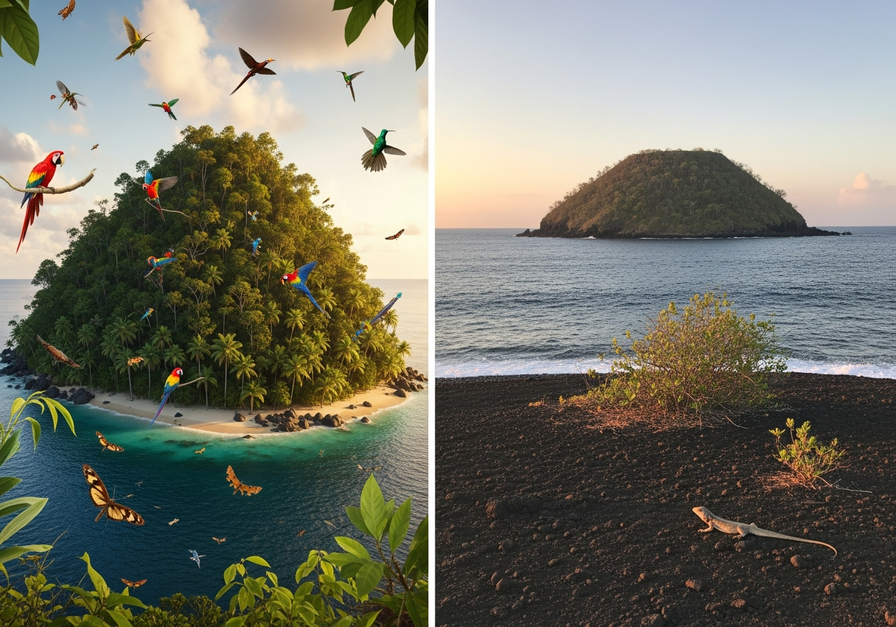
This image visually contrasts how island size and proximity to the mainland influence immigration rates and extinction risk. A large, lush tropical island close to a mainland will naturally experience higher rates of new species arriving because it is an easier target for colonizers and offers more diverse habitats to support them. Conversely, a tiny, isolated volcanic island presents a much greater challenge for new arrivals, and its limited resources mean that any species that does make it faces a higher risk of extinction.
Island Size: A Matter of Space and Resources
One of the most intuitive factors influencing an island’s biodiversity is its size. Larger islands typically support more species than smaller ones. Why? There are several reasons:
- More Habitat Diversity: Larger islands often have a greater variety of habitats, such as different elevations, soil types, and microclimates. This allows for more ecological niches, meaning more ways for different species to make a living.
- Larger Population Sizes: A larger area can support larger populations of each species. Larger populations are less vulnerable to random events like disease outbreaks, natural disasters, or simply failing to find a mate. This reduces the risk of local extinction.
- Greater Target for Immigration: A larger island presents a bigger target for dispersing organisms, making it more likely for new species to successfully colonize.
Island Isolation: The Challenge of Distance
The other critical factor is an island’s isolation, or its distance from a mainland source of species. The farther an island is from the mainland, the harder it is for new species to reach it. This leads to:
- Lower Immigration Rates: Distant islands receive fewer new colonists. Only the most capable dispersers, like strong-flying birds or wind-borne seeds, can make the journey.
- Unique Evolutionary Paths: While lower immigration can mean fewer species, it can also lead to the evolution of highly unique species found nowhere else. With less genetic exchange, populations adapt specifically to their isolated environment, often resulting in fascinating endemic species.
The Equilibrium Theory of Island Biogeography
In the 1960s, ecologists Robert MacArthur and E.O. Wilson formalized these observations into the groundbreaking Equilibrium Theory of Island Biogeography. Their theory proposes that the number of species on an island is determined by a dynamic balance between the rate at which new species immigrate to the island and the rate at which existing species become extinct.
The theory predicts that:
- Immigration rates are highest on islands close to the mainland and decrease with increasing distance.
- Extinction rates are highest on small islands and decrease with increasing island size.
Where these two rates intersect, an equilibrium is reached, representing the predicted number of species an island will sustain. This equilibrium is not static; species are constantly arriving and disappearing, but the total number tends to fluctuate around this predicted value.
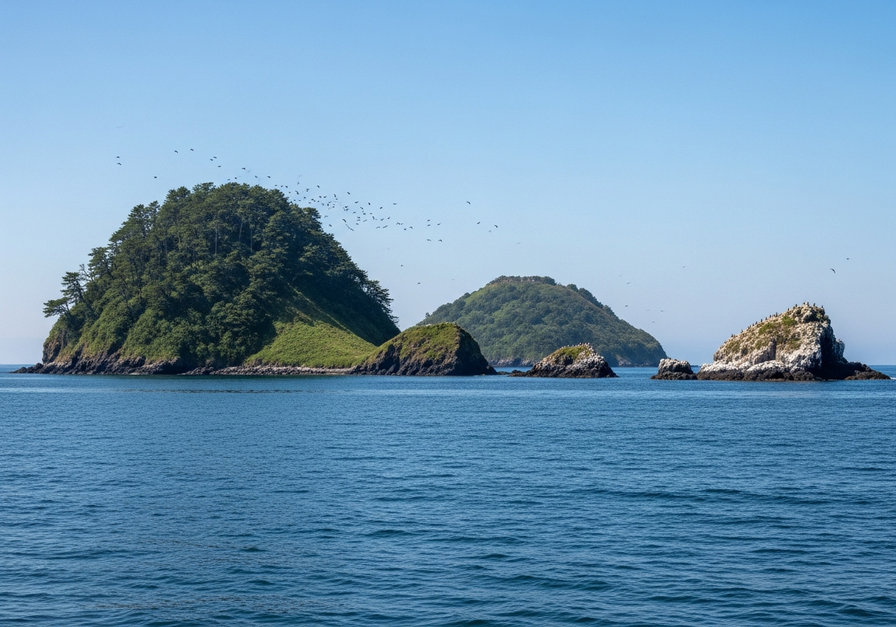
The gradient illustrated in this image shows how the equilibrium theory plays out in nature. A chain of volcanic islands demonstrates that larger islands, typically closer to the source of colonists, sustain higher species richness. As the islands become smaller and more isolated, they support fewer species, reflecting the balance between immigration and extinction rates.
Beyond Oceanic Shores: Habitat Islands and Connectivity
While the theory was initially developed for oceanic islands, its principles have proven incredibly valuable for understanding biodiversity patterns in fragmented landscapes on continents. In today’s world, human activities like agriculture, urbanization, and deforestation often break up large, continuous habitats into smaller, isolated patches. These patches behave much like true islands, surrounded by an “ocean” of unsuitable habitat.
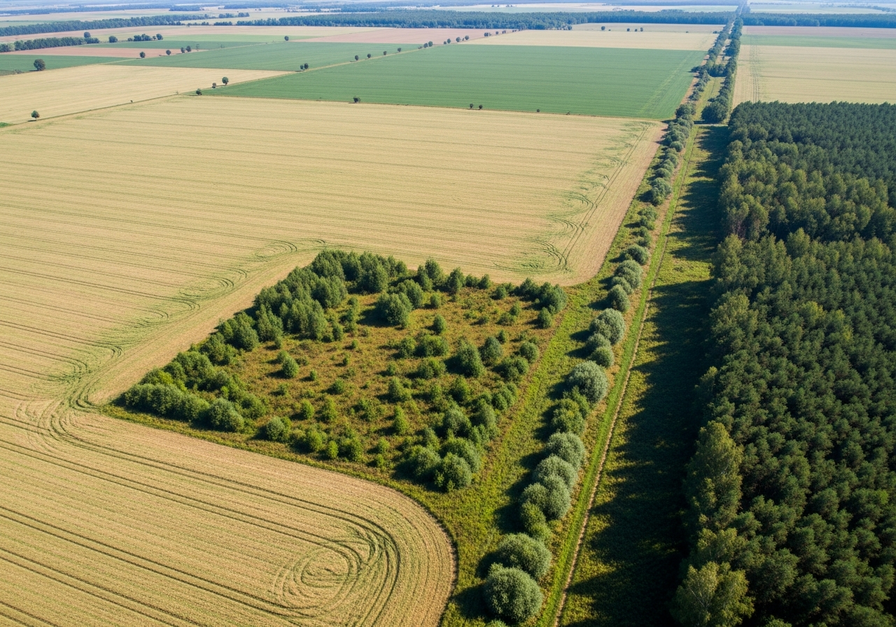
This illustration demonstrates the concept of habitat islands and the importance of connectivity. A small forest patch surrounded by expansive farmland is an excellent example of a habitat island. Just like oceanic islands, these forest fragments experience reduced immigration from larger habitat blocks and increased extinction rates due to their small size and isolation. The narrow vegetated corridor linking this patch to a larger forest reserve highlights a critical conservation strategy: maintaining connectivity to allow species movement and reduce isolation.
The Importance of Ecological Corridors
Recognizing the challenges faced by species in habitat islands, conservationists often advocate for the creation or preservation of ecological corridors. These are strips of natural habitat that connect isolated patches, allowing species to move between them. Corridors can:
- Increase Immigration: Facilitate the movement of individuals, increasing genetic diversity and potentially introducing new species to a fragment.
- Reduce Extinction: Allow populations to be rescued from local extinction by individuals moving in from other patches.
- Expand Effective Habitat: Functionally increase the size of habitat patches by linking them together.
Factors Influencing Island Biogeography in Detail
While size and isolation are primary drivers, several other factors fine-tune the species richness of an island or habitat fragment:
Island Characteristics:
- Habitat Diversity: An island with a greater variety of habitats (e.g., mountains, wetlands, forests) can support more species than one with uniform habitat, even if they are the same size.
- Age of the Island: Older islands have had more time for species to colonize and evolve, potentially leading to higher species richness and endemism.
- Disturbance Regimes: Natural disturbances like volcanic eruptions, hurricanes, or fires can reset the ecological clock, temporarily reducing species richness but also creating opportunities for new colonization.
Species Characteristics:
- Dispersal Ability: Species with excellent dispersal capabilities (e.g., birds, wind-borne seeds) are more likely to colonize distant islands.
- Reproductive Rate: Species with high reproductive rates can establish populations more quickly and recover from disturbances more effectively.
- Trophic Level: Top predators often require larger areas and are more vulnerable to extinction on small islands due to limited prey availability.
Human Impacts:
- Invasive Species: The introduction of non-native species can devastate native island populations, leading to rapid extinctions.
- Climate Change: Rising sea levels can shrink island sizes, while changing weather patterns can alter habitats, impacting species survival.
- Habitat Destruction: Direct human alteration of island habitats reduces carrying capacity and increases extinction risk.
Real-World Examples and Conservation Insights
The principles of island biogeography are beautifully illustrated by some of the world’s most iconic ecosystems and have profound implications for conservation:
- The Galápagos Islands: This remote archipelago is a textbook example. Its isolation has led to the evolution of unique species like Darwin’s finches and giant tortoises, each adapted to different islands. The variations among finches on different islands are a direct result of colonization, adaptation, and speciation in an isolated environment.
- Madagascar: As one of the oldest and most isolated large islands, Madagascar boasts an extraordinary level of endemism. Over 90% of its wildlife is found nowhere else on Earth, a testament to millions of years of evolution in isolation.
- Komodo Dragons: These magnificent reptiles are restricted to a few small islands in Indonesia. Their limited range highlights how specific environmental conditions and isolation can lead to the survival of unique, relict species.
For conservation, island biogeography provides a powerful toolkit:
- Reserve Design: The theory suggests that larger, less fragmented nature reserves are better for preserving biodiversity. When multiple reserves are necessary, connecting them with corridors can enhance their effectiveness.
- Prioritizing Conservation Efforts: It helps identify islands or habitat fragments that are particularly vulnerable to species loss due or those that harbor unique endemic species.
- Managing Invasive Species: Understanding how species colonize islands is crucial for preventing the introduction of harmful invasive species.
Conclusion
Island biogeography is far more than just the study of remote landmasses in the ocean. It is a fundamental ecological theory that illuminates the delicate balance of life in isolated systems, whether they are true islands or fragmented habitats on continents. By understanding the interplay of immigration, extinction, size, and isolation, we gain invaluable insights into how biodiversity is maintained and, critically, how we can better protect it. In a world where natural habitats are increasingly fragmented, the lessons from island biogeography are more relevant than ever, guiding our efforts to preserve the incredible tapestry of life on Earth.