Unraveling the Metapopulation: A Dynamic Dance of Life
Imagine a vast landscape, not as one continuous stretch of habitat, but as a mosaic of isolated pockets where life thrives. These pockets, or patches, are like islands in a sea of unsuitable terrain. Within these patches, populations of animals and plants flourish, but they are not entirely cut off from each other. This intricate, dynamic system of interconnected local populations is what ecologists call a metapopulation. It is a concept fundamental to understanding how species persist in fragmented landscapes and a cornerstone of modern conservation biology.
What Exactly is a Metapopulation?
At its heart, a metapopulation is a “population of populations.” It consists of several spatially separated local populations of the same species, which interact through individuals moving between patches. These patches of suitable habitat are embedded within a “matrix” of unsuitable habitat, which acts as a barrier to movement but is not entirely impenetrable.
Consider a species of butterfly that relies on specific wildflowers found only in scattered meadows. Each meadow represents a habitat patch, and the butterflies within it form a local population. The forests and agricultural fields surrounding these meadows constitute the unsuitable matrix.
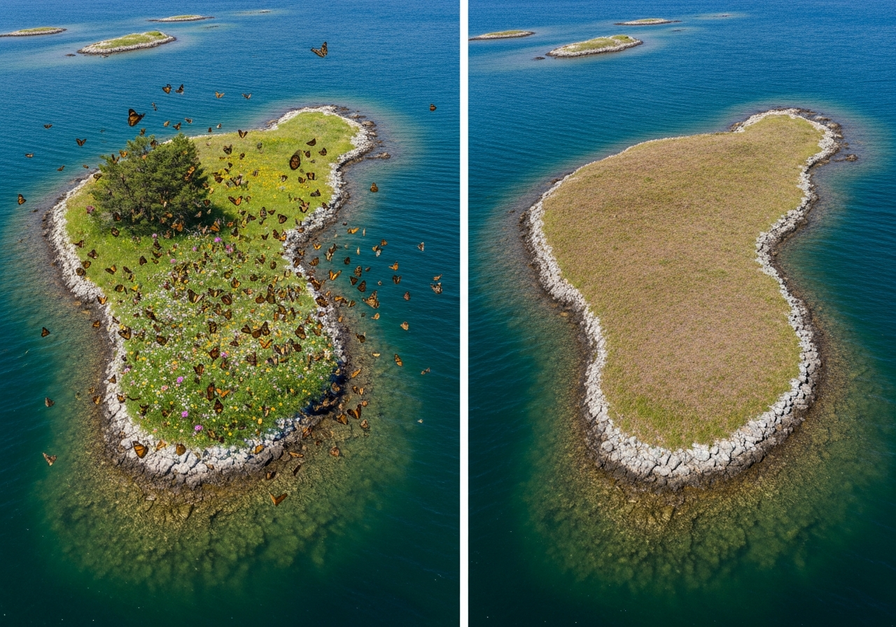
This image directly visualizes the core idea of a metapopulation as a collection of distinct patches—some flourishing, others empty—highlighting the spatial structure and local extinctions discussed in the article. On the left, a vibrant island teems with butterflies, representing an occupied patch. On the right, a barren island stands empty, illustrating a patch where a local population has gone extinct or has yet to be established.
The key characteristic of a metapopulation is its dynamic nature. Local populations within individual patches can go extinct due to environmental changes, disease, or lack of resources. However, these empty patches can then be recolonized by individuals dispersing from other thriving local populations. This continuous cycle of local extinction and recolonization is what gives metapopulations their resilience and allows species to persist even when individual populations face challenges.
The Dynamic Dance: Extinction, Colonization, and Dispersal
The health and longevity of a metapopulation depend on a delicate balance of several critical processes:
- Local Extinction: Individual populations within a patch are often small and vulnerable. They can die out due to various factors such as habitat degradation, disease outbreaks, predation, or simply random demographic fluctuations. When a local population disappears, the patch becomes empty.
- Colonization: An empty patch can be reoccupied when individuals from another existing local population successfully disperse to it and establish a new breeding population. This process is vital for the long-term survival of the metapopulation.
- Dispersal: The movement of individuals between patches is the lifeline of a metapopulation. Dispersal allows for colonization of empty patches and also facilitates genetic exchange, preventing inbreeding and maintaining genetic diversity across the entire metapopulation.
- The Rescue Effect: Sometimes, a local population might be declining and on the brink of extinction. If new individuals immigrate from a healthy population, they can “rescue” the struggling population by boosting its numbers and genetic diversity, preventing its local extinction.

This photo showcases real-world local populations and local extinctions within a forest metapopulation, making the concept of dispersal and genetic exchange between patches tangible to readers. Notice how one pond is alive with frogs, a thriving local population, while a nearby pond, though suitable, appears devoid of amphibians, representing an empty patch awaiting colonization. The surrounding forest acts as the matrix, influencing how easily frogs can move between these aquatic habitats.
Types of Metapopulations: Variations on a Theme
While the core principles remain, ecologists recognize different structures of metapopulations, each with its own dynamics:
- Classic Metapopulation: This is the ideal scenario where all patches are roughly equal in size and quality, and there is a balance between local extinctions and colonizations.
- Mainland-Island Metapopulation: Here, one large, stable “mainland” population rarely goes extinct and acts as a primary source of dispersers for smaller, more vulnerable “island” populations.
- Patchy Metapopulation: In this model, habitat patches are very close together, allowing for frequent movement between them. Local extinctions are rare, and the entire system behaves almost like one large population.
- Non-Equilibrium Metapopulation: This occurs when dispersal is so limited that local extinctions are common, but recolonization is rare. Such metapopulations are often on a trajectory towards overall extinction.
Why Metapopulations Matter: Ecological Significance and Conservation
Understanding metapopulations is not just an academic exercise; it has profound implications for biodiversity conservation and ecological management.
Conservation of Endangered Species
For many endangered species, their natural habitat has been fragmented into isolated patches. A species might appear to have several populations, but if these populations are not connected through dispersal, they are highly vulnerable. Managing these species as metapopulations means:
- Protecting Multiple Patches: Ensuring that a sufficient number of suitable habitat patches remain.
- Maintaining Connectivity: Facilitating movement between patches to allow for colonization and the rescue effect.
- Managing the Matrix: Making the landscape between patches less hostile to dispersing individuals.
Genetic Diversity and Evolution
Dispersal between patches is crucial for maintaining genetic diversity. It prevents inbreeding within small, isolated populations and allows for the spread of beneficial genes throughout the metapopulation, enhancing its adaptive capacity to environmental changes.
Disease Spread and Pest Control
The principles of metapopulations also apply to the spread of diseases and the dynamics of pest species. Understanding how pathogens or pests move between host populations in different patches can inform strategies for disease control or integrated pest management.
The Lifelines of Connectivity: Wildlife Corridors
One of the most direct applications of metapopulation theory in conservation is the creation and protection of wildlife corridors. These are strips of habitat that connect otherwise isolated patches, acting as safe pathways for animals to move, disperse, and interact.

By illustrating a tangible example of a species traversing a corridor to link fragmented habitats, this image reinforces the article’s discussion on habitat connectivity and its role in maintaining metapopulation viability. Here, a grizzly bear utilizes a narrow, forested corridor, highlighting how these vital links allow species to move between larger habitat patches, facilitating dispersal and the crucial rescue effect. Without such corridors, these larger patches could become isolated islands, leading to local extinctions without the possibility of recolonization.
Corridors can take many forms, from riparian zones along rivers to underpasses beneath highways or simply strips of forest connecting larger woodlands. Their effectiveness depends on their width, length, and the quality of habitat they provide. A well-designed corridor can significantly increase the chances of successful dispersal, bolstering the resilience of metapopulations.
Challenges and Future Directions
Despite its importance, managing metapopulations faces significant challenges, primarily due to ongoing habitat fragmentation caused by human development. As natural landscapes are increasingly broken up, patches become smaller and more isolated, making dispersal more difficult and increasing the likelihood of local extinctions without subsequent recolonization.
Future conservation efforts must prioritize:
- Habitat Restoration: Reconnecting fragmented landscapes by restoring degraded areas.
- Strategic Land Use Planning: Incorporating ecological connectivity into urban and rural development plans.
- Monitoring and Research: Continuously studying metapopulation dynamics to adapt conservation strategies to changing environmental conditions.
Conclusion: A Web of Interconnected Life
The concept of a metapopulation offers a powerful lens through which to view the persistence of life on Earth. It reminds us that even seemingly isolated populations are often part of a larger, interconnected web. By understanding the delicate balance between local extinctions and colonizations, and by actively working to maintain and restore habitat connectivity, we can better safeguard biodiversity and ensure that the dynamic dance of life continues across our planet’s ever-changing landscapes.