In the vast theater of the natural world, where life and death play out daily, some of the most fascinating performances involve deception. Organisms across countless species have evolved an extraordinary ability to imitate others, a phenomenon known as mimicry. This intricate art of disguise is not merely a trick of appearance; it is a profound survival strategy, a testament to the relentless forces of natural selection shaping life on Earth.
Mimicry allows a species to gain an advantage by resembling another organism or even an inanimate object. This resemblance can deter predators, attract prey, or even facilitate reproduction. It is a complex evolutionary dance involving at least three participants: the model, the mimic, and the dupe, which is often a predator or a potential mate. The model possesses a trait that the dupe recognizes, and the mimic evolves to imitate that trait, thereby deceiving the dupe for its own benefit.
The Classic Forms of Mimicry
While the concept of mimicry might seem straightforward, its manifestations in nature are incredibly diverse. Scientists have categorized several types, each with its unique evolutionary pressures and outcomes.
Batesian Mimicry: The Harmless Impostor
Perhaps the most widely recognized form of mimicry is Batesian mimicry, named after the English naturalist Henry Walter Bates. In this scenario, a harmless species, the mimic, evolves to imitate a dangerous or unpalatable species, the model. Predators, having learned to avoid the model due to its toxicity or defenses, will then also avoid the mimic, mistaking it for the real threat. This provides the mimic with a significant survival advantage without having to invest in costly defenses of its own.
A classic example of Batesian mimicry involves butterflies. The monarch butterfly (Danaus plexippus) is well known for its vibrant orange and black wings, a warning signal to predators that it is toxic, having accumulated cardenolides from its milkweed diet. Birds that attempt to eat a monarch quickly learn to associate its distinctive coloration with an unpleasant experience. The viceroy butterfly (Limenitis archippus), though not toxic, has evolved to mimic the monarch’s striking appearance. This visual deception allows the viceroy to benefit from the monarch’s protective reputation, fooling predators into leaving it alone.
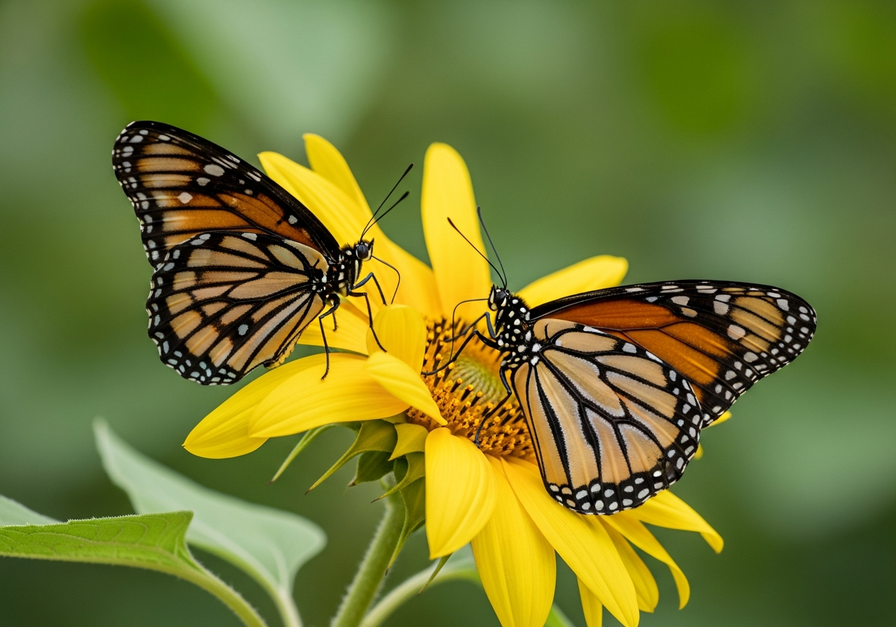
The image above visually demonstrates Batesian mimicry by juxtaposing the harmless viceroy with the toxic monarch, allowing readers to see how the resemblance can deceive predators.
Müllerian Mimicry: Strength in Numbers
Another fundamental type is Müllerian mimicry, named after German zoologist Fritz Müller. Unlike Batesian mimicry, where a harmless species imitates a harmful one, Müllerian mimicry involves two or more unpalatable or dangerous species that evolve to resemble each other. By sharing a common warning signal, such as a distinctive coloration or pattern, these species collectively reinforce the predator’s learning experience. A predator that has a bad encounter with one species will then avoid all species sharing that same warning signal, reducing the individual risk for each species involved. It is a form of mutual advertising, where every encounter with any member of the mimicry ring teaches the predator to steer clear of all of them.
Poison dart frogs of the Amazon rainforest offer a vivid illustration of Müllerian mimicry. Many species within this group are highly toxic and display brilliant, conspicuous colors like bright yellow, red, or blue. These bold hues serve as an unmistakable warning to potential predators. Different species, sometimes even from different genera, can exhibit very similar warning patterns and colors. For instance, several species of poison dart frogs might share a bright yellow-green coloration, signaling their toxicity to predators. This shared signal means that a predator only needs to learn once to avoid any frog with that particular appearance, benefiting all the toxic species involved.
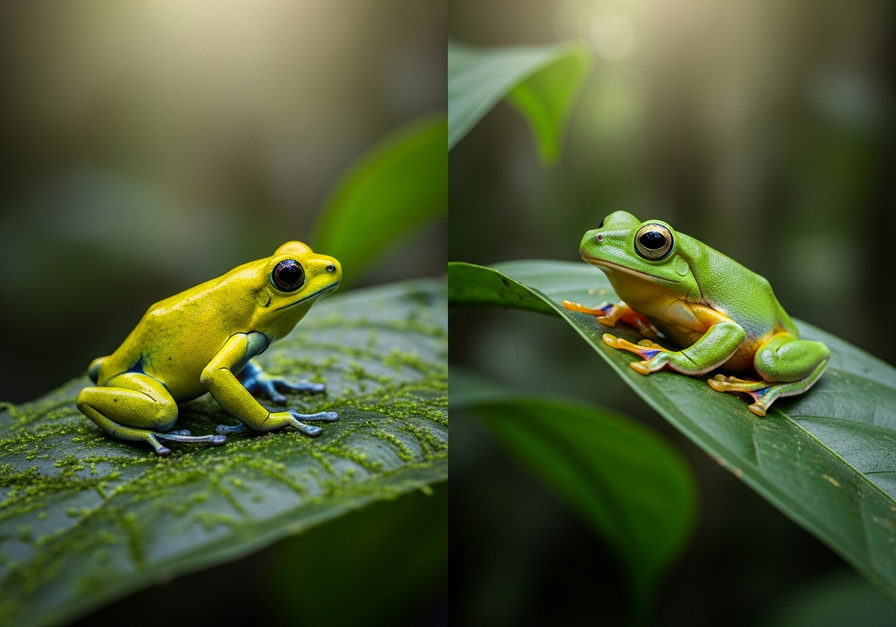
The split-screen image above illustrates Müllerian mimicry, where multiple toxic species share a warning coloration, reinforcing the deterrent signal to predators.
Aggressive Mimicry: The Hunter’s Deception
Not all mimicry is about avoiding danger; some forms are about finding a meal. Aggressive mimicry is a strategy where a predator or parasite mimics a harmless species or an environmental feature to deceive its prey or host. This allows the mimic to approach its target unnoticed or even attract it directly, turning deception into a hunting advantage.
One of the most captivating examples of aggressive mimicry comes from the deep sea: the anglerfish. These bizarre creatures live in the abyssal depths where sunlight never penetrates. To attract prey in this perpetual darkness, many anglerfish species possess a bioluminescent lure, a fleshy appendage that dangles from their head. This lure often resembles a small, edible organism, like a worm or a tiny fish. Unsuspecting smaller fish, drawn to the glowing “bait” in the darkness, approach only to be swiftly devoured by the anglerfish’s enormous mouth.
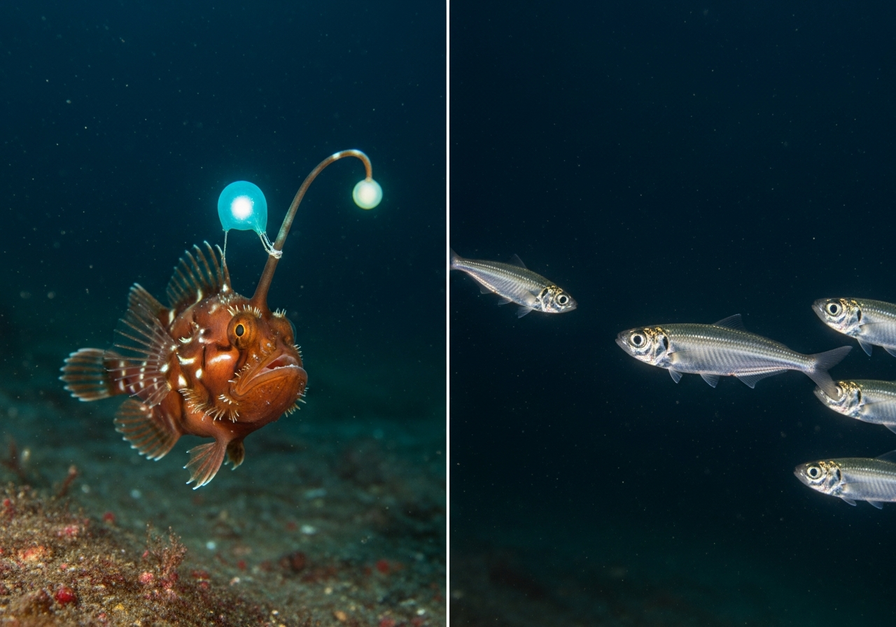
This image captures aggressive mimicry, where a predator uses a lure that mimics prey, underscoring the evolutionary arms race described in the article.
Beyond the Basics: Nuances of Deception
While Batesian, Müllerian, and aggressive mimicry are the most commonly discussed, the world of biological deception is far richer and more complex. Other forms of mimicry highlight the incredible adaptability of life.
- Wasmannian Mimicry: This occurs when a mimic lives in the nest or colony of its model, often as a parasite or commensal. The mimic resembles its host, allowing it to blend in and avoid detection. For example, some beetles mimic ants, living undetected within ant colonies and feeding on their resources.
- Mertensian Mimicry: A less common but fascinating type where a deadly model mimics a less dangerous but still venomous model. This might seem counterintuitive, but it can be advantageous if predators learn to avoid the less dangerous model through non-fatal encounters, thus avoiding the truly deadly one altogether. Coral snakes, with their distinctive red, black, and yellow bands, are often cited in discussions of Mertensian mimicry, though their exact mimicry relationships are complex and debated.
- Automimicry: This is a form of mimicry within a single species. For instance, some butterflies and moths have “eyespots” on their wings that resemble the eyes of a larger predator. This can deter an attacking bird by making the butterfly appear larger or by directing the attack to a less vital part of its body. Another example is when palatable individuals within a toxic species mimic the warning signals of their more toxic conspecifics, benefiting from the overall reputation of the species.
The Evolutionary Arms Race and Ecological Impact
Mimicry is a powerful driver of evolution, often leading to an ongoing “arms race” between species. As mimics become better at deception, their dupes (predators or prey) evolve better detection abilities, which in turn pushes mimics to refine their disguises even further. This co-evolutionary dynamic constantly shapes the traits and behaviors of interacting species, leading to increasingly sophisticated adaptations.
The ecological significance of mimicry is profound. It influences population dynamics, community structure, and even biodiversity. Mimicry can stabilize predator-prey relationships by reducing predation pressure on mimics, or it can destabilize them by giving predators an unfair advantage. It highlights the intricate web of interactions that define ecosystems, where survival often hinges on perception and deception.
Understanding mimicry offers a window into the ingenious strategies that life employs to survive and thrive. From the subtle patterns on a butterfly’s wing to the glowing lure of a deep-sea anglerfish, these natural deceptions remind us of the endless creativity of evolution and the constant struggle for existence that shapes every living thing on our planet.
Conclusion
Mimicry stands as one of nature’s most compelling demonstrations of adaptation. It is a testament to the power of natural selection, sculpting organisms into masters of disguise and deception. Whether it is a harmless butterfly masquerading as a toxic one, a group of dangerous frogs sharing a common warning, or a cunning predator luring its unsuspecting meal, the principles of mimicry reveal the intricate and often surprising ways in which species interact and evolve. These evolutionary strategies are not just biological curiosities; they are fundamental components of ecological balance, showcasing the dynamic and ever-changing tapestry of life.