Imagine a world where animals roam freely, following ancient paths, migrating with the seasons, and finding mates across vast landscapes. Now, imagine that world crisscrossed by roads, dotted with cities, and divided by farms. This is the reality for much of Earth’s wildlife today, a reality where natural habitats are increasingly fragmented, leaving animal populations isolated and vulnerable. But there is a powerful solution emerging from the fields of ecology and conservation: the wildlife corridor.
Wildlife corridors are not just quaint ideas; they are vital lifelines, engineered or naturally occurring pathways that connect otherwise isolated habitats. They are bridges, tunnels, and strips of natural land that allow animals to move safely through human-dominated landscapes, ensuring their survival and the health of entire ecosystems.
What Exactly is a Wildlife Corridor?
At its core, a wildlife corridor is an area of habitat connecting wildlife populations separated by human activities or natural barriers. Think of it as a biological highway, providing safe passage for animals to travel between larger, more stable habitat patches. Without these connections, populations can become isolated, leading to a host of ecological problems.
The Silent Crisis: Habitat Fragmentation
The need for wildlife corridors stems directly from a phenomenon known as habitat fragmentation. This occurs when large, continuous habitats are broken up into smaller, isolated pieces. Roads, urban development, agriculture, and other human land uses are the primary culprits. When habitats are fragmented, animals face several critical challenges:
- Limited Access to Resources: Food, water, and shelter may be scarce within a small, isolated patch.
- Reduced Genetic Diversity: Small populations cannot interbreed with others, leading to inbreeding and a weakened gene pool, making them less resilient to disease and environmental changes.
- Increased Mortality: Animals attempting to cross human-dominated landscapes often face dangers like vehicle collisions, predation, or human conflict.
- Inability to Adapt: As climates change, species need to shift their ranges. Fragmentation prevents this natural movement.
Wildlife corridors directly address these challenges by restoring connectivity, allowing animals to overcome the barriers we have inadvertently, or sometimes intentionally, created.
Diverse Paths: Types of Wildlife Corridors
Wildlife corridors come in many forms, each designed to suit specific landscapes, species, and conservation goals. Understanding these different types helps us appreciate the ingenuity involved in their creation and protection.
Linear Corridors: The Green Strips of Life
These are perhaps the most intuitive type of corridor: long, continuous strips of natural habitat that directly link two larger areas. Riparian zones, which are the vegetated areas along rivers and streams, are classic examples of naturally occurring linear corridors. They provide not only a pathway but often essential resources like water, food, and cover.
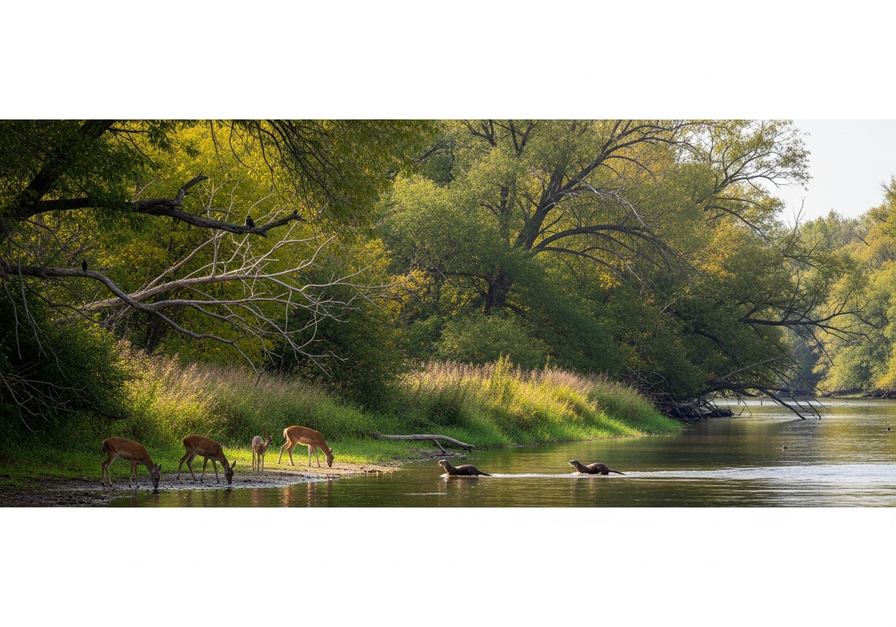
This image illustrates a linear wildlife corridor, a riparian strip, connecting larger forest patches and providing safe passage for species like deer and otters, as described in the article’s definition of linear corridors.
These corridors are crucial for species that require extensive ranges or need to migrate seasonally. They allow for the movement of individuals, facilitating gene flow and reducing the risk of local extinctions.
Stepping-Stone Corridors: Islands of Hope
Sometimes, a continuous strip of habitat is not feasible. In such cases, conservationists employ “stepping-stone” corridors. These consist of a series of smaller, isolated habitat patches that are close enough to each other to allow animals to move between them. Imagine a series of small islands that an animal can hop between to cross a large ocean.
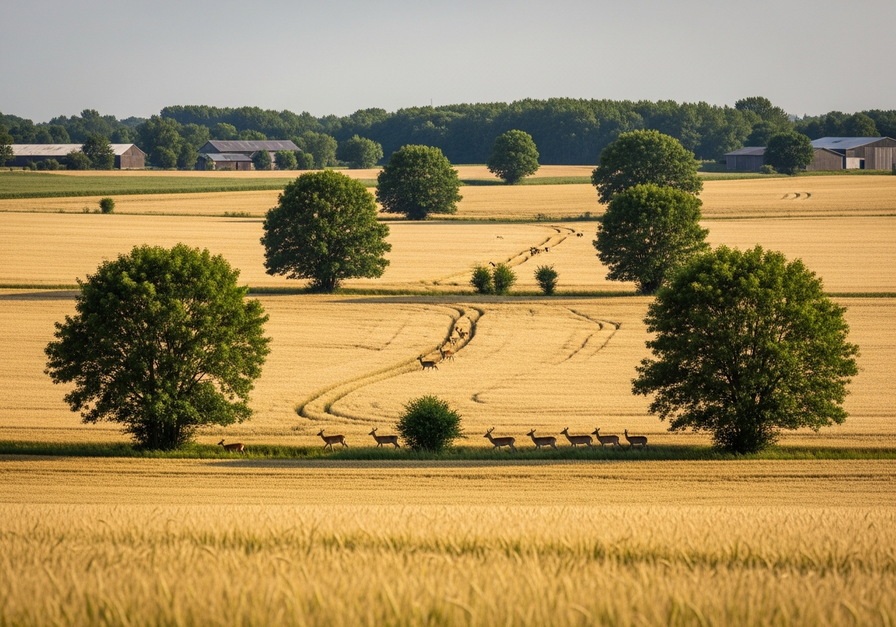
This image showcases stepping-stone corridors, small, scattered habitat patches, providing movement pathways for animals across fragmented landscapes, as explained in the article.
Stepping-stone corridors are particularly effective for smaller animals, birds, and insects that can make shorter journeys between suitable habitats. They are often seen in agricultural landscapes where small woodlots or hedgerows provide crucial resting and foraging points.
Overpasses and Underpasses: Engineering for Wildlife
One of the most visible and impactful types of corridors are those designed to help wildlife navigate human infrastructure, especially roads and highways. Wildlife overpasses are vegetated bridges built over busy roads, allowing animals to cross safely above traffic. Conversely, underpasses are tunnels or culverts that guide animals beneath the road.
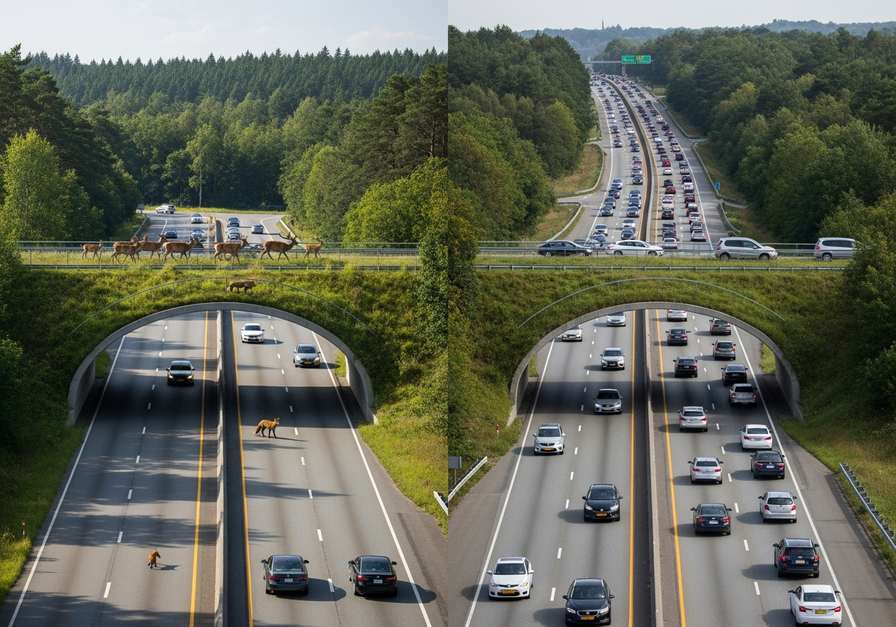
This image demonstrates the effectiveness of underpasses/overpasses in allowing large mammals to safely cross roads, reducing human-wildlife conflict, a key example highlighted in the article.
These structures are critical for reducing wildlife-vehicle collisions, which are dangerous for both animals and humans. They are often designed with specific species in mind, incorporating features like fencing to funnel animals towards the crossing points and appropriate vegetation to make them feel secure.
How Do Wildlife Corridors Work? The Science Behind the Path
The effectiveness of wildlife corridors is rooted in fundamental ecological principles. By facilitating movement, corridors achieve several vital conservation outcomes:
Boosting Genetic Diversity and Population Health
When populations are isolated, they can suffer from inbreeding, which reduces genetic diversity. A diverse gene pool is like a robust toolkit, providing the raw material for a species to adapt to new challenges, such as diseases or changes in climate. Corridors allow individuals from different populations to meet and breed, enriching the genetic makeup of both groups and making them more resilient.
Enhancing Population Viability
Small, isolated populations are inherently more vulnerable to extinction from random events like disease outbreaks, severe weather, or localized habitat destruction. Corridors allow for the “rescue effect,” where individuals from a healthy population can replenish a struggling one, preventing its collapse.
Adapting to a Changing Climate
As global climates shift, many species need to migrate to new areas with more suitable conditions. Without corridors, these climate-driven migrations become impossible, trapping species in unsuitable habitats and increasing their risk of extinction. Corridors provide the pathways necessary for species to track their preferred climatic zones.
A Double-Edged Sword: Disease Transmission
While corridors offer immense benefits, it is also important to acknowledge potential complexities. By increasing connectivity, corridors can, in some cases, facilitate the spread of diseases between populations. Ecologists and conservation managers carefully consider these risks during corridor design, often incorporating monitoring and management strategies to mitigate potential negative impacts.
Designing Effective Corridors: A Balancing Act
Creating a successful wildlife corridor is a complex undertaking that requires careful planning, scientific understanding, and often, significant investment. Key considerations include:
- Width and Length: Corridors must be wide enough to provide a sense of security for animals and long enough to connect distant habitats. The ideal dimensions vary greatly depending on the target species.
- Vegetation and Habitat Quality: The corridor itself must provide suitable habitat, not just a bare path. Appropriate native vegetation offers food, cover, and a sense of familiarity for moving animals.
- Minimizing Human Disturbance: Corridors should ideally be protected from human activities that could deter wildlife, such as excessive noise, light pollution, or direct human presence.
- Species-Specific Needs: A corridor designed for deer might not be suitable for salamanders. Understanding the movement patterns, habitat requirements, and behavioral ecology of target species is paramount.
- Land Acquisition and Protection: Often, establishing corridors involves acquiring land, securing easements, or working with private landowners to protect existing natural areas.
Real-World Impact: Success Stories and Challenges
Across the globe, wildlife corridors are proving their worth, transforming fragmented landscapes into interconnected networks. Projects like the Yellowstone to Yukon (Y2Y) initiative in North America aim to connect vast wilderness areas, ensuring the long-term survival of iconic species like grizzly bears and wolves. Similarly, the Florida Wildlife Corridor seeks to protect and connect critical habitats across the state, benefiting panthers, bears, and countless other species.
However, the path to creating and maintaining these vital connections is not without challenges. High costs, complex land ownership issues, and the need for sustained public and political support are significant hurdles. Educating communities about the importance of corridors and fostering a sense of shared responsibility are crucial for long-term success.
How You Can Help
The concept of wildlife corridors might seem like a large-scale conservation effort, but individuals can play a significant role in supporting these vital connections:
- Support Conservation Organizations: Many non-profits are actively involved in land acquisition, restoration, and advocacy for wildlife corridors.
- Plant Native Species: In your own garden or community, planting native trees, shrubs, and flowers can create mini “stepping stones” for birds, insects, and small mammals, contributing to local connectivity.
- Drive Responsibly: Be aware of wildlife crossing signs, especially at dawn and dusk, and reduce your speed in areas known for animal movement.
- Advocate for Green Infrastructure: Support local and regional planning efforts that prioritize ecological connectivity and incorporate wildlife-friendly design into development projects.
Conclusion
Wildlife corridors are more than just pathways; they are a testament to our growing understanding of ecological systems and our commitment to coexisting with the natural world. In an increasingly fragmented planet, these vital connections offer hope for biodiversity, ensuring that future generations can continue to witness the wonder of wildlife moving freely across healthy, interconnected landscapes. By understanding, supporting, and advocating for wildlife corridors, we help weave back the intricate tapestry of life on Earth, one crucial link at a time.