Step outside and feel the sun on your face, then move into the shade of a large tree. Notice the immediate difference in temperature? That subtle shift is not just a passing sensation, it is an encounter with a fundamental ecological concept: the microclimate. While meteorologists track weather patterns across vast regions, ecologists and keen observers of nature understand that the world around us is a mosaic of tiny, localized climates, each with its own unique characteristics.
A microclimate is essentially the climate of a very small or restricted area, differing significantly from the climate of the general surrounding region. These miniature worlds are shaped by an intricate dance of factors, influencing everything from the plants that thrive in a garden corner to the energy efficiency of our homes. Understanding microclimates unlocks a deeper appreciation for the subtle complexities of our environment and offers practical insights for living more harmoniously within it.
What is a Microclimate? The Basics
Imagine a vast landscape. While the regional weather forecast might predict a sunny 25 degrees Celsius, the reality on the ground is far more nuanced. One spot might be baking hot, another surprisingly cool, and yet another damp and sheltered. These localized variations in temperature, humidity, wind speed, and light are what we call microclimates.
Think of it this way: a microclimate is like a miniature weather system operating on a very small scale, perhaps just a few square meters or even centimeters. It is influenced by immediate surroundings rather than broad atmospheric conditions. These tiny climates are not just curiosities, they are powerful forces that dictate where specific plants can grow, where animals seek shelter, and even how comfortable we feel in our own backyards.
Everywhere You Look: Examples of Microclimates
Microclimates are not abstract scientific concepts, they are part of our everyday experience. Once you start looking, you will find them everywhere.
The Warmth of a South-Facing Wall
Consider a brick wall facing south in the Northern Hemisphere. Throughout the day, it absorbs a tremendous amount of solar radiation. This stored heat is then slowly released, creating a pocket of warmth right against its surface, even when the ambient air temperature is cooler. This effect is particularly noticeable in temperate climates, allowing certain heat-loving plants to flourish in an otherwise unsuitable environment.

The image above beautifully illustrates this phenomenon. A south-facing wall becomes a haven for plants like rosemary and lavender, which bask in the direct sunlight and benefit from the wall’s retained warmth. The ground nearby, however, might host cooler grasses and weeds, highlighting the stark contrast created by this localized heat source. This exemplifies how a simple architectural feature can profoundly alter local growing conditions.
Shade vs. Sun: The Tree’s Influence
A single large tree can create multiple distinct microclimates beneath its canopy and around its trunk. The dense foliage blocks direct sunlight, reducing temperature and increasing humidity. The ground beneath the tree remains cooler and often moister, fostering a different community of plants and organisms than the sun-drenched areas just a few feet away.
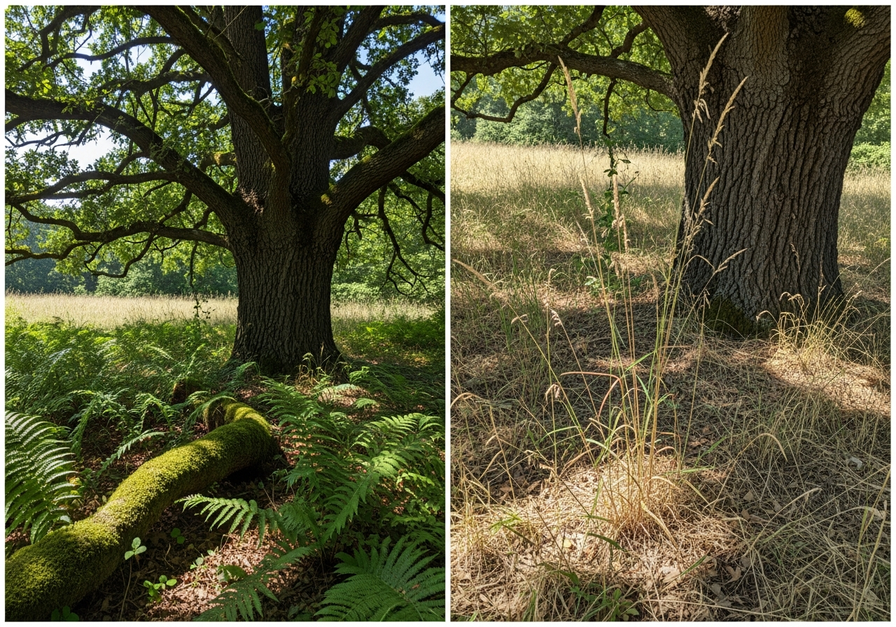
This split-screen image vividly demonstrates the microclimatic contrast created by a tree. On one side, lush ferns and moss thrive in the cool, dappled light of the shade. On the other, sun-tolerant grasses and seedlings endure the brighter, drier conditions just outside the canopy’s reach. This simple observation reveals how a single natural element can carve out diverse habitats within a small area.
Urban Heat Islands: Human-Made Microclimates
Perhaps one of the most significant human-influenced microclimates is the urban heat island effect. Cities, with their vast expanses of concrete, asphalt, and buildings, absorb and retain far more solar radiation than surrounding rural areas. This leads to significantly higher temperatures in urban centers, especially at night, creating a distinct microclimate that impacts everything from energy consumption to human health.
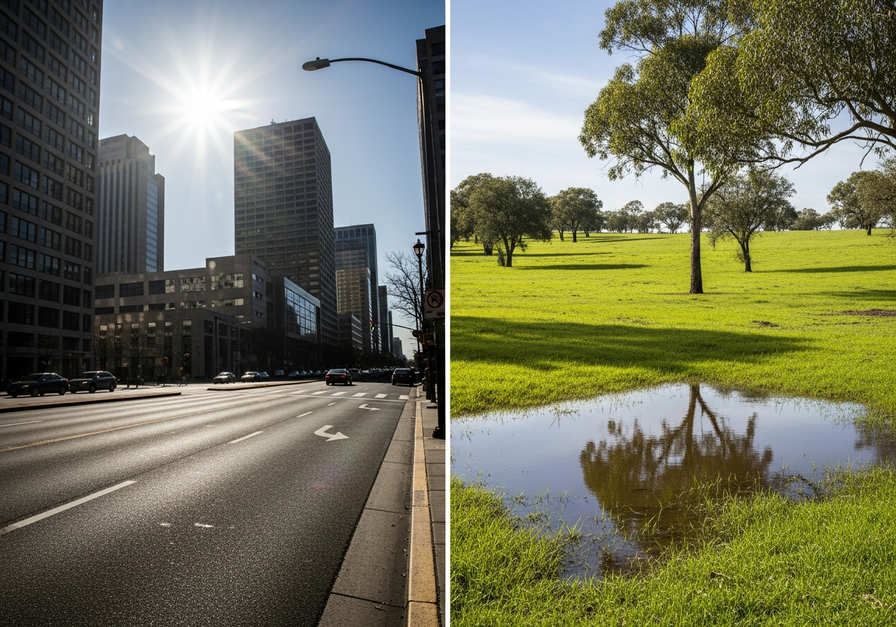
The visual comparison here powerfully illustrates the urban heat island effect. The left panel shows a city street, a landscape dominated by heat-absorbing materials. The right panel depicts a cooler, greener rural scene. This stark difference underscores how human development can dramatically alter local temperatures and create entirely new microclimates.
Factors Shaping Microclimates
The creation of a microclimate is a complex interplay of several key factors:
- Topography: The shape of the land plays a crucial role.
- Slope and Aspect: A north-facing slope receives less direct sunlight than a south-facing one, leading to cooler, moister conditions. Valleys can trap cold air, creating frost pockets.
- Elevation: Even small changes in elevation can affect temperature and wind exposure.
- Vegetation: Plants are powerful microclimate modifiers.
- Canopy Cover: Trees provide shade, reducing solar radiation and lowering temperatures. They also release water vapor through transpiration, increasing humidity.
- Ground Cover: Dense ground cover can insulate the soil, retain moisture, and reduce wind speed at the surface.
- Water Bodies: Water has a high heat capacity, meaning it heats up and cools down more slowly than land.
- Lakes, rivers, and even small puddles can moderate local temperatures, creating cooler conditions nearby during the day and warmer conditions at night.
- Evaporation from water surfaces also increases local humidity.
- Surface Materials: The type and color of the ground or building materials significantly impact heat absorption and reflection.
- Dark, dense materials like asphalt and concrete absorb and retain heat, contributing to warmer microclimates.
- Light-colored surfaces, like sand or light-colored roofs, reflect more sunlight, staying cooler.
- Human Structures: Buildings, walls, and fences can block wind, create shade, or absorb and radiate heat, all contributing to localized climatic variations.
Why Do Microclimates Matter?
The seemingly small differences in microclimates have profound implications across various fields.
Ecology and Biodiversity
Microclimates are fundamental to understanding species distribution. A plant or animal might thrive in one small patch of habitat but be absent just a few meters away due to subtle differences in temperature, moisture, or light. This explains why you might find delicate ferns in a shaded, damp gully, while drought-tolerant succulents flourish on an exposed, rocky outcrop nearby. Microclimates create ecological niches, fostering biodiversity within a larger region.
Gardening and Agriculture
For gardeners and farmers, understanding microclimates is a powerful tool. Knowing which parts of a garden are warmest, coolest, shadiest, or most exposed to wind allows for strategic plant placement. A gardener might use a south-facing wall to grow tender herbs that would otherwise struggle, or plant shade-loving species under a dense tree canopy. This knowledge can extend growing seasons, protect vulnerable crops, and optimize yields.
Urban Planning and Design
In urban environments, recognizing and mitigating the effects of microclimates, particularly urban heat islands, is crucial. Planners can incorporate green spaces, plant more trees, use reflective building materials, and design for better airflow to reduce city temperatures, improve air quality, and enhance residents’ comfort and health. Thoughtful design can transform harsh urban microclimates into more livable spaces.
Human Comfort and Health
Our personal comfort is often dictated by the microclimate we are in. A breezy spot on a hot day, or a sheltered corner on a windy one, can make all the difference. In extreme conditions, understanding microclimates can even be a matter of health, helping us find relief from heat stress or protect ourselves from cold exposure.
Delving Deeper: Advanced Concepts
For those seeking a more in-depth understanding, the science of microclimates involves complex energy exchanges and atmospheric dynamics.
Energy Balance
At the heart of every microclimate is the concept of energy balance. This refers to the incoming and outgoing radiation and heat exchanges at a specific surface. Key components include:
- Solar Radiation: The primary energy input, varying with sun angle, cloud cover, and surface reflectivity (albedo).
- Longwave Radiation: Heat radiated by the Earth’s surface and atmosphere.
- Sensible Heat Flux: Heat transferred through conduction and convection, warming the air.
- Latent Heat Flux: Heat transferred through evaporation and condensation, involving changes in water’s state.
- Ground Heat Flux: Heat stored in or released from the soil or surface material.
The balance of these fluxes determines the temperature of a surface and the air directly above it, shaping the microclimate.
Boundary Layers
Microclimates are most pronounced within the “boundary layer,” the thin layer of air directly adjacent to a surface. Within this layer, the air’s properties are strongly influenced by the surface below it. For example, wind speed is significantly reduced near the ground due to friction, and temperature gradients are steepest. Understanding boundary layers is critical for modeling and predicting microclimatic conditions.
Temporal Variation
Microclimates are not static. They change dramatically over daily and seasonal cycles. A spot that is warm and sunny at midday might become cool and damp by evening. A deciduous forest microclimate shifts from bright and airy in winter to cool and shaded in summer. These temporal dynamics add another layer of complexity and importance to their study.
Instrumentation and Measurement
Scientists use specialized instruments to measure microclimatic variables with high precision. These include thermistors for temperature, psychrometers for humidity, anemometers for wind speed, and pyranometers for solar radiation. Deploying networks of these sensors allows researchers to map and analyze microclimatic patterns across landscapes, providing invaluable data for ecological studies, agricultural planning, and urban design.
Conclusion
From the smallest patch of moss on a shaded rock to the sprawling heat of a metropolis, microclimates are a constant, dynamic force shaping our world. They remind us that climate is not a monolithic entity but a tapestry woven from countless localized conditions. By observing and understanding these miniature climates, we gain a deeper appreciation for the intricate workings of nature and acquire practical knowledge to better manage our gardens, design our cities, and live more attuned to our immediate environment. The next time you feel a subtle shift in temperature or humidity, pause and consider the fascinating microclimate at play around you.